4

I am reading the first chapter from Topology by Armstrong. There, after stating the classification theorem for closed surfaces, he has mentioned an example that a sphere with one handle and one Möbius strip glued is homeomorphic to a sphere with three Möbius strips glued.

I am not able to see this. I know that to prove the above is to say that a torus with a Möbius strip glued is homeomorphic to a Klein bottle with a Möbius strip glued. How do I prove this? Or how do I at least convince myself that this is the case, in case I don't yet have the tools to prove it.

azimut
  • 24,316
user52991
  • 748
  • Are you familiar with the Euler characteristic of a surface and how it changes when taking connected sums? – Miha Habič Jan 05 '13 at 08:16
  • No I dont know much about it. Is there not a direct approach? – user52991 Jan 05 '13 at 13:51
  • Polygonal models of surfaces should be enough to prove this. The torus is a square with opposite sides identified in natural way. The Moebius band is a square with a pair of opposite sides identified in an unnatural way. Connected sums can be performed by chopping off a vertex on each diagram (leaving a short edge in its place) and identifing these new edges. Then some cutting and pasting may be necessary to bring the two connected sums to the same polygonal form. –  Jan 06 '13 at 02:40

3 Answers3

2

Each compact surface (except the sphere) has a standard fundamental polygon representation, and each surface belongs to one of the two categories (non-orientable) $mP^2$ or (orientable) $nT^2$. For example, a torus ($T^2$) has a standard representation $aba^{-1}b^{-1}$, see the following figure:

Fundamental polygon of the torus

To construct the connected sum between two surfaces, we cut off a corner from each fundamental polygon, then glue the two polygons along the cut off edge. This is a process of concatenating (or inserting) the standard representation of one surface to another. For example, if you glue two torus handles you get a new representation like:

$$aba^{-1}b^{-1}cdc^{-1}d^{-1}$$

This is the standard representation of a $2T^2$, that is, a genus $2$ torus (a torus with two holes).

Back to your question, a Mobius band is a (real) projective space with a disc cut. It has a triangle representation:
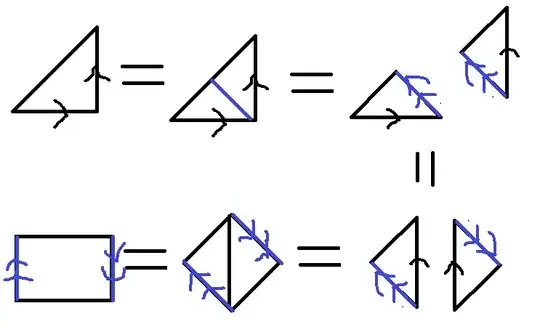
Fundamental polygon of the Mobius band

Glue the third edge of this triangle with the torus handle, we get a new representation:

$$abcca^{-1}b^{-1}$$

See the following figure: Connected sum of torus and the projective space
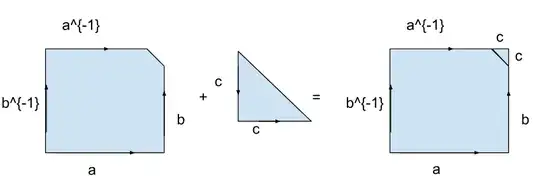
This representation has an edge pair $cc$ indicating that it belongs to the non-orientable category, and it has a single vertex class thus it has $6$ edges in its standard representation, implying that it is a $3P^2$. That is we've shown that the connected sum between $T^2$ and $P^2$ is

$$T^2\#P^2=3P^2$$

Xipan Xiao
  • 2,781
0

Mobius strip allows access into the inside surface of the sphere. So slide one end of the g-handle into the strip and and it will then become attached to the sphere from the inside surface. That effectively turns the g-handle into a klien bottle and every such bottle is made up of two mobius strips.

So there, the three mobius strips you mentioned.

0

See the proof of Lemma 7.1 in Massey's "A Basic Course in Algebraic Topology" (1991), pp 23-25.

user31714
  • 131
  • 1
    Could you summarize the basic idea of the proof here? It would be helpful for people without immediate access to the textbook. –  Jan 06 '13 at 18:40