EDIT1:
I understood your question in this way:
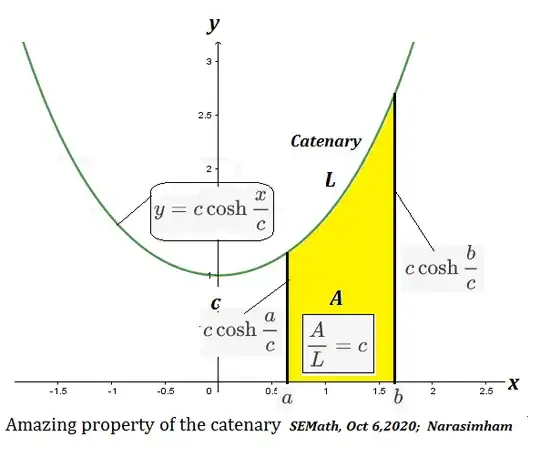
How is it that the area under a Catenary is proportional to the arc length? i.e., how is
$$ c=\dfrac{A}{L}$$
valid for some constant of proportionality $c$?
At first about the sign in front of radical sign in DE
Let us at the outset consider very familiar similar situations:
If two DEs are given as
$$ y'= + \sqrt {1-y^2},\; y'= - \sqrt {1-y^2} $$
we have in either case by squaring
$$ y^{'2} = (1-y^2) $$
Differentiate
$$ 2 y' y^{''}= -2 y y',\to y^{''}+y =0 $$ which is the differential equation of a sine curve.
With BC $ x=0,y=1,y'=0 \to y= \cos x $ in either case
Similarly if two DEs are given as
$$ y'= + \sqrt {y^2-1},\; y'= - \sqrt {y^2-1} $$
we have in either case
$$y^{'2}= (y^2-1)$$
Differentiating
$$ 2 y' y^{''}= 2 y y',\to y^{''}-y =0 $$ which is the differential equation of a Catenary. With BC $ x=0,y=1,y'=0 \to y= \cosh x $ in either case.
However, if you do not wish to square thereby losing its sign but wish to directly integrate the two BCs, the following:
$$ y'= + \sqrt {1-y^2},\; y'= - \sqrt {1-y^2} $$
we get
$$ \sin^{-1}y= x +c_1, \sin^{-1}y=- x-c_2 $$
$$y= \sin (x+c_1),y= -\sin (x+c_2)$$
For (an even ) a symmetric solution $ x=0, y=1 $
we have respectively
$$c_1=\pi/2, c_2= 3 \pi/2$$
both yielding the same solution
$$ y = \cos x $$
When we have here our actual case
$$ y'= + \sqrt {1+y^2},\; y'= - \sqrt {1+y^2} $$
we get
$$ \cosh^{-1}y= x +c_1, \cosh^{-1}y=- x-c_2 $$
$$y= \cosh (x+c_1),y= \cosh (x+c_2)$$
For even symmetric solution $ x=0, y=1 $
we have respectively
$$c_1= c_2= 0 $$
yielding both the same solution
$$ y = \cosh x $$
So we can say in conclusion that in front of any (square root) radical sign we have $\pm$ and both signs are equally applicable for first order DE. It is only by a convention that we put in a positive sign implying the unsaid negative. They result in the same differential equation and hence also the same integrand for given boundary conditions in this particular case.
Geometrically a negative or positive sign of derivative relates to different slopes of the curve in different portions of the curve.
Next to answer what I considered to be your main question let us set up its DE which uniquely defines the curve.
To get a physical/geometrical idea a length dimension quantity $c$ is introduced as the quotient of covered area $A$ to the length of its curved "roof".
$$c=\dfrac {\int y \; dx}{\int\sqrt{1+y'^2}dx}$$
Using Quotient Rule differentiate to simplify
$$c=\dfrac{ y} {\sqrt{1+y'^2}}= \to y' = \dfrac{\sqrt{y^2-c^2}}{c} $$
which is the differential equation of the unique curve being sought.
Integrating with boundary condition $ y(0)=c ,y'(0)=0,$ one obtains the equation of the only curve that satisfies the required property.
$$ \dfrac{y}{c}= \cosh\dfrac{x}{c}$$
which is recognized as a catenary as stated. And in association this property is recognized as well... that $c$ is the constant of proportionality which is the minimum distance of the catenary to the x-axis.
$$ c=\dfrac{A}{L}$$
as also shown here graphically.