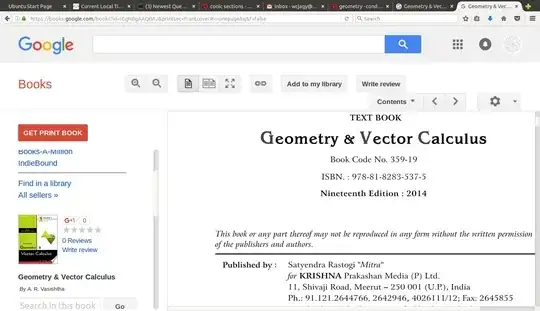
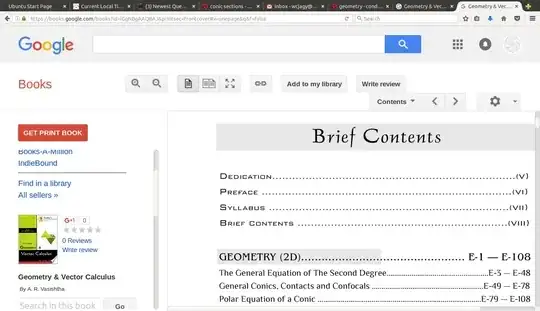
This book seems to do conic sections in the first twenty pages or so, although the online preview shows only the end of the chapter. It would appear they do not require linear algebra before this material, so that might be an advantage. They do a hyperbola on page E-24, an ellipse pages E-27 to E-29, then exercise E-29 to E-30, just the final answers pages E-30 to E-32. This book is Geometry & Vector Calculus
by A. R. Vasishtha.
Here is the treatment of a different ellipse, pages E-27 to E-29. If not clear, you can go to the web preview and compare.
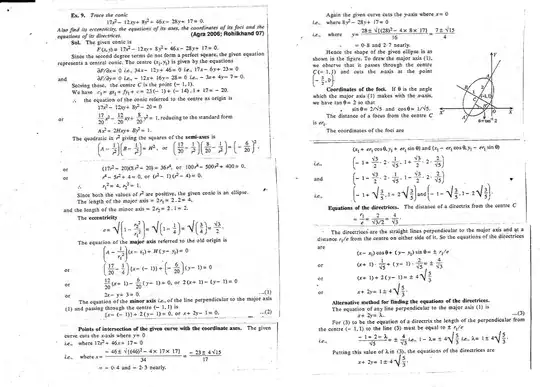
THIS SEEMS TO BE a good book for this, extra practice problems and solutions, to go with an existing textbook in engineering mathematics. To get anywhere with this problem, basic linear algebra and simple multivariable calculus (partial derivatives) are required, unless you are able to memorize a large number of formulas.
An edition of the main textbook seems available here. Maybe safe to use, maybe not. I cannot seem to find conic sections in this book, though. They jump to three dimensional stuff.
Te center of the ellipse is at $(1/4, 1/4).$ If we take translated coordinates $(p,q)$ with
$$ p = x + \frac{1}{4}, \; \; q = y + \frac{1}{4}, $$ or
$$ x = p - \frac{1}{4}, \; \; y = q - \frac{1}{4}, $$
we get
$$ 13 p^2 - 18 pq + 37 q^2 = 4. $$
For the next part, a rotation, you need to deal with eigenvalues and eigenvectors. Not bad, they deliberately made the eigenvalues integers. However, square roots do appear.
Let
$$ u = \frac{3}{\sqrt {10}} p + \frac{1}{\sqrt {10}} q, $$
$$ v = - \frac{1}{\sqrt {10}} p + \frac{3}{\sqrt {10}} q, $$ or
$$ p = \frac{3}{\sqrt {10}} u - \frac{1}{\sqrt {10}} v, $$
$$ q = \frac{1}{\sqrt {10}} u + \frac{3}{\sqrt {10}} v. $$
Then
$$ 10 u^2 + 40 v^2 = 4. $$