In the 6th edition of Edwards & Penney's Calculus, in the chapter on transcendental functions, there is an interesting question about a special limit that leads to the famous Euler's number
$$\lim_{x\to\infty} \left( 1 + \frac{1}{x} \right)^x \approx 2.718281828 $$
However, if you raise variable $x$ to the higher power, say $10$, the graph literally goes crazy as $x \to \infty$ and the kills of to $1$. Here is the graph of this situation:
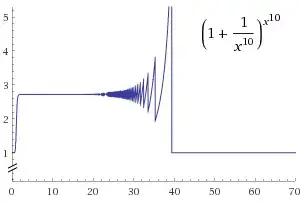
This special limit states that: the further you go with $x$ the closer you approach $\exp(1)$. So, as you see the limit fails at higher powers. Please, help me to to understand this situation. I suppose it has something to do with the capability of computer systems to calculate.


