32

I keep looking at this picture and its driving me crazy. How can the smaller circle travel the same distance when its circumference is less than the entire wheel?
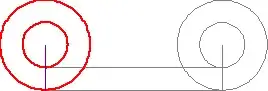
demonstration image

Glorfindel
  • 4,000
  • 8
    The wheel paradox is simply a cute way of showing that one-to-one correspondence does not imply equality of length. A more straightforward way of showing this is by drawing a line from the top vertex of an isosceles triange to its base, passing though a segment connecting the two equal sides of triangle and parallel to the base. – Mike Jones Aug 18 '11 at 10:55
  • 1
    I don't have an answer---- but--- what if the wheel made two or 3 revolutions. If you got rid of the straight line and just put a pencil dot where the line hit the circles, wouldn't the center of the wheel make a straight line and the smaller circle trace a loop and the outside circle trace a loop showing it was trying to go in the opposite direction ?? –  Sep 07 '12 at 14:43
  • 2
    -1 No, the point on the outer rim traces out a cyclod: see http://en.wikipedia.org/wiki/Cycloid or http://mathworld.wolfram.com/Cycloid.html The point on the inner circle traces out a curate cycloid: see http://mathworld.wolfram.com/CurtateCycloid.html – Ross Millikan Sep 07 '12 at 16:49
  • 1
    suppose the horizontal line is a railroad rail and the wheel rests on it. The point on the outer rim traces a cyclod. The point on the inner circle traces a cycloid. However a railroad wheel has a flange that extends about an inch and 1/2 below the outer rim sitting on the rail. Now what does that trace line look like ? –  Sep 08 '12 at 21:21
  • 1
    The trace line of a point on the wheel that contacts the rail traces a cycloid, as that is the radius that moves without slipping. The trace line on the flange that extends below the rail traces a prolate cycloid http://mathworld.wolfram.com/ProlateCycloid.html which has a small loop where the point travels backwards. – Ross Millikan Sep 08 '12 at 21:45
  • This Wolfram demonstration shows how visualizing the analogue for polygons can help to understand the slippage of the inner circle: http://demonstrations.wolfram.com/AristotlesWheelParadox/ – shamisen Mar 30 '18 at 17:15
  • I was confused at first by Ross Millikan's comments, which seem to have little to do with the original post. To save future readers the same confusion, I wanted to point out that user39706's immediately preceding comment was originally an answer and that Ross Millikan's downvote and comments, as well as user39706's second comment all refer to that now deleted answer, not to the original post. When that answer was deleted, it and all its comments got inserted into this comment thread. – Will Orrick Jul 17 '23 at 14:41

9 Answers9

43

the smaller wheel does not just rotate, but also slides. If you had cogwheels instead of smooth wheels, you'd notice that movement is not possible.

mau
  • 10,176
26

That picture confuses things by making it look as though the red line is being "unwound" from the circle like paper towel being unwound from a roll. Our brains pick up on that, since it is a real-world example.

Both circles complete a single revolution, and both travel the same distance from left to right. If these really were rolls of paper towel, the smaller roll would have to spin faster (and therefore complete more than one full revolution) in order to lay out the same length of paper towel as the larger roll. Alternatively, if the two rolls were spinning at the same rate, the free end of the strip of towel left behind by the smaller roll would also move to the right.

In short, the image is a kind of optical/mental illusion, and you're not going crazy :)

24

As e.James mentions, the amount of red line laid out by the inner wheel is twice the circumference of the inner wheel. So the impression that the inner wheel is rolling out the red line is an illusion. In actuality, the inner wheel slips as it rolls out the red line. The slippage is hard to see since the only fixed reference that appears on the inner wheel is its radius that follows its rotation, and its radius only comes near the line on which the wheel is rolling at the ends of the line.

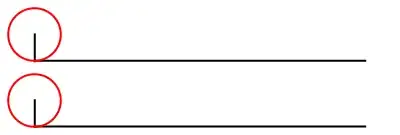
I have isolated the inner wheel and placed a second wheel just below it which actually rolls out a red and green line in a proper length-for-length manner. Watching the two together, makes the slippage more noticeable.

${\hspace{4cm}}$enter image description here
robjohn
  • 353,833
  • Which software did you use to produce this figure? – yaa09d Oct 20 '15 at 10:35
  • @yaa09d: I used Mathematica to generate the animation. – robjohn Oct 20 '15 at 12:06
  • How is the length of red line twice the circumference of the inner circle? In your graphics, the second circle is moving faster than the first one – Manjoy Das May 29 '24 at 08:37
  • Yes. The upper circle in my answer is the same as the inner circle in the question; it slips and so only appears to roll once. The lower circle in my answer is actually rolling without slipping; it shows that the line is twice the circumference of the circle. – robjohn May 31 '24 at 07:36
14

If the two circles are fixed, then they will be traveling the same difference, but at different velocities.

In fact, the ratio of the radii is equal to the ratio of the velocities a point on either circle will be traveling.

If you tried to repeat this by putting two different-sized circles on a track and making them spin to come out to be the same distance with the same angular velocity, you will notice that one of the circles will have to slide/slip along the track in order to keep them at the same pace.

Justin L.
  • 15,120
  • Re your second paragraph: what you say is true in the frame of reference of the center of the circles. But to understand distance traveled you need to say something about what is happening in the frame of reference of the ground, and your second paragraph does not apply in that frame. I'm also confused about your first paragraph: if two objects travel the same distance in the same amount of time, they have the same velocity. I do completely agree with your third paragraph however. To clarify your first two paragraphs I think you need a detailed discussion of rolling motion. – Will Orrick Jul 17 '23 at 15:04
1

Have two cylindrical wheels spin on an axle which passes through their centers. Draw a line vertical to the axle. At the point of the intersection of the line with the two wheels tie on each point a ball of string. After one revolution the lengths of string on each cylindrical wheel are different and proportional to the radius of the wheels.

  • I'm not clear on what you are describing. What happens to the balls of string as the assemblage translates to the right? Do the balls stay put at their original locations, resulting in a trail of string behind each cylinder, or do they move with the cylinders? If the latter, do they stay attached to their original circumference points (and therefore rotate around the center point), or do they stay attached to the points of contact between the cylinders and their respective horizontals (and therefore undergo only horizontal translation)? – Will Orrick Jul 17 '23 at 14:56
  • @Will Orrick. In Gordon Gustafson's question, there is an illusion. The inside and the outside circle are parts of one circular disc. They do not move independently. If they were separate the two would not travel the same distance in one revolution. – Vassilis Parassidis Jul 19 '23 at 23:07
  • I guess I'm no longer sure I know what you are saying in your original answer. Do the cylinders rotate together, or are they free to rotate separately? I had assumed they must rotate together, and then became curious about how the balls of string are configured so that string is able to wind onto both cylinders at the same time. If my assumption was wrong, then my question isn't so relevant. – Will Orrick Jul 20 '23 at 03:00
  • Now that I reread your answer, I realize that you don't even mention rolling. Are your wheels spinning about an axle fixed in position? I may have been reading things into your answer that you didn't intend. – Will Orrick Jul 20 '23 at 03:12
1

Imagine this as a wheel on a car the red line in this case is the distance the car has moved forward for one rotation of the tyre. The hubcap has moved forward by the same amount. Both wheel and hubcap have performed one rotation yet a spot on the outer edge of the hubcap will have moved a shorter distance through space than a point on the tread related to the circumferential difference between tyre and hubcap.

1

From a physical point of view, the usual animation is misleading because it omits the wheels slippage. The animation below reflects what would happen in practice.

  • If the smaller circle doesn't slide, then it "pushes" the larger circle; in this case, the larger circle slides and therefore unwinds faster (third picture).

  • If the larger circle does not slide, then it "pulls" the smaller circle; in this case, the smaller circle slides and therefore unwinds more slowly (fourth picture).

enter image description here

Remark: The rigorous proof that one of the wheels certainly slides can be seen here.

Pedro
  • 19,965
  • 9
  • 70
  • 138
1

Look at the path traced by each contact point between a circle and its red line. The larger wheel's point traces a much longer path from its starting point to its finishing point. The distance from start to finish is the same for each circle, but the path to reach it is different.

0

Another demonstration of the falsity, since I spent a little too much time doing this for a now-closed-as-duplicate question.


Ultimately, just because their displacement is the same doesn't mean anything else: the points on each circle traveled different paths of different lengths. You can see this by parameterizing the paths of a fixed point on each circle, in the vein of cycloids.

If we use the bottommost point as the fixed point, and the larger circle has radius $R$ and the smaller one radius $r$, and we have them concentrically centered at $(0,R)$ initially, then $$ \begin{align*} \text{inner circle's fixed point parameterization is: } &\begin{cases} x(t) = t - r \sin t\\ y(t) = r(1 - \cos t)+(R-r) \\ t \in \mathbb{R} \end{cases} \\ \text{outer circle's fixed point parameterization is: } &\begin{cases} x(t) = t - R \sin t\\ y(t) = R(1 - \cos t)\\ t \in \mathbb{R} \end{cases} \end{align*}$$

From here, you can calculate the distance traveled by a point between times $t=0$ and $t=T$ by the usual arc length formula for parametric curves: $$ L = \int_0^T \sqrt{ [x'(t)]^2 + [y'(t)]^2 } \, \mathrm{d}t $$ (though you may need to approximate the value depending on the $r,R$ involved, for which there are many standard methods).

To see this in action, I have a Desmos demo from which this visual is derived:

enter image description here

PrincessEev
  • 50,606