There may exist ways to make the above approach work, but I have not managed to find one yet.
Instead the idea that left and right multiplication does different things lead me to believe we would need another approach. Instead we adopt the vectorization and Kronecker product approach used in some previous questions and answers.
$$\left[\begin{array}{cc}
{I_2\otimes {\bf 0}}&-(I_2\otimes {\bf C}^T)\\I_2\otimes I_2&I_2\otimes \bf 0
\end{array}\right]$$
Since our small 2 degree polynomial for $2\times 2$ matrix is so small we can show it explicitly:
$${\bf M}=\left[\begin{array}{rrrr|rrrr}\epsilon&0&0&0&-C_{11}&0&-C_{21}&0\\0&\epsilon&0&0&0&-C_{11}&0&-C_{21}\\0&0&\epsilon&0&-C_{12}&0&-C_{22}&0\\
0&0&0&\epsilon&0&-C_{12}&0&-C_{22}\\\hline
1&0&0&0&\epsilon&0&0&0\\0&1&0&0&0&\epsilon&0&0\\0&0&1&0&0&0&\epsilon&0\\0&0&0&1&0&0&0&\epsilon\end{array}\right]$$
Please note the $+\epsilon{\bf I}$ we added to slightly push the eigensystem as explained by Robert Israel.
This also lets us decide if each multiplications by $\bf C$ is from the left or from the right. It should make no practical difference in this case since $\bf C$ is not multiplied onto $\bf T$ from any direction, but for other equations it will make a difference. The difference from before is that our right vector will be $(2\cdot 4)\times 1$ this time. We also need to do a devectorization to make sense of the result.
It is also easy to extend, for example solving ${\bf T}^2-\bf C_2T-C =0$ (where would we put the elements to $\bf C_2$ in the matrix above?) For example solving :
$${\bf T}^2-\left[\begin{array}{cc}
0.4152969&-0.302774\\
1.296701&0.4620149
\end{array}\right]{\bf T}-\left[\begin{array}{cc}
-1.594623&0.4579296\\
2.536964&-2.300262
\end{array}\right]={\bf 0}$$
gives us the solution ${\bf T} = \left[\begin{array}{cc}-1.55046838107395&1.02247507618352\\-3.50309793756543&1.86219643308248\end{array}\right]$
With absolute element errors < $10^{-14}$, quite close to the double precision arithmetics used.
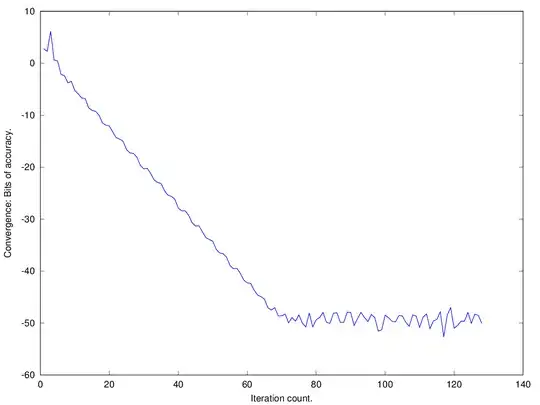 Convergence plot in a case when $\bf C, C_2$ admit for a real solution. Notice the convergence is both exponential and stops at error of $2^{-50}$: close to the mantissa of 52 bits for double precision floats.


