3

A young boy (13 years old), son of friends of mine, is already very dedicated to mathemetics. He told me that, in the classical formula $$A=P\frac{i \,(i+1)^n}{(i+1)^n-1}$$ using his calculator he was able to compute any number knowing the three other except $i$ for which he needs to use a trial and error method. Since we use to "play mathemetics" (as he says) together, he asked me how he could do it simply.

For sure, I explained what are the problems and how the equation in $i$ could be easily solved by a numerical method such as Newton. This was probably looking too complex and he asked me if a "good" approximation could be given to him. But, deceptively, he asked for a formula which could be used on paper without any calculator.

Accepting the challenge, I worked the equation $$r=\frac{i\,(i+1)^n}{(i+1)^n-1}$$ for which I built two approximations.

  • The first one by Taylor series (around $i=0$) limited to first order $$r=\frac{i\, (n+1)}{2 n}+\frac{1}{n}\implies i_1=\frac{2 (n r-1)}{n+1}$$ which is an overestimate (Darboux theorem since this corresponds to the first iteration of Newton method).

  • The second one building the simplest Pade approximant (around $i=0$) $$r=\frac{\frac{1}{n}+\frac{ (n+2)}{3 n}i}{1-\frac{n-1}{6} i }\implies i_2=\frac{6 (n r-1)}{2(n+2)+n(n-1)r}$$ which is, as one could expect, much better than the first one but which corresponds to an underestimate (which I cannot prove).

Trying to improve that, using generated data ($0 \leq i\leq 0.01$ and $1 \leq n \leq 240$) and using linear regression, I finally proposed (rounding the coefficients) $$i_3\approx \frac 14 i_1+\frac 34 i_2$$ which is not too bad.

For example, using $r=0.01$ and $n=180$, the above formulas give $i_1=0.008840$, $i_2=0.006995$, $i_3=0.007456$ while the exact solution is $i=0.007299$.

My question is : does any one know a simple and accurate formula which could be proposed to this young man (remember : pen and paper only) ?

I must confess that I am now stuck (if he would have accepted a formula to be used with a calculator, I could have proposed a nice expression from a slightly more complex Pade approximant but this would require solving an ugly looking quadratic equation). For the conditions used above, it would lead to the estimate $0.007304$.

  • You could suggest an iterative procedure: guess an initial value of $i$ and then iterate (for instance) $f(i) = r\frac{(i+1)^n-1}{(i+1)^n}$. Although there are probably more clever / better ways solve this iteratively; I tried it out with $r=0.01$, $n=180$ and an initial guess of $i=0.1$ and it became better than your formula in about $4$ steps. (Smarter would be to start from your value $i_3$ and iterate from there.) – Myself Nov 19 '15 at 10:24
  • @Myself. Yes, I know but the problem is that he wants that to be doable by hand without any calculator. This was the challenge ! Otherwise, the problem is very simple as you commented. Cheers. – Claude Leibovici Nov 19 '15 at 10:30
  • I think it is widely accepted in the financial community that there is no "closed-form formula" for the yield to maturity of a cash-flow, so - sadly for your young friend, there is no "pen-and-paper" solution. – uniquesolution Nov 19 '15 at 10:34
  • @uniquesolution. Just a "good" and simple approximation is looked for. Accepting solving quadratic or cubic polynomials give me almost the exact answer. – Claude Leibovici Nov 19 '15 at 10:35
  • Maybe you can get some inspiration from this: http://math.stackexchange.com/questions/1512549/what-is-the-q-for-the-formula-s-n-fraca-11-qn1-q-with-given-a-1/1512561#1512561 –  Nov 19 '15 at 14:17
  • @YvesDaoust. Thank you very much. It is good material for me to work. Cheers. – Claude Leibovici Nov 19 '15 at 14:20

2 Answers2

2

I was about to give up with this problem when an idea came to my mind.

The approximate solution must not require solving even quadratic equations; so, if the approximation is a Padé approximant, it should be of degree $1$ in numerator and degree $m$ in denominator but, at the same time, the function to be approximated, around $i=0$, has to be $$\frac{i\,(i+1)^n}{(i+1)^n-1}-r$$ In such a way I should need to solve for $i$ equation $$\frac{1-n\, r}{n}+b_m\, i=0$$ which is simple except that coefficients $b_m$ become very quickly quite ugly.

For $m=2$, introducing as an intermediate variable $$y=\frac{2 (n r-1)}{n+1}$$ (which is $i_1$ in the question), I arrived to $$i\approx\frac{2y\left(6+(n-1)y\right)}{12+(n-1)(4-y)y}$$ which is, for sure, not as good as the solution given by a $[2,2]$ Padé approximant but better than the $i_3$.

Repeating the calculation for $n=180$ and $r=0.01$, this leads to $i=0.007319$ while the exact value is $i=0.007299$.

Now, I give up !

Edit (almost three years later)

In an naswer to this question, I reported results obtained meanwhile for the approximation $$i=y\,\frac{\sum_{k=0}^3 c_k\, y^k }{\sum_{k=0}^3 d_k\, y^k }\qquad \text{where}\qquad y=\frac{2 ( nr-1)}{n+1}$$ with $$\left( \begin{array}{cc} \color{red} {k} & \color{red} {c_k} \\ 0 & 15120 \left(n^2-20 n+1\right) \\ 1 & -1260 (n+2) \left(8 n^2+113 n-13\right) \\ 2 & -90 \left(90 n^4+355 n^3+942 n^2+705 n-148\right) \\ 3 & -4 (n+2) \left(194 n^4+388 n^3+687 n^2+493 n-142\right) \end{array} \right)$$ and $$\left( \begin{array}{cc} \color{red} {k} & \color{red} {d_k} \\ 0 & 15120 \left(n^2-20 n+1\right) \\ 1 & -3780 \left(2 n^3+57 n^2+57 n-8\right) \\ 2 & -60 \left(170 n^4+823 n^3+1560 n^2+508 n-145\right) \\ 3 & -(2 n+1) \left(874 n^4+1559 n^3+3336 n^2+1139 n-428\right) \end{array} \right)$$ Repeating the calculation for $n=180$ and $r=0.01$, this leads to $$i=\frac{338717216186170264}{46405051549088067895}\approx 0.00729915$$ while the exact value is $i\approx0.00729945$.

1

Here is my 1st order simple equation:

$$A = P (1/n + 0.6r)$$ when $r n < 1$

Assume your variable i = my variable r

Take a $1M loan example with 4% interest over 15 years, (r * n = 0.6 OR r * n < 1).

Interest loan equation = $7,495 per month (annually compounding)

1st order approx. = $7,556 per month

error = + 0.8%, not bad!

If you use month compounding, the error does get a little higher.

Here is some comparison results of A for a range of r and n values: A vs r

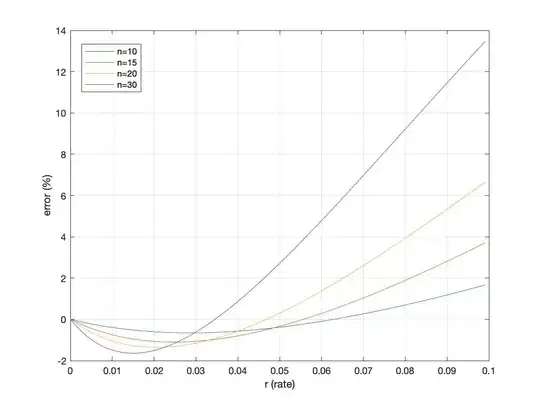
Here is error function: error vs r

Your boy seems very smart and you also seem like a maths wiz. I don't know why my approximation works (especially where the 0.6 constant come from?!?) - I am just an engineer and realized for low r*n values, the curves are reasonably linear and can be linearly interpolated by my simple equation

dantopa
  • 10,768