I just investigated randn(1024) + 1i*randn(1024), a 1024x1024 complex valued matrix with elements both real part and imaginary part drawn from $\mathcal{N}(\mu = 0, \sigma = 1)$. I was a bit surprised when I found that the eigenvalue distribution seemed to be uniformly distributed over a circular disc in the complex plane. I.e. constant density of eigenvalues within the circle.
As I have studied some matrix perturbations, I was thinking that every new random addition performs a random walk on each eigenvalue. But if that was the case, it would seem more likely that the probability to reach points far out on the disc should drop, but that does not happen.
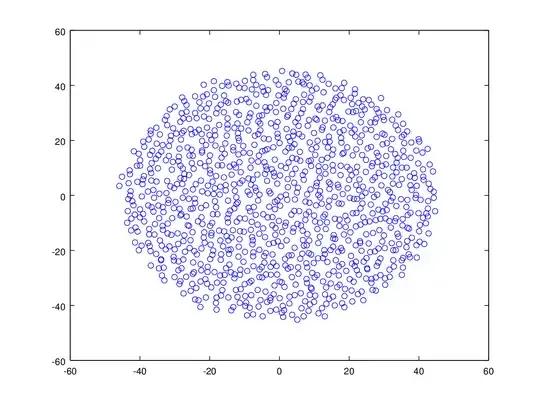
Does anyone know any good way to analyze or explain this?
Edit I did another command
In other words: $$A \text{ is } 512\times 512 \hspace{1cm}{\bf A}_{ij} = \frac{\mathcal{N}(0,2\pi)}{\sqrt{512}}, \forall (i,j)$$
A = 2*pi*(randn(512))/sqrt(512);
Now it seems I can get the picture below, all within $2\pi$:

