9

Romeo and Juliet have a date at a given time, and each will arrive at the meeting place with a delay between 0 and 1 hour, with all pairs of delays being equally likely. The first to arrive will wait for 15 minutes and will leave if the other has not yet arrived. What is the probability that they will meet?

My text has the answer as 7/16, and I just don't get it. I'm just reading the book for self study - no one to ask!

My logic:

One of them has to arrive first, or they both arrive at the same time. The probability they arrive at the exact same time is zero. Suppose Romeo arrives first.

If Romeo is the first to arrive, and he arrives after 45min, they are guaranteed to meet.

A = P(Romeo arrives within the first 45min) = 45/60 = 3/4.
B = P(Juliette arrives within some 15min interval) = 15/60 = 1/4.

P(A and B) = 3/4 * 1/4 = 3/16.

Help?

2 Answers2

11

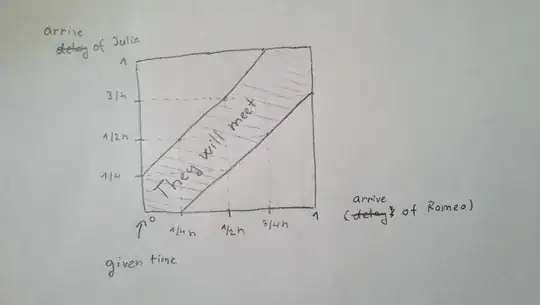
I would solve it like this (I'm sorry, but I'm not good at drawing pictures in LaTeX, so I've made it by my hand, hope it helps).

So let $x$ be the time whem Romeo arrives. He can arrive at any time between 0 and 1, let $y$ be the time when Julia comes.

So the points [x,y] of the square are every possible combinations of times when they comes, if I can say it like that. The area of the square if 1.

The situation that they come at the same moment is symbolized by the diagonal. But one of them can arrive even 15 minutes later - the upper line symbolize the situation when Romeo will wait for Julia 15 minutes exactly, so the area between diagonal and upper line symbolize the situation when Romeo will wait for Julia 15 minutes or less.

The lower line, on the other hand, represents the situation when Julia will wait for Romeo 15 minutes exactly, so the area between this line and the diagonals means that Julia is waiting for Romeo 15 minutes or less.

Together, these two areas gives oll possible "time-combinatoins" at which they'll meet.

So now the probability $P(they \ meet) \ = \frac{the \ area \ of \ the \ part \ in \ which \ they \ meet}{the \ area \ of \ the \ square} = \frac{7}{16}$.

0

Let the point $(x,y)$ mean that romeo arrives at $x$ time, juliet arrives at $y$ time. The sample space is the unit square since $0 \le x,y \le 1$.

Let $A$ be the event that romeo and juliet meet, $A$ is the subset of points $(x,y)$ satisfying $|x-y| \le 0.25$ and lying inside the unit square. If $x\ge y$, then $x \le y + 0.25 \implies y \ge x -0.25$. If $y \ge x$ then $y \le x+0.25$.

Thus event $A$ consists of all points in the unit square satisfying $y \ge x-0.25$ when $x\ge y$ and $y \le x +0.25$ when $y\ge x$. Graphing this set of points and calculating its area (divided by area of unit square = 1) will yield the answer $7/16$.

Ray
  • 537