It does sound plausible, especially by analogy with infinite series. But yes, there are counterexamples. Here's one:
Consider a continuous function that is zero, except for triangles centered on the integers, of height 1 and area going like $1/2^n$. Then the integral will exist but the function itself doesn't converge to zero.
Added: A rough diagram (graph of function with is zero for all $x \geq 1$ except for two sides of isosceles triangles of height 1, base length $2^{-(n-2)}$ centered over each integer $n \geq 2$; the area of the triangle over the integer $n$ is $2^{-(n-1)}$.)
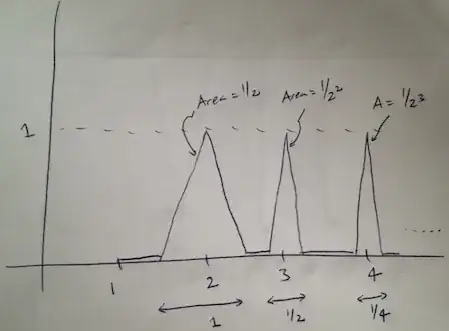
Then for such a function,
$$\lim_{x\to\infty} \int_1^x f(x) \ dx = \lim_{N\to\infty} \sum_{n=2}^N 2^{-(n-1)} = 1$$
however $\lim_{x\to\infty} f(x)$ does not exist.
The counterexample can be made more exotic by allowing it be unbounded: let the isosceles triangle over integer $n$ have height $n/2$ and base length $(n2^{n-3})^{-1}$; each triangle's area remains $2^{-(n-1)}$.


