7

Consider a grid $G$ in the $\mathbb{R}^2$ plane formed by the points $(x,y)$ with integer coordinates i.e. $G=\{(x,y)\in\mathbb{R}^2: x\in\mathbb{Z},\;y\in\mathbb{Z} \}$. For $n>0$ let $B_n$ square centered at $(0,0)$ whose sides have length $2^{n+1} + 1$. Note that $B_n=\{-2^n,\ldots,0,\ldots,+2^n \}\times \{-2^n,\ldots,0,\ldots,+2^n \}$.

Consider all the circuits as a finite set of points $p_{0},p_1,\ldots, p_{k-1},p_k,p_{k+1}\ldots, p_n$ such that:

  • the starting point $p_0$ is equal to its endpoint $p_n$, that is, $p_0=p_n $;
  • the circuit trace has no self-intersection;
  • $p_k$ and $p_{k+1}$ are neighbors for $k=0,1,3,\ldots,n $. By neighboring points we understand the points that are distance 1 according to the metric $d(p,q)=\max\{|x_p-x_q|,|y_p-y_q| \}$ for points $p=(x_p,y_p)$ and $q=(x_q,y_q)$ in $\mathbb{Z}^2$.

For an illustration with rectangles $B_2$ and $B_3$ see the figure below.

.........................Circuit round the ball of radius 2 in Z ^ 2
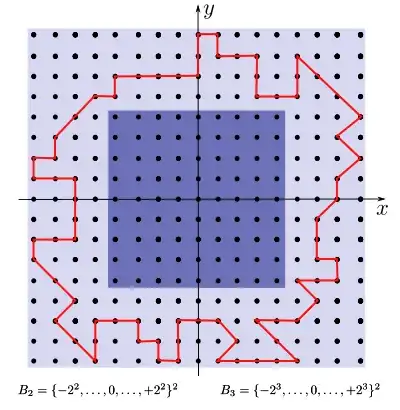
Question. What is the maximum number of circuits that can be drawn within the square $B_{n+1}$ and out of $B_n$ square?

My attempt was to divide the region where the circuit can pass in 8 rectangles. As shown below. And then try to count the number of paths running from side to side of each rectangle.

.........................!enter image description here

Elias Costa
  • 15,282
  • 1
    don't forget the circuit path need not move regularly from one of your twelve rectangles to the next. even in the simple case shown, with $B_3$ and $B_2$ some retracing is possible. do you have the answer for the total number of circuits in a $B_n$ (i.e. without a "forbidden" inner zone)? – David Holden Apr 02 '15 at 15:15
  • @DavidHolden +1 Yes. That's why we could not solve the problem with this strategy. But at least I can get a lower bound for the number of circuits. And I think with some trick I improve my lower bound. – Elias Costa Apr 02 '15 at 15:20
  • looking for a lower bound is a more "tractable" problem, for sure. in the case of your reduced problem you need first to compute two kinds of $2^n \times 2^n$ matrices (corresponding to the entry/exit points for the "side" rectangles and the "corner" rectangles), then think how to combine them, and impose the circuit condition. it still seems a daunting task, though certainly a useful exercise in combinatorial thinking! – David Holden Apr 02 '15 at 15:30
  • see also another related question here. – Elias Costa May 02 '15 at 15:05
  • The $n$ for the number of points in your path ($p_n$) is evidently not the same as the $n$ in $B_n$: you should probably change one of them :-). – Nick Matteo May 08 '17 at 15:33

0 Answers0