6

I will start with an example. Suppose that I would like to cover the set $\{1,2,3\}$ by differences between three integers $m_1,\ m_2$ and $m_3$ in the following sense: $$ \{1,2,3\}=\{m_2-m_1,m_3-m_2,m_3-m_1\}. $$ This is possible by taking $m_1=1,m_2=2$ and $m_3=4$.

I take another example: the equality $$ \{1,2,3,4,5,6\}=\{m_2-m_1,m_3-m_1,m_3-m_2,m_4-m_1,m_4-m_2,m_4-m_3\} $$ is satisfied for $m_1=1,m_2=2,m_3=5,m_4=7$.

Now I can formulate the problem to which, hopefully, someone can help me to arrive to the solution:

(a) Find the set of all positive integers $n\ge 2$ (or, at least, an infinite subset) for which there exist integers $m_1,\dots,m_n$ such that $$ \{m_j-m_i\}_{1\le i<j\le n}=\Bigl\{1,2,\dots,\frac{(n-1)n}{2}\Bigr\}. $$

.

As regarding the case $n=5$, I was able to prove that it is not possible to find a sequence of $5$ integers such that their differences cover the set $\{1,2,\dots,10\}$. It turns out that in this case the best possible scenario is to cover the set from $1$ to $11$ in which $6$ is missing: $$ \{1,2,3,4,5,7,8,9,10,11\}=\{m_j-m_i\}_{1\le i<j\le 5}. $$ A solution here is: $m_1=1,m_2=2,m_3=5,m_4=10,m_5=12$.

This last remark led to the second question:

(b) For each $n\ge 2$ find an increasing finite sequence $m_1,\dots,m_n$ of integers such that the set $\{m_j-m_i\}_{1\le i<j\le n}$ has $\frac{n(n-1)}{2}$ elements (the differences are distinct) and $m_n-m_1$ is minim.

I realize that these problems can be very difficult. I will be satisfied with partial solutions or, at least, ideas on how to proceed. Thank you!

Alex Ravsky
  • 106,166
aly
  • 897
  • Are you having difficulty finding this set and that sequence? Do you have a specific question? – abiessu Feb 09 '15 at 21:48
  • Yes, I do not know the answers to these problems and I would like to find the solutions. I assumed that this is clear. – aly Feb 09 '15 at 21:50
  • 1
    This is not homework, it is a problem encountered in my research. By the way, I am not a student and I do not get homework from anyone (I'm happy with this situation). – aly Feb 11 '15 at 23:12
  • Thank you for clarifying and adding some detail to your question. – abiessu Feb 11 '15 at 23:51

4 Answers4

4

For (a), you can only find integers $m_i$ such that

$$ \{m_j-m_i\}_{1\le i<j\le n}=\Bigl\{1,2,\dots,\frac{(n-1)n}{2}\Bigr\} $$

if and only if $n \leq 4$. The proof is by construction. Fix $n$ and let $M = \{m_i\}$ and $D$ be the set of differences induced by $M$. Without loss of generality start with $M = \{0\}$. We proceed by adding elements to $M$ such that we cover the next largest difference not in $D$. To start, we cover ${n \choose 2}$ by adding it to $M$, so $M = \left\{ 0, {n \choose 2} \right\},\; D = \left\{ {n \choose 2} \right\}$. For notational convenience, I simply use $\pm c$ to denote ${n \choose 2} \pm c$, so instead I write $$M = \{ 0,-0\}, \;\; D = \{-0\}$$ The next difference we try to cover is -1. There are only two possibilities we can add to $M$, namely 1 or -1. By symmetry we can pick either without any loss of generality. So $$M=\{0,1,-0\}, \;\; D=\{1,-1,-0\}$$ The next difference to cover is -2, and there are three possibilities 2,-2,-1. However, we must keep $|D| = {|M| \choose 2}$, so we cannot add any element to $M$ that induces a difference already in $D$. In other words, we cannot have $\,m_i\!-\!m_j = \,m_k\! -\! m_l = x\,$ for different pairs $(i,j)$ and $(k,l)$. So 2 and -1 don't work and we are forced to add -2 to $M$.

$$ M = \{0,1,-2,-0\},\;\; D = \{1,2,-3,-2,-1,-0\} $$

The next difference to cover is -4. The possibilities are 2,4,-4,-3 but by the same argument we are forced to choose 4.

$$ M = \{0,1,4,-2,-0\}, \;\; D = \{1,2,3,4,-6,-4,-3,-2,-1\} $$

The next difference to cover is -5, and we find nothing works and we are stuck. Because our choices up until this point were either forced or wlog, we are done. We have found constructions for $n=2,3,4$, and have showed there is no $M$ for $n \geq 5$ (since it is impossible for $M$ to cover $\{-5,-4,-3,-2,-1,-0\}$).

  • Nice proof. Thank you. Maybe a similar approach can be considered for the second problem. For the moment I am working on some examples trying to find a pattern. – aly Feb 15 '15 at 16:22
3

The problem is a special case of the turnpike reconstruction problem (wikipedia on related problems), which is concerned with finding a set of distinct positive integers $M = \{m_{1}, m_{2}, \dots m_{n}\}$ already given the set of pairwise differences $\Delta{M} = \{m_{i} - m_{j}\}_{1 \leq i \leq n, \ 1 \leq j \leq n}$ (note that this includes positive and negative differences, mostly for convenience).

This problem is usually approached from a computational perspective: how can we find the set $M$ most efficiently from $\Delta{M}$. One approach is to convert the problem into that of factoring polynomials. Particularly, given a symmetric polynomial $$ q(x) = \sum_{k = -\alpha}^{\alpha}{a_{k} x^{k}} $$ we can find a polynomial $$ p(x) = \sum_{i = 1}^{n}{x^{m_{i}}} $$ such that $$ p(x)p(x^{-1}) = \left(\sum_{i = 1}^{n}{x^{m_{i}}}\right)\left(\sum_{i = 1}^{n}{x^{-m_{i}}}\right) = q(x) $$ In this case, the set $\{k: a_{k} \not = 0\}$ is exactly $\Delta{M}$, the pairwise differences. Thus we have $$ q(x) = \sum_{k \in \Delta{M}}{a_{k}x^{k}} = \left(\sum_{i = 1}^{n}{x^{m_{i}}}\right)\left(\sum_{i = 1}^{n}{x^{-m_{i}}}\right) = p(x)p(x^{-1}) $$ The question of whether this has a solution comes down to determining two things: what the $a_{k}$ are, and when we can factor certain symmetric polynomials. This may or may not be easier to determine.

To illustrate with your example of $\Delta{M} = \{-3, -2, -1, 0, 1, 2, 3\}$, $$ (x^{1} + x^{2} + x^{4})(x^{-1} + x^{-2} + x^{-4}) = (x^{-3} + x^{-2} + x^{-1} + 3x^{0} + x^{1} + x^{2} + x^{3}) $$ Note that the coefficient of $x^{0}$ is $3 = n$. Indeed, this holds generally as $x^{0}$ can only occur as the product of $x^{m_{i}}$ and $x^{-m_{i}}$. The other $a_{k}$ are not quite as direct but they likely follow a typical pattern for $\Delta{M} = \{0, \pm 1, \pm 2, \dots \}$.

  • 2
    Thank you very much for your interesting answer. I will award it with a vote, but I will keep the problem open hoping that something more related to my particular case appears. In fact, for problem (a) I need solutions for arbitrarily large n's, if they exist. If not, I would be extremely interested in solutions for problem (b), also for arbitrarily large n's. – aly Feb 12 '15 at 14:38
  • @aly I realize it is not a full solution, but it was mainly intended as an addition to more specific answers. However, I may edit it later to include more about the particular problem (most of the reason I did not initially was due to the unanticipated issue of finding the coefficients $a_{k}$ in the polynomial). – Jacob Maibach Feb 16 '15 at 05:00
3

Your second problem is known as finding optimal Golomb rulers. Your first problem is known as finding perfect Golomb rulers and, as Drew has shown in another answer, these only exist for $n \leq 4$.

mhum
  • 2,557
3

It seems the following.

I don’t know an answer to Part a), so I say a few words about part b). For the convenience I introduce the function $f(n)$ which is equal to the minimum $m_n-m_1$ which is taken over all increasing finite sequences $m_1,\dots,m_n$ non-negative integers such that the all differences $m_j-m_i$ (where $i<j$) are mutually distinct. By the way, I recently considered a similar question, where all differences $\frac 1{m_i}-\frac 1{m_j}$ have to be mutually distinct.

The function $f(n)$ has a trivial lower bound $f(n)\ge n(n-1)/2$. The situation with upper bounds is much more complex. First of all, the sequence $m_i=2^{i-1}$ yields a bound $f(n)\le 2^{n-1}$. Because the gap between an exponential upper bound and a polynomial lower bound is very large, we try to obtain a polynomial upper bound for $f(n)$. For this purpose we shall search $m_i$ in the form $m_i=(i-1)N+h(i)$ for some special number $N$ and function $h$. We impose the condition $0\le h(i)<N/2$ for each $i$. Assume that there exist numbers $j>i$ and $k>l$ such that $m_j-m_i=m_k-m_l$. Then

$$jN+h(j)-iN-h(i)=kN+h(k)-lN-h(l),$$ $$N(j-i-k+l)=h(k)+h(i)-h(l)-h(j).$$

The absolute value of the right hand side is less than $N$, so both sides are equal to zero: $$i+k=j+l$$ $$h(i)+h(k)=h(j)+h(l)$$

Now we have to choose the function $h$.

Assume that $h(i)=(i-1)^2$. Then

$$(i-1)^2+(k-1)^2=(j-1)^2+(l-1)^2$$ $$(i-1)+(k-1)=(j-1)+(l-1)$$

$$((i-1)+(k-1))^2=((j-1)+(l-1))^2$$

So $$2(i-1)(k-1)=((i-1)+(k-1))^2-(i-1)^2-(k-1)^2+$$ $$((j-1)+(l-1))^2-(j-1)^2-(l-1)^2=2(j-1)(l-1).$$

Therefore both pairs $\{i-1,k-1\}$ and $\{j-1,l-1\}$ are roots of a square equation

$$x^2-(k-1+i-1)x+(k-1)(i-1)=0.$$

Therefore $\{i-1,k-1\}=\{j-1,l-1\}$.

In order to $0\le h(i)<N/2$ for each $i$ we have to put $N=2(n-1)^2+1$. Then we obtain $$f(n)\le m_n-m_1=m_n=(n-1)(2(n-1)^2+1)+(n-1)^2=$$ $$(n-1)(2(n-1)^2+n)=(n-1)(2n^2-3n+1).$$

Similarly we can proceed by putting $h(i)=(i-1)^2 \pmod p$, where $p\le N/2$ is an odd prime number. Then we have an equality of pairs $\{i-1,k-1\}$ and $\{j-1,l-1\}$ of residues mod $p$. So if $p\ge n$ then it implies the equality of the pairs $\{i-1,k-1\}$ and $\{j-1,l-1\}$. We can choose such prime number $p\ge n$ of asymptotic order $n(1+o(1))$ and we may put $N=2p$. Thus we obtain a bound $$f(n)\le 2(n-1)p+p-1=2np-p-1=2n^2+O(n^2).$$

Also we can to build the sequence $\{m_i\}$ consecutively, starting from $m_1=0$ and at each step take as $m_n$ the smallest number such that all differences $m_j-m_i$ $(i<j)$ are distinct (since there are at most $n{n \choose 2}$ forbidden values for $m_n$, we have $m_n\le n{n \choose 2}$). In such a way we obtain

$$\{m_i\}=0,1,3,7,12,20,30,44,\dots.$$

This is Sequence A025582 from The On-Line Encyclopedia of Integer Sequences.

$$m_i$$

enter image description here

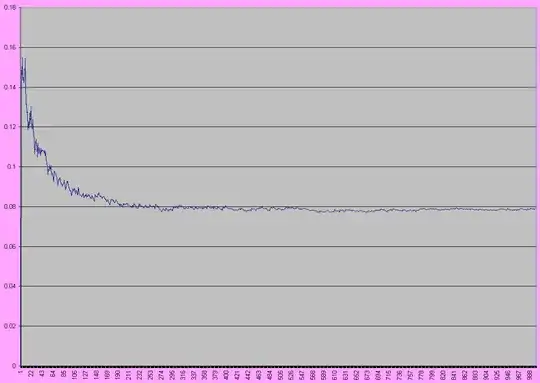
Empirical evidence suggests that this sequence grows asymptotically as $n^{11/4}$.

$$\frac{m_i}{i^{11/4}}$$

enter image description here

Alex Ravsky
  • 106,166