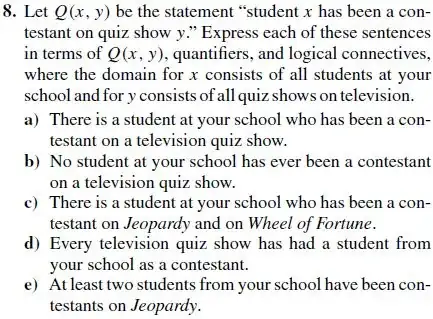
I have been stumped trying to solve problem e. I am confused as how to state "At least two students..." using quantifiers!
I know if it were ONE student it would be: ∃x,y(Q(x,Jeopardy)).
And all students would be:∀x,y(Q(x,Jeopardy))
So how can I expand on this?
Asked
Active
Viewed 5,860 times
2

Evan Bechtol
- 123
- 1
- 5
-
We can say at least two satisfy $\varphi$ by writing $\exists u\exists v(\lnot(u=v)\land \varphi(u)\land\varphi(v))$. – André Nicolas Feb 04 '15 at 03:53
-
It stands for any formula you may need. I left it to you to choose the relevant $\varphi$ in your particular problem. – André Nicolas Feb 04 '15 at 04:04
-
I deleted my comment right as you posted this, I reread it a few times and figured it out! Thank you for the concise answer. – Evan Bechtol Feb 04 '15 at 04:05
-
You are welcome. The same kind of trick can be used to make a sentence that says there exist at least $3$, at least $4$, and so on. It cannot be used to make a single sentence that says there are infinitely many. – André Nicolas Feb 04 '15 at 04:11
2 Answers
3
Suppose $P(x)$ denotes the predicate that $x$ has been on Jeopardy.
One can assert $\exists x,y$ s.t. $P(x) \land P(y) \land x\neq y$.

hardmath
- 37,715
1
As another way to put this, this is the negation of the "there exists at most one" quantifier, which I usually denote as $\;\langle !x :: P(x) \rangle\;$. Looking at another answer of mine and doing some basic manipulations, that negation would be $$ \langle \forall z :: \langle \exists x :: x \not= z \land P(x) \rangle \rangle $$ where of course $\;P(x)\;$ stands for "$\;x\;$ has been on Jeopardy", and $\;x,z\;$ range over the school students.
Perhaps that looks counterintuitive, but it is correct: you could read it as, "Whichever $\;z\;$ you take away (even if $\;P\;$ holds for it), you will still have at least one $\;x\;$ left that satisfies $\;P\;$."
Note how this is the only formula which contains $\;P\;$ only once: the usual formulations have two occurrences of $\;P\;$.

