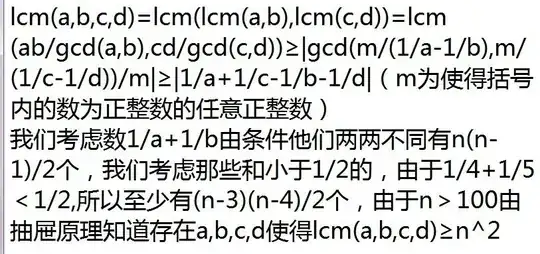
Last year I was in China too. :-D Unfortunately, I can read only a few Chinese words, but I can read the formulas. :-D So, it seems the following.
The hint is bad written. Indeed, let $f(a,b,c,d)=\left|\dfrac{1}{a}+\dfrac{1}{c}-\dfrac{1}{b}-\dfrac{1}{d}\right|.$ Then $f(a,b,c,d)\le 2,$ so the equality $\text{Icm}[a,b,c,d]\ge f(a,b,c,d)$ becomes trivial. :-) But, reducing the expression for $f(a,b,c,d)$ for a common denominator $\text{Icm}[a,b,c,d]$, we see that there exists an integer $A$ such that $$f(a,b,c,d)=\left|\dfrac{A}{\text{Icm}[a,b,c,d]} \right|.$$ The assumption $a_{i}a_{j}a_{k}+a_{j}a_{k}a_{l}\neq a_{i}a_{k}a_{l}+a_{i}a_{j}a_{l}$ implies that $f(a,b,c,d)>0$, so $A\ne 0$ too. Hence $$f(a,b,c,d)\ge \left|\dfrac{1}{\text{Icm}[a,b,c,d]} \right|$$ and $$\text{Icm}[a,b,c,d]\ge\dfrac{1}{f(a,b,c,d)}.$$ Similarly we can prove that $\text{Icm}[a,b]\ge\left|\dfrac{1}{a}-\dfrac{1}{b}\right|.$
Now let $A=\{a_m:m\in [1,n]\}$ and $A’$ consists of the $n-3$ biggest integers from $A$. For each pair of different numbers $a,b$ from the set $A’$ we have $\dfrac{1}{a}+\dfrac{1}{b}\le \dfrac{1}{4}+\dfrac{1}{5}=\dfrac{9}{20}$. Also there are ${n-3 \choose 2}=\dfrac{(n-3)(n-4)}2=M$ different pairs of different numbers $a,b$ from the set $A’$. Therefore the set $S=\left\{\dfrac{1}{x}+\dfrac{1}{y}:x,y\in A’\right\}$ consists of $M$ points which belong to an interval $\left[0; \dfrac{9}{20}\right]$ of length $\dfrac{9}{20}.$ Therefore there exist two different points of the set $S$ with distance between them at most $\frac{\dfrac{9}{20}}{M-1}.$ It means that there exist different pairs $\{a,c\}$ and $\{b,d\}$ of different numbers from the set $A’$, such that
$$f(a,b,c,d)=\left|\dfrac{1}{a}+\dfrac{1}{c}-\dfrac{1}{b}-\dfrac{1}{d}\right|\le\frac{\dfrac{9}{20}}{\dfrac{(n-3)(n-4)}2-1}=\frac {9}{10}\frac 1{n^2-7n+10}<\frac 1{n^2},$$
because $n>100$.
If the pairs $\{a,c\}$ and $\{b,d\}$ have no common number, then $$\text{Icm}[a,b,c,d]\ge\dfrac{1}{f(a,b,c,d)}> n^2.$$ If the pairs have a common number (for defineteness, let $c=d$), then $a\ne b$ and already $$\text{Icm}[a,b]\ge\left|\dfrac{1}{a}-\dfrac{1}{b}\right|=f(a,b,c,d)>n^2.$$