11

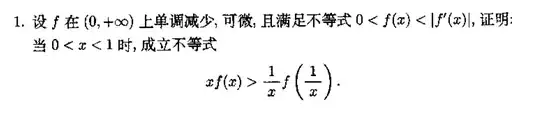
Let $f(x)$ be monotone decreasing on $(0,+\infty)$, such that $$0<f(x)<\lvert f'(x) \rvert,\qquad\forall x\in (0,+\infty).$$

Show that $$xf(x)>\dfrac{1}{x}f\left(\dfrac{1}{x}\right),\qquad\forall x\in(0,1).$$

My ideas:

Since $f(x)$ is monotone decreasing, $f'(x)<0$, hence $$f(x)+f'(x)<0.$$ Let $$F(x)=e^xf(x)\Longrightarrow F'(x)=e^x(f(x)+f'(x))<0$$ so $F(x)$ is also monotone decreasing. Since $0<x<1$, $$F(x)>F\left(\dfrac{1}{x}\right)$$ so $$e^xf(x)>e^{\frac{1}{x}}f\left(\frac1x\right).$$ So we must prove $$e^{\frac{1}{x}-x}>\dfrac{1}{x^2},\qquad0<x<1$$ $$\Longleftrightarrow \ln{x}-x>\ln{\dfrac{1}{x}}-\dfrac{1}{x},0<x<1$$ because $0<x<1,\dfrac{1}{x}>1$ so I can't. But I don't know whether this inequality is true. I tried Wolfram Alpha but it didn't tell me anything definitive.

PS: This problem is from a Chinese analysis problem book by Huimin Xie. enter image description here
epimorphic
  • 3,270
math110
  • 94,932
  • 17
  • 148
  • 519
  • Note that $xe^{x}$ is an increasing function if $x\in\left(0,1\right)$ so $xe^{x}<\frac{1}{x}e^{1/x}$ and then your inequality is false (the inequality in the comment). – Marco Cantarini Dec 23 '14 at 13:57
  • oh,this inequality is not true,that mean my idea is not usefull? – math110 Dec 23 '14 at 14:01
  • maybe this books problem is not true? maybe we can take countexapmle? – math110 Dec 23 '14 at 14:05
  • @MarcoCantarini, you are maybe wrong. See http://www.wolframalpha.com/input/?i=plot+e%5E%7B1%2Fx-x%7D-%5Cdfrac%7B1%7D%7Bx%5E2%7D+from+0+to+1. – Alex Silva Dec 23 '14 at 14:05
  • To clearify the comment of @MarcoCantarini: $x\mapsto xe^x$ is increasing for all $x>0$. Thus $xe^x<1/xe^{1/x}$ for $x\in(0,1)$. Isnt, however, the function one should study $x\mapsto xe^{1/x}$? – mickep Dec 23 '14 at 14:07
  • Oh.Now I also don't know this inequality is true?$$e^{\frac{1}{x}-x}>\dfrac{1}{x^2}?$$,$$\Longrightarrow \ln{x}-x>\ln{\dfrac{1}{x}}-\dfrac{1}{x},0<x<1?$$ – math110 Dec 23 '14 at 14:18

2 Answers2

7

A tentative of proof:

Put $g(x)=x^2f(x)-f(1/x)$. We have

$$g^{\prime}(x)=2xf(x)+x^2f^{\prime}(x)+\frac{1}{x^2}f^{\prime}(\frac{1}{x})=A+B+C$$ with $\displaystyle A=x^2(f(x)+f^{\prime}(x))$, $\displaystyle B=\frac{1}{x^2}(f(\frac{1}{x})+f^{\prime}(\frac{1}{x}))$, and $\displaystyle C=x(2-x)f(x)-\frac{1}{x^2}f(\frac{1}{x})$.

You have proved that $A<0$ and $B<0$. We have $$C =x(2-x)f(x)-\frac{1}{x^2}f(\frac{1}{x})=-(x-1)^2 f(x)+\frac{1}{x^2} g(x)$$ Hence $\displaystyle g^{\prime}(x)-\frac{1}{x^2}g(x)<0$. Put $h(x)=g(x)\exp(1/x)$, we have $\displaystyle h^{\prime}(x)=(g^{\prime}(x)-\frac{1}{x^2}g(x))\exp(1/x)$, and hence $h$ is decreasing. As $g(1)=0$, we have $h(1)=0$, $h(x)>0$ for $x\in (0,1)$, and we are done.

Kelenner
  • 18,894
4

I think the answer by @Kelenner is really good. This answer is just to prove the inequality $$ e^{1/x-x}>1/x^2,\quad 0<x<1.\tag{*} $$ that was discussed in the post/comments. We apply the logarithm, and since the logarithm is monotonically increasing, the inequality $(*)$ is equivalent to $$ 2\ln x>x-\frac{1}{x},\quad 0<x<1.\tag{**} $$ Let $$ g(x)=2\ln x-x+\frac{1}{x}. $$ Then $g(1)=0$ and a differentiation (and simplification) gives $$ g'(x)=-\frac{(x-1)^2}{x^2}. $$ Hence $g'(x)<0$ for $0<x<1$ (so $g$ is monotonically decreasing) and it follows that $g(x)>0$ for $0<x<1$ and thus that $(**)$ holds. But $(**)$ was seen to be equivalent to $(*)$, and so the inequality $(*)$ is true.

Edit: I updated the solution without the change of variable, since I don't think it simplified anything in the end.

mickep
  • 20,102