A right-angled hexagon is simply a hexagon in the hyperbolic plane with hyperbolic lines (geodesics) as its edges, and interior angles all right angles:
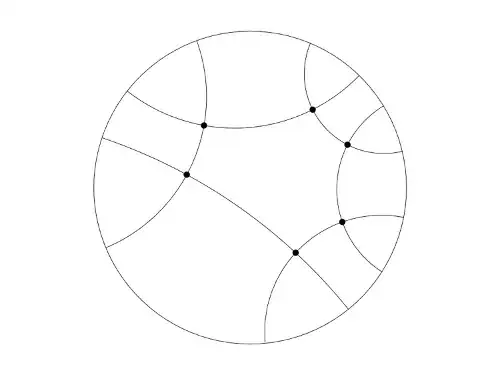
These have lesser total interior angle (and greater total exterior angle) than you'd get in a euclidean hexagon, but that's fine in the hyperbolic plane.
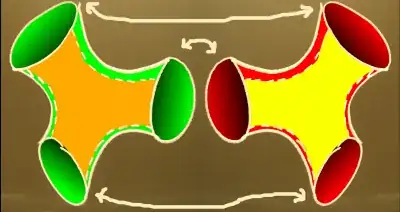
There exists a unique one of these given three non-adjacent side lengths, which is a nice but non-trivial exercise in hyperbolic geometry, and is useful for constructing hyperbolic surfaces from pairs of pants. You can glue two identical ones along three non-adjacent sides to get a pair of pants (and, by the above, you can even specify the cuff lengths for the pair of pants). Then these hyperbolic pairs of pants can be glued to form closed hyperbolic surfaces. If we didn't use right-angled hexagons, the pairs of pants wouldn't have straight boundaries, and the construction wouldn't work.
Here's an image (courtesy David Austin), showing two pairs of pants each built out of two hyperbolic hexagons, which can then be glued to give a hyperbolic genus-2 surface:
At a more basic level, it can be easily seen that there's one with all side lengths equal, at least: start with a very small hyperbolic hexagon, whose angles will be close to those of Euclidean hexagons (i.e. $2\pi/3$), and then pull the geodesics apart; at some point you will get right angles, because as they get further apart, the angles go to zero.

