14

STATEMENT: A dolphin is a special chess piece that can move one square up, OR one square right, OR one square diagonally down and to the left. Can a dolphin, starting at the bottom-left square of a chessboard, visit each square exactly once?

QUESTION: How would one approach this type of problem. It seems that whatever way the dolphin moves the maximum moves always involve the dolphin to traverse an 6x8 square.

Enigma
  • 3,989
  • Yeah, my intuition and scratch work seems to suggest that it s impossible. But how would you give a formal proof of its impossibility? – Enigma Dec 07 '14 at 01:58
  • No, it was a question suggested by a professor. – Enigma Dec 07 '14 at 02:01
  • I have a path it can follow that hits all but one square, so the question becomes then how can we be sure that it can't hit all, – JMoravitz Dec 07 '14 at 02:08
  • I would hint at looking at this from a graph theory intuition. The related Knight's Tour asks the question if there is a Hamiltonian Circuit on the board based on using a Knight. So we use a Dolphin and seek to find a Hamiltonian Circuit. – ml0105 Dec 07 '14 at 02:53

3 Answers3

21

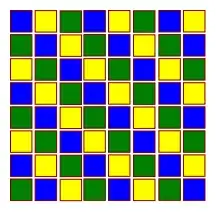
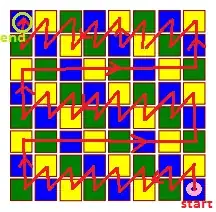
Hint: Instead of the usual black/white pattern, color the square $(a,b)$ either green, blue, or yellow, according to the remainder of $a+b$ (mod $3$). Each color forms a diagonal stripe going from the upper left to the lower right, with the stripe pattern going green, blue, yellow, $\dots$ as you move up or to the right. Think about how this coloring relates to a Dolphin's movement, and what a tour of the board would look like in terms of these colors.

Addendum: For your viewing pleasure:

enter image description here

Mike Earnest
  • 84,902
  • Very nice. To complete the proof then will also require noting that the starting square matters. If you were to start on one of the blue squares it is indeed possible to hit every space. – JMoravitz Dec 07 '14 at 02:28
  • @JMoravitz At least, the coloring argument would not preclude the existence of a tour. Have you found a Dolphin tour starting at, say, the lower right blue square? – Mike Earnest Dec 07 '14 at 02:32
  • Was working on something else entirely. Yes, in fact, there is a path starting from the lower right blue, assuming your definition is that it need not be a closed walk or need to "arrive at" the starting square (having begun there is good enough). Posted below. – JMoravitz Dec 07 '14 at 04:29
  • I still can't completely formulate the final argument. Using this coloring we see that for every diagonal movement it has to be superseded by a right movement and two up movements. This give us a 2-2-1 choice of colors. I also know that there is 20-21-22 groupings of distinct colors Green-Yellow-Blue. But what is the contradiction I am supposed to arrive at? – Enigma Dec 07 '14 at 04:47
  • 1
    @S.S See below for the punchline to the proof. In fact there are 21 green, 21 yellow, and 22 blue spaces. Regardless which move is chosen, you will move $g\to b$, from $b\to y$, and from $y\to g$. The contradiction is that having started on a green (or yellow) square, you will not have the ability to continue movement after having reached the 21st blue (or green resp.) you come to. – JMoravitz Dec 07 '14 at 04:53
  • Okay I see it now. Thanks. Also my 20-21-22 referred to the pieces that could be moved to, since we can't backtrack to the piece we started on. – Enigma Dec 07 '14 at 05:16
  • But the squares $(1,1)$, $(2,2)$ are both blue and yet $2\not\equiv 1\pmod 3$. – user26486 Dec 07 '14 at 07:54
  • @mathh here the squares are labeled from left to right and from bottom to top. (1,1) is green and (2,2) is yellow. If you dislike that numbering, then do a:left to right, b:top to bottom, and color according to a-b mod 3 – JMoravitz Dec 07 '14 at 15:29
12

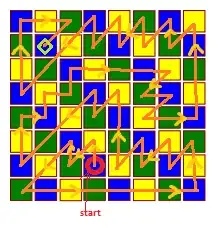
In response to Mike Earnest's question regarding the existence of a Dolphin Tour from alternate starting points: If we started at a blue square, say for example the bottom right corner instead, dolphintour

The punchline of the proof is that there are in fact 21 yellow, 21 green, and 22 blue squares. Any sequence of moves will be (...,green,yellow,blue,...) repeated. Having started from a green square, after reaching the 21st blue, you will no longer have another green square to go to, and so you cannot continue until reaching the 22nd blue.

In a similar fashion, it is then impossible to reach every square having started at a yellow square either.

Having started at a blue however, as shown above, can be possible (depending on the square), and if is impossible for a specific starting square, would require a different argument.

another dolphin tour

JMoravitz
  • 80,908
  • Very nice :) I imagine this is the exceptional case, and most blue squares are not the starting point of tours. – Mike Earnest Dec 07 '14 at 08:01
  • 2
    After playing with it for a while, I have in fact found dolphin tours starting from each of the blues from the bottom two rows and haven't yet checked the others. I'm not yet convinced if any blues don't have a dolphin tour. – JMoravitz Dec 07 '14 at 12:49
  • 1
    After a (not so quick) computational search, in fact most of the blue squares do start dolphin tours, but not all of them. 6 of them do not, mostly on the top right part of the board. – TonioElGringo Jul 28 '23 at 07:36
3

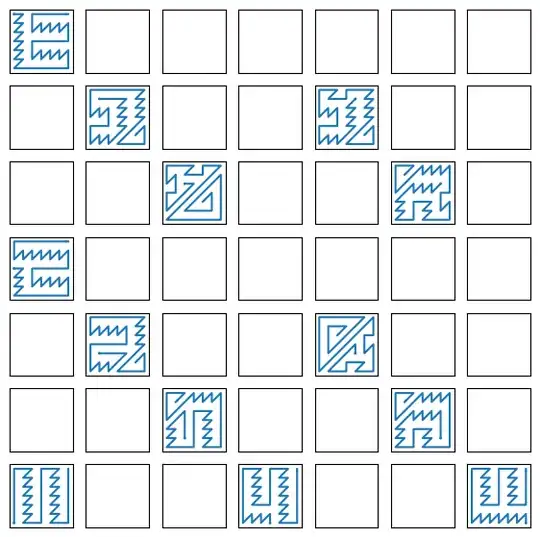
Here are all the starting points which would allow for a complete dolphin tour, with examples (these are not unique) of such tours for each one.
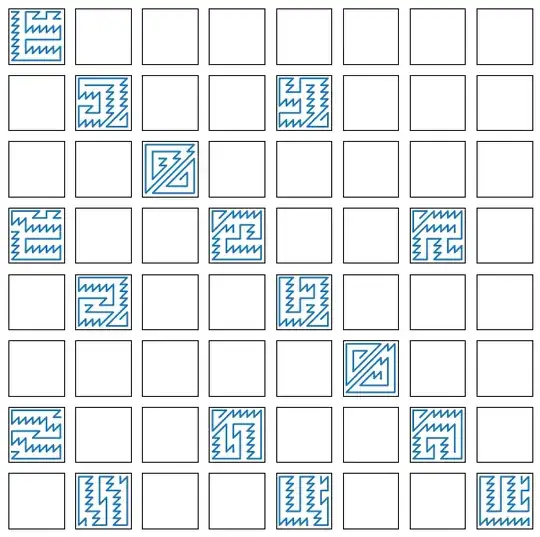
Solutions 8x8

These solutions were obtained by exhaustively searching tours, starting from the blue cells in Mike's answer, using a simple depth-first search. One can speedup the process by noting the symmetry across the bottom-left / top right diagonal, and stopping the search when some cells become unattainable. Here is the python code which was used:

import numpy as np
import matplotlib.pyplot as plt
from enum import Enum

class Moves(Enum): UP = (0,1) RIGHT = (1,0) DOWNLEFT = (-1,-1)

class State: def init(self, grid, pos, moves=[]): self.size = 1 for s in grid.shape: self.size *= s self.grid = grid self.pos = pos self.moves = moves

@classmethod
def new(cls, size, init_pos):
    state = np.full((size,size), True)
    state[init_pos] = False
    return cls(state, init_pos)

def is_done(self):
    return len(self.moves)+1 == self.size 

def is_impossible(self):
    if len(self.moves) == 0:
        # Check if the starting point is in a "blue" cell
        cnts = [0,0,0]
        for i,j in np.ndindex(self.grid.shape):
            cnts[(i+j)%3] += 1
        i,j = self.pos
        for c in cnts:
            if c > cnts[(i+j)%3]:
                return True
    # Check if the last move did block a cell
    for dx,dy in ((-2,-1),(-1,-2),(-1,1),(1,-1),(2,1),(1,2)):
        x,y = (self.pos[0]+dx,self.pos[1]+dy)
        if self.is_valid((x,y)):
            blocked = True
            for move in Moves:
                npos = (x-move.value[0], y-move.value[1])
                if self.is_valid(npos):
                    blocked = False
                    break
            if blocked:
                return True
    return False

def is_valid(self, pos):
    for v in pos:
        if v < 0 or v >= len(self.grid):
            return False
    return self.grid[pos]

def plot(self, ax, *args, **kwargs):
    start = self.pos
    coords = [start]
    for m in self.moves[::-1]:
        start = tuple(s-d for s,d in zip(start,m.value))
        coords.append(start)
    nx,ny = self.grid.shape
    ax.set_xlim(-0.5, nx-0.5)
    ax.set_ylim(-0.5, ny-0.5)
    ax.set_aspect("equal")
    dr = self.moves[-1].value
    ax.add_patch(plt.Circle(coords[-1], 0.15))
    ax.arrow(*(p-0.1*dp for p,dp in zip(self.pos, dr)), *(0.2*p for p in dr),
            shape='full', lw=0, length_includes_head=True,
            head_width=0.3)
    return ax.plot(*zip(*coords[::-1]), *args, **kwargs)

def move(self, move):
    newpos = tuple(x+dx for x,dx in zip(self.pos,move.value))
    if self.is_valid(newpos):
        newgrid = self.grid.copy()
        newgrid[newpos] = False
        return self.__class__(newgrid, newpos, self.moves+[move])
    return None

def avail_moves(self):
    avail = {}
    for move in Moves:
        moved = self.move(move)
        if moved is not None:
            avail[move] = moved
    return avail

def find_solution(self):
    if self.is_done():
        return self
    if self.is_impossible():
        return None
    for move,res in self.avail_moves().items():
        sol = res.find_solution()
        if sol is not None:
            return sol
    return None

def make_sym(self):
    def tr(c):
        a,b = c
        return b,a
    tr_m = {
        Moves.UP : Moves.RIGHT,
        Moves.RIGHT : Moves.UP,
        Moves.DOWNLEFT : Moves.DOWNLEFT,
    }
    return State(self.grid.T, tr(self.pos), [tr_m[m] for m in self.moves])

def plot_grid(n): fig, axes = plt.subplots(n,n, sharey=True, sharex=True, figsize=(n,n)) for i in range(n): for j in range(i+1): ax = axes[-j-1][i] ax_t = axes[-i-1][j] ms = State.new(n,(i,j)) sol = ms.find_solution() if sol: print("{} -> Found".format((i,j))) sol.plot(ax) if i != j: sol.make_sym().plot(ax_t)
else: print("{} -> Not found".format((i,j))) ax.set_aspect("equal") ax_t.set_aspect("equal") ax.set_xticks([]) ax.set_yticks([])

plot_grid(8) plt.show()

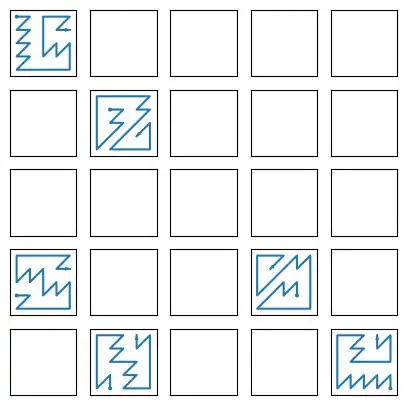
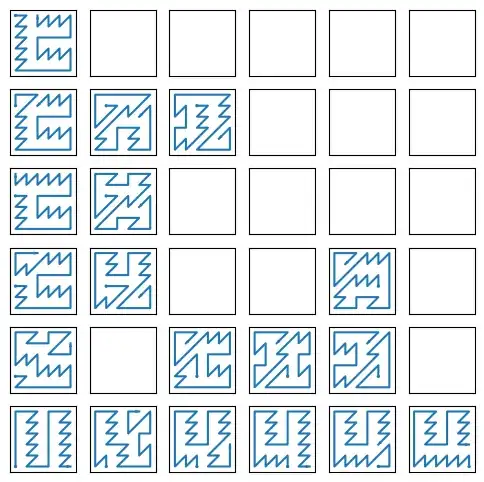
To be exhaustive, and as there are some nice patterns, here are the solutions for smaller boards: 2x2 board
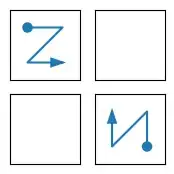
3x3 board

4x4 board

5x5 board

6x6 board

Solutions