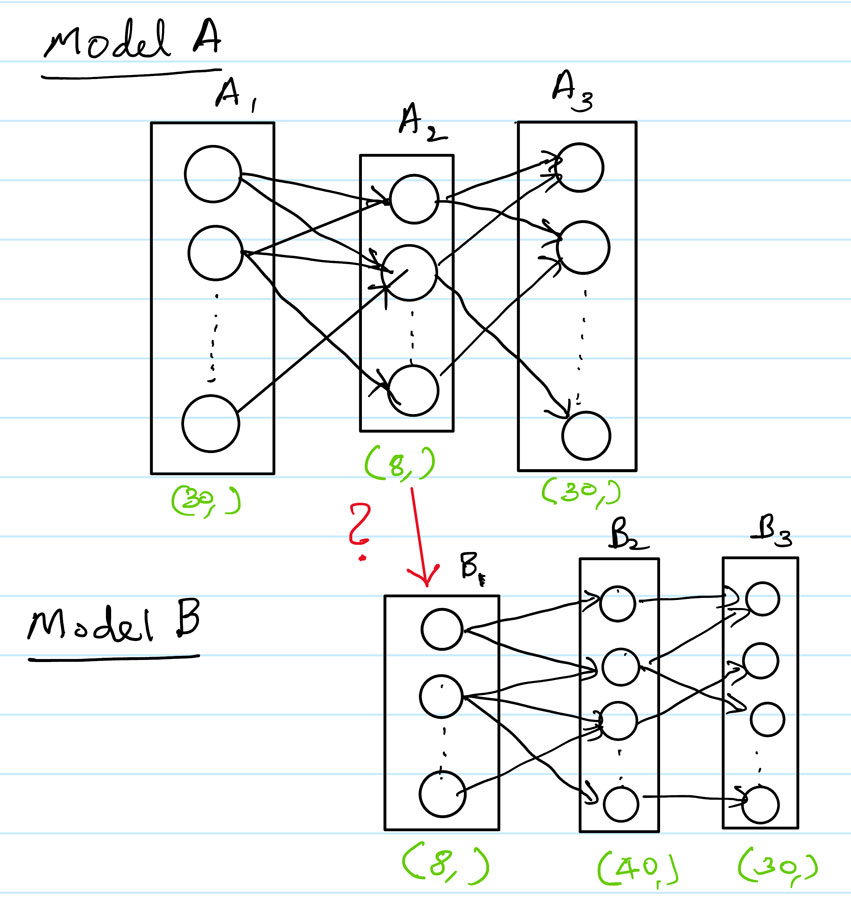
In Keras there is a helpful way to define a model: using the functional API. With functional API you can define a directed acyclic graphs of layers, which lets you build completely arbitrary architectures. Considering your example:
#A_data = np.zeros((1,30))
#A_labels = np.zeros((1,30))
#B_labels =np.zeros((1,30))

A1 = layers.Input(shape=(30,), name='A_input')
A2 = layers.Dense(8, activation='???')(A1)
A3 = layers.Dense(30, activation='???', name='A_output')(A2)


B2 = layers.Dense(40, activation='???')(A2)
B3 = layers.Dense(30, activation='???', name='B_output')(B2)

## define A
A = models.Model(inputs=A1, outputs=A3)

## define B
B = models.Model(inputs=A1, outputs=B3)

B.compile(optimizer='??',
          loss={'B_output': '??'}
          )

B.fit({'A_input': A_data},
  {'B_output': B_labels},
  epochs=??, batch_size=??)
So, that's it! You can see the result by: B.summary():
Layer (type)                 Output Shape              Param
A_input (InputLayer)         (None, 30)                0
_________________________________________________________________
dense_8 (Dense)              (None, 8)                 248
______________________________________________________________
dense_9 (Dense)              (None, 40)                360
_________________________________________________________________
B_output (Dense)             (None, 30)                1230