40

Can anyone suggest me a linear time algorithm that takes as input a directed acyclic graph $G=(V,E)$ and two vertices $s$ and $t$ and returns the number of simple paths from $s$ to $t$ in $G$.
I have an algorithm in which I will run a DFS(Depth First Search) but if DFS finds $t$ then it will not change the color(from white to grey) of any of the nodes which comes in the path $s \rightsquigarrow t$ so that if this is the subpath of any other path then also DFS goes through this subpath again.For example consider the adjacency list where we need to find the number of paths from $p$ to $v$.
$$\begin{array}{|c|c c c|} \hline p &o &s &z \\ \hline o &r &s &v\\ \hline s &r \\ \hline r &y \\ \hline y &v \\ \hline v &w \\ \hline z & \\ \hline w &z \\ \hline \end{array}$$ Here DFS will start with $p$ and then lets say it goes to $p \rightsquigarrow z$ since it doesnot encounter $v$ DFS will run normally.Now second path is $psryv$ since it encounter $v$ we will not change the color of vertices $s,r,y,v$ to grey.Then the path $pov$ since color of $v$ is still white.Then the path $posryv$ since color of $s$ is white and similarly of path $poryv$.Also a counter is maintained which get incremented when $v$ is encountered.

Is my algorithm correct? if not, what modifications are needed to make it correct or any other approaches will be greatly appreciated.

Note:Here I have considered the DFS algorithm which is given in the book "Introduction to algorithms by Cormen" in which it colors the nodes according to its status.So if the node is unvisited , unexplored and explored then the color will be white,grey and black respectively.All other things are standard.

Saurabh
  • 929
  • 2
  • 10
  • 15

4 Answers4

44

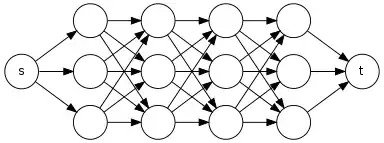
Your current implementation will compute the correct number of paths in a DAG. However, by not marking paths it will take exponential time. For example, in the illustration below, each stage of the DAG increases the total number of paths by a multiple of 3. This exponential growth can be handled with dynamic programming.

dag

Computing the number of $s$-$t$ paths in a DAG is given by the recurrence, $$\text{Paths}(u) = \begin{cases} 1 & \text{if } u = t \\ \sum_{(u,v) \in E} \text{Paths}(v) & \text{otherwise.}\\ \end{cases}$$

A simple modification of DFS will compute this given as

def dfs(u, t):
    if u == t:
        return 1
    else:
        if not u.npaths:
            # assume sum returns 0 if u has no children
            u.npaths = sum(dfs(c, t) for c in u.children)
        return u.npaths

It is not difficult to see that each edge is looked at only once, hence a runtime of $O(V + E)$.

Nicholas Mancuso
  • 3,927
  • 1
  • 25
  • 39
16

You only need to notice that the number of paths from one node to the target node is the sum of the number of paths from its children to the target. You know that this algorithm will always stop because your graph doesn't have any cycles.

Now, if you save the number of paths from one node to the target as you visit the nodes, the time complexity becomes linear in the number of vertices and memory linear in the number of nodes.

Juho
  • 22,905
  • 7
  • 63
  • 117
molyss
  • 261
  • 1
  • 2
0

As Nicholas' answer mentioned, you can use a top-down recursive approach, and use memoïzation to prevent solving overlapping subproblems. However, you can also use a bottom-up approach, which counts the number of paths to the target from all nodes in the graph, with the same complexity of $O(V+E)$.

def dfs(G, s, t):
    fifo = Queue()
    fifo.put(s)
    n_paths = [0] * len(G.V)
    n_paths[s] = 1
    while not fifo.empty():
        current = fifo.get()
        for p in G.parents(current):
            n_paths[p] += n_paths[current]
            if not p.already_visited:
                fifo.put(p)
                p.already_visited = True
    return n_paths[t]
0

The number of paths between any two vertices in a DAG can be found using adjacency matrix representation.

Suppose A is the adjacency matrix of G. Taking Kth power of A after adding identity matrix to it, gives the number of paths of length <=K.

Since the max length of any simple path in a DAG is |V|-1, calculating |V|-1 th power would give number of paths between all pairs of vertices.

Calculating |V|-1 th power can be done by doing log(|V|-1) muliplications each of TC: |V|^2.