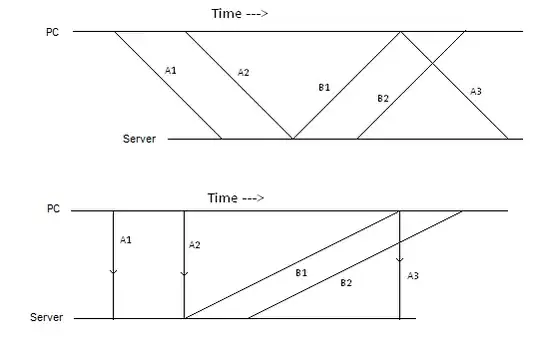
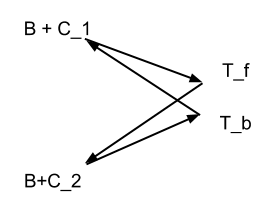
Consider a network of time servers known to be synchronous, $\theta = \{A, B, C\}$, and a client machine $P$.
Let $T_{XY}$ be the one way time of flight from machine $X$ to machine $Y$, with the possibility that $T_{XY}\neq T_{YX}$.
Let $\Delta_{XY} = |T_{XY} - T_{YX}|$ be the measure of the asymmetry between machine $X$ and $Y$.
Now, consider that the asymmetry between two synchronous machines can be measured by having the synchronous machines agree to send a one way message to each other at the same time. The difference in the arrival times is $\Delta$ between those machines, i.e.:
$\Delta_{AB} = |T_{AB} - T_{BA}|$
$\Delta_{BC} = |T_{BC} - T_{CB}|$
$\Delta_{CA} = |T_{CA} - T_{AC}|$
can be measured.
Now consider the time of flight of circuits:
$P \rightarrow A \rightarrow B \rightarrow P$, denoted by $C_{AB}$,
$P \rightarrow B \rightarrow A \rightarrow P$, denoted by $C_{BA}$.
$C_{AB} = T_{PA} + T_{AB} + T_{BP}$
$C_{BA} = T_{PB} + T_{BA} + T_{AP}$
Consider the client machine $P$ to initiate both of these circuits simultaneously, and measures the difference in arrival times, $x$:
$x = C_{AB} - C_{BA} = \Delta_{PA} + \Delta_{AB} + \Delta_{BP}$
Both $x$ and $\Delta_{AB}$ are known by previously mentioned measurements, so moving the unknowns to the left hand side:
$x - \Delta_{AB} = \Delta_{PA} + \Delta_{BP}$
Similarly, for $\{C_{AC}, C_{CA}\}$ and $\{C_{BC}, C_{CB}\}$ it can be shown that:
$y - \Delta_{BC} = \Delta_{PB} + \Delta_{CP}$
$z - \Delta_{CA} = \Delta_{PC} + \Delta_{AP}$
Inspecting carefully, we note that $\Delta_{XY} \equiv \Delta_{YX}$. The left sides contain values known from measurements, the right sides contain 3 unknowns in 3 equations.
Solving simultaneously,
$\Delta_{AP} = \frac{r + s - t}{2}$
$\Delta_{BP} = \frac{r - s + t}{2}$
$\Delta_{CP} = \frac{t - r + s}{2}$
where,
$r = x - \Delta_{AB}$
$s = y - \Delta_{BC}$
$t = z - \Delta_{CA}$