In Kunen's book, Set Theory,chapter I.7, he said: $1+\omega=\omega \neq \omega+1$. I want to know why $\omega \neq \omega+1$.
Asked
Active
Viewed 1,430 times
14


-
11What have you tried? Did you write out the definitions? Note that $\omega+1$ has a ... element. – t.b. Jan 12 '12 at 08:23
-
7As an ordered set, $\omega +1$ has a largest element, while $\omega$ doesn't. – André Nicolas Jan 12 '12 at 08:24
4 Answers
18
There is an easy way to see this. You need to apply the definition of ordinal addition:
$$\omega + 1 = \omega \times \{0\} \cup \{1\} \times \{1\} = \{0, 1, 2, \dots 1^\prime\}$$
So $\omega + 1$ has an element at the end that is not a successor of anything while $\omega$ does not.
On the other hand, $$1 + \omega = \{1\} \times \{0\} \cup \omega \times \{1\} = \{1 ^\prime, 0, 1, 2, \dots\} \cong \omega$$
so you see that addition doesn't commute.
There is some more information about this here on Wikipedia. Hope this helps.

Zev Chonoles
- 132,937

Rudy the Reindeer
- 48,301
-
3Nice. The $\omega+1$ being seen as the set ${ 0, 1, 2, \dots 1^\prime }$ help me a lot. – Paul Jan 12 '12 at 08:40
-
-
No, it does not help because the sets ${0,1,2,\dots,1^\prime}$ and ${1^\prime,0,1,2,\dots }$ are just the same set, so it would not highlight the difference. – Jan 14 '12 at 10:00
-
-
2I have to say that on the basis of this response, I would agree with Lmn6 so far. How do { 0,1,2,…1′} and { 1′,0,1,2,…} denote different sets? Looking around, I found this sentence "For example, 1+ω is not the same as ω+1; i.e., ω+1 = ord({0,1,2,...; 0}) but 1+ω is ord({0,0,1,2,3,...})=ω." But, I don't see this either. As I understand we could denote 0, 1, 2, ... by say N. Then we have {0, N} and {N, 0} both of which equal N. So, ord({0,1,2,...; 0})=ord({0,0,1,2,3,...}). So, how do the sets here differ? – Doug Spoonwood Jan 14 '12 at 12:57
-
5@Doug: In this answer, the notation ${a,b,c,...}$ is being used to represent an ordered list. Indeed, as sets $1+\omega$ and $\omega+1$ are equivalent, but it is the order that distinguishes them. – Cheerful Parsnip Jan 14 '12 at 13:03
-
2@JimConant Thanks Jim, that's right, it's a totally ordered set. Maybe you could suggest a better notation -- how are ordered lists usually denoted? – Rudy the Reindeer Jan 14 '12 at 13:10
-
1Ordered lists are usually denoted by round brackets, i.e. (..., ..., ...). – AlexE Jan 14 '12 at 16:26
-
@Matt So, don't you just mean a special type of sequence? If you do mean a special type of sequence, then you could write <0, 1, 2, ..., 1'> and <1', 0, 1, 2, ...>. – Doug Spoonwood Jan 15 '12 at 00:58
-
2To all those fiddling notational issues, in the case of the natural numbers in the context of set theory $0\in1\in2\in\ldots\in\omega\in\ldots$, even as an unordered set there is still a natural order. – Asaf Karagila Jan 15 '12 at 07:43
-
1@AsafKaragila: Yes, but how do you justify the presence of $1^\prime$ in both sets? Where do you place it? – Jan 15 '12 at 12:59
12
I find pictures to help. The idea here is that $\omega$ is a limit ordinal and tacking on the ordinal $1$ after it is fundamentally different:
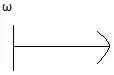
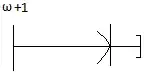
The picture for $\omega$ has a curved edge which indicates that it is a limit ordinal opposed to being a successor ordinal. When we tack on $1$ to the right of $\omega$ we have this ordinal $\omega+1$ that contains a limit ordinal which is not something that occurs in $\omega$. This means that $\omega$ and $\omega+1$ can't be isomorphic.
Can you use see why $1+\omega$ and $\omega+1$ aren't equal? Do you see why $1+\omega = \omega$?

tomcuchta
- 3,385
4
$\omega + 1$ has a limit point (i.e. $\omega$ — using the von Neumann definition $\omega + 1 = \omega \cup \lbrace\omega\rbrace$) in the order topology while $\omega$ is discrete in the order topology.

kahen
- 16,130
3
Because the elements of $\omega$ are all finite, whereas $\omega + 1$ has one infinite element.

Gigili
- 5,569
- 8
- 42
- 62