1

I have a problem with the proof of Cantor-Bernstein Theorem here below:

Take $A = (0,1)$ and $B = (0,\frac{1}{2})$. Then, $f(X) = \frac{x}{2}$ is a one to one function from $A$ to $B$ and from $B$ to $A$. So define $f_1 = f_2 = \frac{x}{2}$ (with the appropriate domaints).

I have tried to apply the proof on these sets but I seem not to be able following.

Can anyone describe what will happen to these sets during the proof?

Or, if it is easier, how can one be sure that the function $g$ defined in the proof is one-to-one and onto?

Thank you.
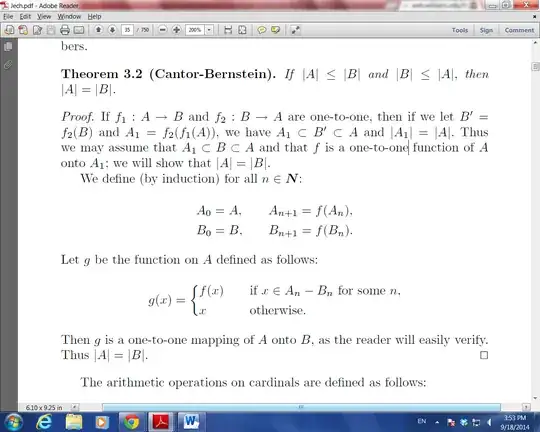
enter image description here

CopyPasteIt
  • 11,870
A student
  • 517
  • what is not well defined in $f(x)=\frac{x}{2}$? – A student Sep 18 '14 at 13:34
  • 1
    I find that proof very confusing, if you want to start from scratch with a different proof, try here starting at page 15. – David Sep 18 '14 at 13:37
  • 1
    Here is a formal proof (in my own DC Proof format) http://dcproof.com/CBS.htm. Being a formal proof it goes into excruciating detail and it is VERY long (hundreds of lines), but each step of the way should be fairly self-evident. Informal commentary is shown in a blue font (like comments in computer source code). – Dan Christensen Sep 18 '14 at 15:21

1 Answers1

0

I think I have managed to get the basic idea:

We have:$f:A \rightarrow B$, $g:B \rightarrow A$. Bothe one-to-one.

We want: to create a function $h:A \rightarrow B$ which is one-to-one and onto.

How do we built $h$:

  1. Define $g(B) = A_1$

  2. Define $C_0 = A \setminus A_1$

  3. We would like to perform $h(A_1)=g^{-1}(A_1)$. But we did not define $h$ on $C_0$. So,

  4. Apply $h(C_0)=f(C_0)$.

  5. Problem, $g^{-1}(A_1) \cap f(C_0) \neq \emptyset$. So $h$ is not one-to-one.

  6. Define: $D_0 = g^{-1}(A_1) \cap f(C_0)$

  7. Define $g(D_0) = C_1$. So, $C_1$ is the set on which $h$ is not defined.

  8. Define: $h(C_1) = f(C_1)$. Problem $g^{-1}(f(C_0)) \cap f(C_1) \neq \emptyset$

  9. Define $D_1 = g^{-1}(f(C_0)) \cap f(C_1)$, ...

Define: $C=\bigcup_{n=0}^{\infty}C_n$. and define: $h(a) = f(a)$ if $a \in C$ and $h(a) = g^{-1}(a)$ if $a \in A \setminus C$

I think this is the function Jech is refering to and it is left to check that it is one-to-one and onto.

A student
  • 517