For non-integral ‘$\nu$’, substituting the Schlaefli integral form of the function $P_\nu(z)$
\begin{equation*}
P_\nu(z)=\frac{2^{-\nu}}{2\pi i} \oint_Γ\frac{(t^2−1)^\nu}{(t−z)^{\nu+1}} dt \tag{1}
\end{equation*}
into the left-hand side of Legendre’s equation
\begin{equation*}
(1-z^2)P_\nu^{\prime \prime}(z)-2zP_\nu^\prime(z) +\nu(\nu+1)P_\nu(z)=0 \tag{2}
\end{equation*}
would lead to
\begin{align*}
&(1-z^2)P_\nu^{\prime \prime}(z)-2zP_\nu^\prime(z) +\nu(\nu+1)P_\nu(z)\\
=&\frac{2^{-\nu}}{2\pi i}(\nu+1)\oint_\Gamma \frac { (t^2-1)^\nu}{ (t-z)^{\nu+3}}[\nu t^2-2z\nu t-2zt+\nu+2]~dt \\
=&\frac{2^{-\nu}}{2\pi i}(\nu+1)\oint_\Gamma \frac{d}{dt} \left[ \frac { (t^2-1)^{\nu+1}}{ (t-z)^{\nu+2}}\right]~dt \tag{3}
\end{align*}
Call the right-hand side of (3), $\mathbf{\tilde{A}}$
\begin{equation*}
\mathbf{\tilde{A}}=\frac{2^{-\nu}}{2\pi i}(\nu+1)\oint_\Gamma \frac{d}{dt} \left[ \frac { (t^2-1)^{\nu+1}}{ (t-z)^{\nu+2}}\right]~dt \tag{4}
\end{equation*}
If, $\mathbf{\tilde{A}}=0$, then the Sclaefli integral satisfies the Legendre equation.
See my first answer, to this question, dated Oct 7 2022,
Showing Schlaefli integral satisfies Legendre equation .
There I analyse, starting with $P_n(z)$ not $P_\nu(z)$, but the derivations can easily be adapted, changing ‘$n$’s to ‘$\nu$’s in the math, should do the trick, but only up to (2), after which there is material on $\mathbf{A}=0$. See (1) and (2) in particular.
For $\mathbf{\tilde{A}}$ to equal zero, we must have, for the multi-valued function
$(t^2-1)^{\nu+1}/ (t-z)^{\nu+2}$
\begin{equation*}
\left[ \frac { (t^2-1)^{\nu+1}}{ (t-z)^{\nu+2}}\right]_{t_1}^{t_2}=0
\end{equation*}
where $t_1$ is considered the start of $\Gamma=\Gamma_1$, i.e. the start of our chosen contour, and $t_2$ is the end point of the same contour.
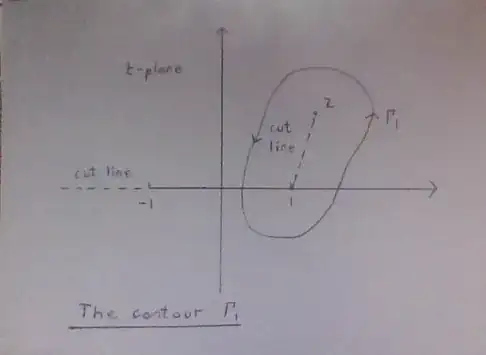 $\Gamma_1$." />
There is now described an Arfken$^1$ type closed contour, called $\Gamma_1$, which lies in the complex t-plane.
The t-plane contains a particular point called $z$, placed in the upper right quadrant. Special points are $t=+1$, $t=-1$, $t=z$. There are two cut-lines, the first from $t=1$ to $t=z$, the second from $t=-1$ to $t=-\infty$.
The closed contour $\Gamma_1$, encircles both the points $t=z$ and $t=+1$, but does not cross either of the two cut-lines. Hence the cut-line from $t=+1$ to $t=z$ is completely enclosed by $\Gamma_1$
The contour $\Gamma_1$ does not cross any cut-lines, hence it looks as if $t_2$ is the same point as $t_1$. It looks as if, it is not on some other sheet of a multi-sheeted construct. So we have, $\mathbf{ \tilde{A}}=0$.
Knowing that $\mathbf{ \tilde{A}}=0$ we may say that the function
\begin{equation*}
P_\nu(z)=\frac{2^{-\nu}}{2\pi i} \oint_Γ\frac{(t^2−1)^\nu}{(t−z)^{\nu+1}} dt
\end{equation*}
satisfies Legendre’s equation
\begin{equation*}
(1-z^2)P_\nu^{\prime \prime}(z)-2zP_\nu^\prime(z) +\nu(\nu+1)P_\nu(z)=0
\end{equation*}
The Schlaefli integral, satisfies Legendre’s equation.
Reference
1, George Arfken, Mathematical Methods For Physicists, Second Edition, Academic Press (1970). See Ch12 Legendre Functions, Section 12.4 Alternate Definitions of Legendre Polynomials, Fig12.9.


 $\Gamma_1$." />
\begin{equation} \frac { (t^2-1)^{n+1}}{ (t-z)^{n+2}} \end{equation}
would return to it's original value, after completing the closed contour in the definition of $P_\nu(z)$ and $\mathbf{A}=0$.
– user151522 Oct 12 '22 at 13:34