6

I am trying to find $z(r,\phi)$ from the 2D Poisson equation in polar coordinates: $$\frac{1}{r}\frac{\partial}{\partial r}\left(r \frac{\partial z}{\partial r}\right)+\frac{1}{r^2}\frac{\partial^2z}{\partial \phi^2}=C \tag{1}$$ where $C$ is a constant and the following boundary conditions apply: $$z^{(1,0)} (0,\phi)=0 \tag{2}$$ $$z (r_0(\phi),\phi)=0 \tag{3}$$ $$z^{(0,1)} (r,0)=0 \tag{4}$$ $$z^{(0,1)} (r,\pi/2)=0 \tag{5}$$

where $z^{(1,0)}=\partial z/\partial r$ and $z^{(0,1)}=\partial z/\partial \phi$.

The part I cannot wrap my head around is how to work with the dirichlet boundary condition on a variable boundary $r=r_0(\phi)$ in $(3)$.

Can someone guide me through the steps to find $z(r,\phi)$?

If it helps $r_0(\phi)$ is an ellipse, i.e. $r_0(\phi)=\frac{a b}{\sqrt{b^2 \cos^2\phi + a^2 \sin^2\phi}}$.


Following up on the comment by @Dmoreno to use a different coordinate system: $x=a r \cos \phi$ and $y=b r \cos \phi$. Indeed this transform BC$(3)$ into $z(1,0)=0$, which seems convenient. However, transforming the original equation $(1)$ for this coordinate system results in the following nasty equation: $$\left(\frac{\cos^2\phi}{a^2}+\frac{\sin^2\phi}{b^2}\right)\frac{\partial^2 z}{\partial r^2}+\left(\frac{\cos^2\phi}{b^2 r^2}+\frac{\sin^2\phi}{a^2 r^2}\right)\frac{\partial^2z}{\partial \phi^2}+\\ \left(\frac{\cos^2\phi}{b^2 r}+\frac{\sin^2\phi}{a^2 r}\right)\frac{\partial z}{\partial r}+ \frac{2 \cos\phi \sin \phi}{r^2}\left(\frac{1}{a^2}-\frac{1}{b^2}\right)\frac{\partial z}{\partial \phi} + \\ \frac{2 \cos\phi \sin \phi}{r}\left(\frac{1}{b^2}-\frac{1}{a^2}\right)\frac{\partial^2 z}{\partial \phi \partial r} = C\tag{6}$$

Which I don't think I can solve anymore in the framework of the poisson equation. Any other input/suggestions on solving this system?

Michiel
  • 414
  • I guess you are interested in solving the 2D Poisson equation and you have decided to go with polar coordinates, $x = r \cos \phi$, $y = r \sin \phi$. Two ideas: 1) maybe obtaining an expression for the Laplacian with the change of variables: $x = a r \cos{\phi}$, $y = b r \sin{\phi}$ will do the trick? 2) Note that you cannot, generally speaking, set a boundary condition for $r = 0$ since this is a geometric singularity. Instead of setting $z_r = 0$, wouldn't $\lim_{r\to 0}|z(r)| < \infty$ be the right boundary condition for $z$? – Dmoreno Aug 19 '14 at 17:38
  • @Dmoreno I will certainly try the other choice of coordinates, indeed that would turn the boundary condition simply into $r=r_0=1$. I'm not sure I completely understand your second point, I can see that $r=0$ is indeed a singular point in the differential equation, but would the boundary condition be something like $\lim_{r\to0}$ $z_r\to0$ (sorry about the notation, don't quite know how to write that) ? – Michiel Aug 19 '14 at 18:52
  • Hi @Michiel. I mean that you cannot force $z$ or its derivative to be any prescribed function since the solution might be singular at $r = 0$. The usual way to deal with this is to set the singular part of the solution (which usually are Bessel functions, logarithms, etc.) to zero as a way to keep $z$ bounded, i.e., $\lim_{r\to 0} |z| < \infty$ (which usually leads to a bounded derivative). Cheers! – Dmoreno Aug 19 '14 at 19:06
  • 1
    @Dmoreno ok, I think I get it now. Thanks! I actually know roughly what the solution to this problem should look like (because of the physical shape it represents) and I know that there isn't a singularity at $r=0$, but I will work with the mathematically correct formulation you propose! – Michiel Aug 19 '14 at 19:32
  • To make sure I've got your boundary conditions correct: Your region is the region in the first quadrant bounded by a generic ellipse. You want to solve Poisson's equation with BC's of $z=0$ along the ellipse boundary, and $\partial_\phi z=0$ along the two axes. – Semiclassical Aug 24 '14 at 21:17
  • @Semiclassical Yes, that is indeed what I am looking for. – Michiel Aug 25 '14 at 05:19
  • I suspect there is a solution in terms of Mathieu functions; I'm trying a transformation to elliptical coordinates to see how this plays out, I will let you know how it goes. – rajb245 Aug 25 '14 at 18:49
  • @rajb245 Terrific thanks. Note that the bottom part of my question contains a transformation of (1) to (what I would call) elliptical coordinates. Might save you some work?! – Michiel Aug 25 '14 at 19:20
  • The variable change proposed by @Dmoreno seems to give you an equation with nice boundary conditions, but the equation is quite more complex. I was thinking of the following transformation instead: https://en.wikipedia.org/wiki/Elliptic_coordinates – rajb245 Aug 25 '14 at 19:35
  • @rajb245 Ah, ok. Didn't know that coordinate system. I'm curious how it goes! – Michiel Aug 26 '14 at 05:04
  • 2
    This recent paper looks like it'd provide the relevant Green's function. Unfortunately, it's behind a paywall and so I can't verify that. Another earlier paper by the same author is also behind a paywall but one which I can actually read; I'll see if I can figure out how to adapt the method there for this case. – Semiclassical Aug 26 '14 at 14:46
  • @Semiclassical I can access the paper behind the paywall, but to be honest I don't exactly get what I am looking at. – Michiel Aug 28 '14 at 11:47
  • I do see that they indeed use the elliptic coordinates that @rajb245 mentioned so that seems to be the right route – Michiel Aug 28 '14 at 11:48

1 Answers1

3

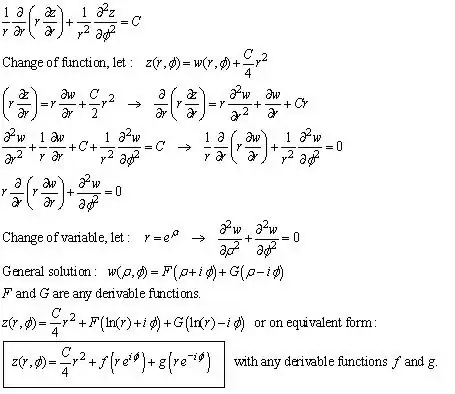
Finding the general solution of the PDE (below) is not the more difficult part of the task :

enter image description here

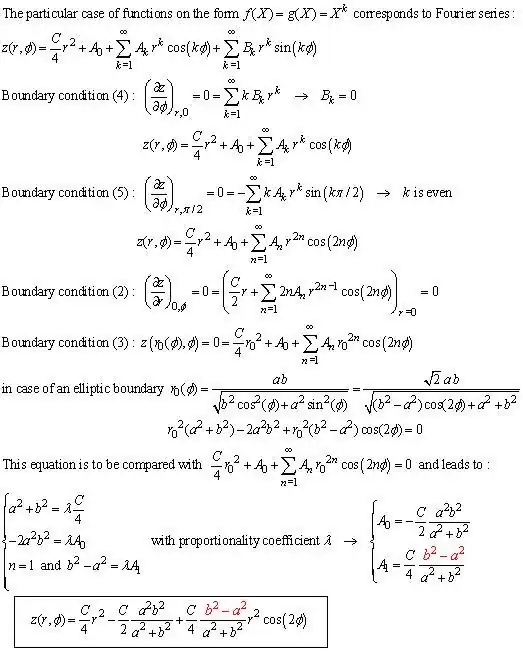
As usual, the arduous part is to determine, among the infinite number of solutions which one fits with the boundary conditions :

enter image description here

JJacquelin
  • 68,401
  • 4
  • 40
  • 91
  • 1
    Wow, Awesome, thanks! Minor correction, you missed a minus sign in $A_1$ i.e. $A_1=\frac{C}{4}\frac{b^2-a^2}{a^2+b^2}$ – Michiel Aug 28 '14 at 20:15
  • You are right. I made the correction. – JJacquelin Aug 28 '14 at 20:51
  • Subtracting out the $r^2/4$ part of the solution seems to have worked like magic! This is a very elegant answer to something I thought had a much more complicated solution. What motivates that substitution apriori? – rajb245 Aug 28 '14 at 23:39
  • @rajb245 I think you have to decide that you want to eliminate $C$ from the pde :) – Bernhard Aug 29 '14 at 06:17
  • @rajb245 : The motivation is to simplify the original PDE and reduce it to an homogeneous PDE. For that, the usual way is to search for a convenient change of function. Of course, it is not always possible. But, it was possible for this kind of PDE. – JJacquelin Aug 29 '14 at 07:21
  • @Bernhard, oh that pesky $C$! It scales everything; I so thoroughly see that as $C=1$ in some suitable choice of units that I forgot it was there. Anyway, great solution! – rajb245 Aug 29 '14 at 21:56