Yes, your group $H$ is finite. You should consider Jyrki's comment (hint: the element $abc$ is central) but it a certain sense it does not matter - I will explain why the group with presentation $\langle a, b, c; a^2, b^3, c^5, abc\rangle$ is finite, which corresponds to the group $G/\langle\langle abc\rangle\rangle$, where $\langle\langle abc\rangle\rangle$ is the normal closure of the element $abc$. If you are wanting $H$ to be a group, then this is the group you are meaning.
To see that $H$ is infinite, note that it is a triangle group. The triple $(2, 3, 5)$ then means that $H$ is finite. So, a triangle group is a group with a presentation of the following form.
$$T_{p, q, r}=\langle a, b, c; a^p, b^q, c^r, abc\rangle$$
Your group has this form. The infinite-ness of the group $T_{p, q, r}$ is determined by the following rules.
The group $T_{p, q, r}$ is finite if and only if $\frac1p+\frac1q+\frac1r>1$. Such groups are called spherical triangle groups.
The group $T_{p, q, r}$ is infinite if $\frac1p+\frac1q+\frac1r=1$. Such groups are called Euclidean triangle groups.
The group $T_{p, q, r}$ is infinite if $\frac1p+\frac1q+\frac1r<1$. Such groups are called Hyperbolic triangle groups.
The names spherical, Euclidean and hyperbolic triangle groups are because these groups act faithfully on surfaces tiles by triangles (with angles $(\pi/p, \pi/q, \pi/r)$), and for spherical triangles groups the surfaces is a sphere, for Euclidean triangle group the tiled surface is the Euclidean plane, while for hyperbolic groups the tiled is the hyperbholic plane. The Euclidean and hyperbolic planes are both infinite, so the corresponding groups are infinite, while spheres have finite area so spherical triangle groups must be finite.
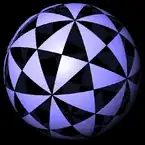
Indeed, your group can be viewed as the group of orientation-preserving symmetries of the following tiling of the sphere (image from wikipedia).