4

Suppose a unit square $X$, with side length $l=1$ as below, which is COVERed by a set $Y$ of circles with the same constant radius of $r=\dfrac{\sqrt{2}}{10}$, where a cover set $Y$ of another set $X$ means, $x\in Y,\forall x\in X$.

Questions are :

1) how to obtain the minimum number $n^*$ of circles in $Y$?

2) And I am also interested in the relationship between the ratio $\eta=\dfrac{r}{l}$ of circle radius to the side length of the square, and the number of circles $n^*$.

enter image description here

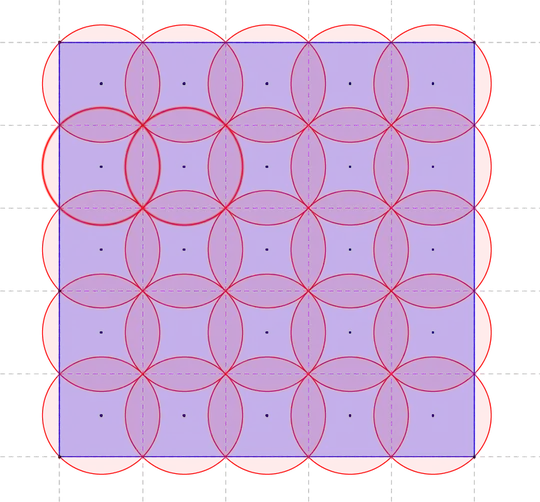
I also guess, if the pattern as above is right, then $n^*=\left\lceil {\dfrac{\sqrt{2}}{2\eta}} \right\rceil^2 $, but don't know how to prove or disprove it. Probably, below is a counter example? enter image description here

MJD
  • 67,568
  • 43
  • 308
  • 617
LCFactorization
  • 2,102
  • 18
  • 23
  • 1
    You should make it clear in the question that you want to find the minimum number of circles of a FIXED radius that can cover a square of fixed side length. Also what have you tried so far? For instance can you offer a geometric argument to claim that a regularly distributed array of circles is the optimal pattern? (like in your figure). – wonko Aug 15 '14 at 15:17
  • I guess for the cover of squares, such a pattern should be the best but have no idea how to prove it; and I think the function $\eta\left(n^\right)$ should be a step function, but I don't know how to prove it either. e.g, $n^ = \text{Ceiling}\left(\dfrac{\sqrt{2}}{2\eta}\right)^2$ – LCFactorization Aug 15 '14 at 23:29
  • 2
    The lower figure suggests a honeycomb arrangement giving the best average coverage over large areas. I suspect that this problem has many different answers depending on the square/circle ratio. With very small circles, you are better off with the honeycomb scheme across the bulk of it, but you will lose some at the edges; so there may be some range of ratios where the best solution is not a grid but doesn't have a large honeycomb area, either. – greggo Aug 16 '14 at 00:16
  • 1
    Possible approach is to find a formula for the grid case, given a ratio; and to find a formula for the honeycomb case, given a ratio; between the two you at least have a decent lower bound for any given ratio. The 'grid rotated 45 degrees' scheme might be a bit better for some ratios too. – greggo Aug 16 '14 at 00:23
  • 1
    This is close to packing problems, which are hard. You could look at packomania to see that for small numbers things go crazy. As you go to large numbers, the hexagonal packing can't be beat, then worry about the boundary. – Ross Millikan Aug 16 '14 at 03:00
  • How does the number of guards required to gaurd a city depend on ho... – Clemens Bartholdy Sep 03 '24 at 06:06

2 Answers2

4

According to Table 1 of following paper by GK Das et al (2006),

$\hspace0.3in$Efficient algorithm for placing a given number of base stations to cover a convex region

the minimum radius for 23 circles to over a unit square is at most $0.14124482238793135951$. Since this is smaller than $\displaystyle\;\frac{\sqrt{2}}{10}$, at most 23 circles is enough.

I have no idea how the configuration for 23 circles look like. However, following is a page which has the configuration of best known covering of a square by up to $12$ equal circles. As your can see, the configuration doesn't seem to follow any obvious pattern. It is highly unlikely that $n^{*}$ has any simple formula.

Update

The configurations in Table 1 are computed in a research notes (Ref 15 in GK Das' paper)

$\hspace0.3in$Covering a square with up to 30 equal circles by K.J. Nurmela, P.R.J. Ostergard

An online copy (in postscript) is available here. It has pictures for configuration up to 30 circles.

Based on above paper, following is one way to cover the unit square with 23 circles of radius $\frac{\sqrt{2}}{10}$. For simplicity of presentation, we will center the unit square at the origin and only show the $8$ circles on the first quadrant.
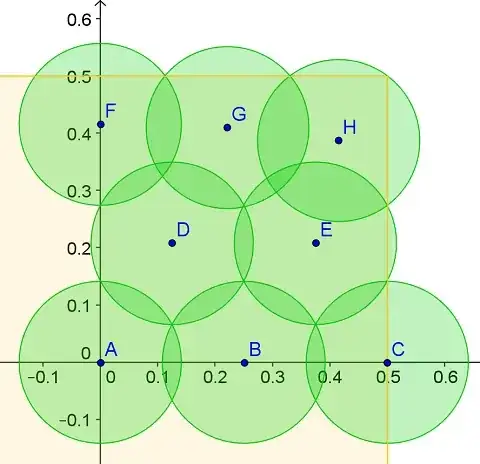
Cover 1/4 square by 8 circles

In this configuration, the centers of the circles are positioned at:

$$\begin{array}{|c:l|} \hline \text{eg.} & (x,y)\\ \hline A, B, C & (0,0), (\pm 0.25,0), (\pm 0.5,0)\\ D, E & (\pm 0.125,\pm 0.20756513901392), (\pm 0.375,\pm0.20756513901392)\\ F & (0, \pm 0.41513027802785)\\ G & (\pm 0.22172066050239,\pm 0.40940831933773)\\ H & (\pm 0.41515845958082,\pm 0.38685446089527)\\ \hline \end{array}$$

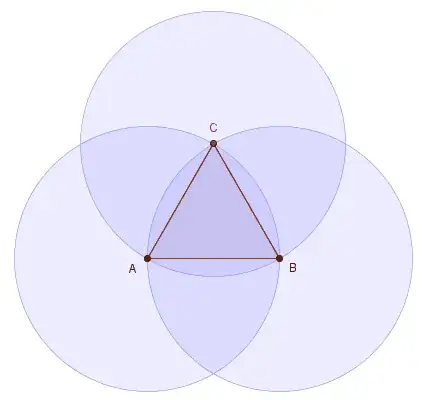
The centers of the middle 3 layers (i.e those in the same layers as $A,B,C,D,E$) are forming a triangular lattice elongated in the vertical direction.
achille hui
  • 125,323
-1

Well just few thoughts for the problem. The formula for dimension $l=ne^d$ the area that covers a circle is $ E=πρ^2$ and for Square is $E=a^2$ so if we try solve this in order to find the radius, then we take the following result this is if you want a constant radius otherwise if you want multiple circles you have to find the sum $ \sum_{i=1}^n ρ_i =\pm a /\sqrt{\pi} $ for interpretation you can use formulas of Gregory and Leibniz or Abraham Sharp

a = value of square side ρ = radius π = 3,14... Ε = Area l = length n = number of shapes d = dimension e = the characteristic value of the shape (radius for circle , side for square)

Ν Κ
  • 1