2

I am trying to find the value of $\displaystyle\int_0^\infty\frac{(\log x)^2}{1 + x^2}\,dx$ using contour integration.

My approach: Contour
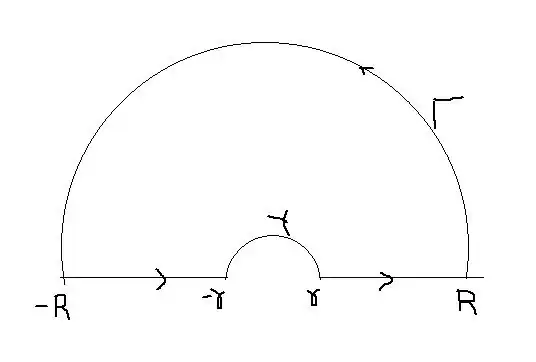
I have calculated the residue at z = $i$ and have shown that integration over small circle is equal to $0$.

However I am having trouble in establishing that $\int_\Gamma f(z) = 0$

The book that I am following states that to show that it is equal to zero it is sufficient to show that $\lim_{z \to \infty} zf(z) = 0$ But if I use this method then the limit tends to $\infty$ and not zero.

Am I applying any wrong concept ?

amWhy
  • 210,739
bhavesh
  • 764
  • 1
    Another way, you may also use a keyhole contour and consider $$ \oint_C\frac{\ln^3z}{1+z^2}dz $$ You'll obtain the integral is equal to $\dfrac{\pi^3}{8}$. – Tunk-Fey Aug 14 '14 at 11:27
  • 1
    Just for your interest, you might want to write the integral as $$\lim_{a \to 0}\frac{d^2}{da^2}\int^\infty_0\frac{x^a}{1+x^2}dx$$ and use Euler's reflection formula. – SuperAbound Aug 14 '14 at 12:53

1 Answers1

2

$\lim_{x \to \infty} xf(x) = \lim_{x \to \infty} \frac{(\log x)^2}{x}$
$ = \lim_{x \to \infty} \frac{2\log(x)\frac{1}{x}}{1}= \lim_{x \to \infty} \frac{2\log(x)}{x}= \lim_{x \to \infty} \frac{2\frac{1}{x}}{1}=0$ (using L'Hospital's rule twice).

ShakesBeer
  • 3,699