6

I'm looking for a non-calculus proof of the statement that $\tan x>x$ on $(0,\pi/2)$, meaning "not using derivatives or integrals." (The calculus proof: if $f(x)=\tan x-x$ then $f'(x)=\sec^2 x-1>0$ so $f$ is increasing, and $f(0)=0$.) $\tan x$ is defined to be $\frac{\sin x}{\cos x}$ where these are defined by their infinite series. What I have so far:

$$|z|\le1\implies\left|\sum_{n=4}^\infty\frac{z^n}{n!}\right|<\sum_{n=0}^\infty\frac{|z|^4}{4!\,5^n}=\frac{5|z|^4}{4\cdot 4!}$$ $$\left|\sin x-\Big(x-\frac{x^3}6\Big)\right|=\Im\left[\sum_{n=4}^\infty\frac{(ix)^n}{n!}\right]<\frac{5x^4}{4\cdot 4!}<\frac{x^3}6$$ $$\left|\cos x-\Big(1-\frac{x^2}2\Big)\right|=\Re\left[\sum_{n=4}^\infty\frac{(ix)^n}{n!}\right]<\frac{5x^4}{4\cdot 4!}<\frac{x^2}6$$

Thus $\sin x>x-\frac{x^3}3$ and $\cos x<1-\frac{x^2}3$, so $\tan x>x$. However, this only covers the region $x\le1$, and I still need to bound $\tan x$ on $(1,\pi/2)$. My best approximation to $\pi$ is the very crude $2<\pi<4$, derived by combining the above bounds with the double angle formulas (note that $\pi$ is defined as the smallest positive root of $\sin x$), so I can't quite finish the proof with a bound like $\sin x>1/\sqrt 2$, $\cos x\le\pi/2-x$ (assuming now $x\ge1\ge\pi/4$) because the bound is too tight. Any ideas?

Jonas Meyer
  • 55,715
  • 4
    The approach looks even more calculus-involved than the other, just saying. – Quang Hoang Jul 29 '14 at 15:55
  • 3
    The following is a geometric (rather than algebraic) 'proof', and so I'll only give it as a comment. Draw a right triangle with base 1 and base angle $x$; it has area $\dfrac{1}{2}\tan x$. One may inscribe a circular arc of radius $1$ and angle $x$ within the triangle; the resulting sector has area $\dfrac{1}{2}x$. Since the sector is within the triangle, the area of the sector must be less than that of the triangle. – Semiclassical Jul 29 '14 at 16:02
  • @QuangHoang I guess I should clarify this "non-calculus" business a bit. I mean "not using derivatives or integrals". Infinite series and sums are fair game. I'd prefer to have some slick manipulation of trig identities, but I can't be too picky until I see a valid approach. – Mario Carneiro Jul 29 '14 at 16:23
  • Any answers that use Maclaurin series expansions for trig functions are using derivatives, are they not? Unless you have purely algebraically defined trig functions by way of those power series. But then what would be the connection between them and the geometric meaning of the trig functions? – 2'5 9'2 Jul 29 '14 at 18:27
  • @alex.jordan Technically, the basic definition here is $e^x$, which is defined as a power series. Taylor's theorem is not proven, but it is known that the series for $e^x$ is convergent everywhere, and that it is continuous and satisfies $e^ae^b=e^{a+b}$. Thus there is no differentiation going on here. The "geometric meaning" of the trig functions is not proven, nor is it even well-formed without a rigorous notion of what geometry is. (This is a formal proof.) – Mario Carneiro Jul 29 '14 at 18:38
  • It's perhaps worth noting that Baby Rudin (aka Principles of Mathematical Analysis) also takes a power-series approach to trig functions, proving properties of the functions "without any appeal to the geometric notion of angle." – Barry Cipra Jul 29 '14 at 18:44
  • How do you define $\tan x$? If you accept a geometric definition, here's a visual proof: http://www.geocities.ws/xpf51/pix/TRIG.jpg . – pppqqq Jul 29 '14 at 20:38
  • @pppqqq As I stated, $\tan x$ is the quotient of $\sin x$ and $\cos x$, where $\sin x:=\sum_{n=0}^\infty(-1)^n\frac{z^{2n+1}}{(2n+1)!}$ and $\cos x:=\sum_{n=0}^\infty(-1)^n\frac{z^{2n}}{(2n)!}$. Visual proofs are not rigorous, and that is my main aim here. – Mario Carneiro Jul 29 '14 at 22:28
  • @MarioCameiro if one can prove the equality beetween the power series definition of $\cos x$, $\sin x$, $\tan x$ and the segments in the picture, the visual proof can easily be made rigorous. As Barry said, in Rudin's book there's a similar approach to the trigonometric functions and the rigorous proof that I'm claiming is practically given. But, as you may expect, this one is ruled out by the “non calculus” requirement. – pppqqq Jul 30 '14 at 12:36
  • power series are based on concept of limit and hence their use is fundamentally within the scope of calculus. In fact the theory of any transcendental function (worthy of some practical use) is non-algebraic in nature and belongs more properly to calculus/analysis. The geometrical definitions of trigonometric functions are also founded on ideas of arc-length and area which are defined using calculus. – Paramanand Singh Apr 20 '16 at 07:47
  • @ParamanandSingh I suppose that's one viewpoint, although I was quite clear in the question what I meant about "non-calculus". Also, keep in mind that from a foundational standpoint, you need either limits or suprema to define the real numbers, so if that's calculus then every statement that uses real or complex numbers is calculus. Limits are a fairly basic technology, while derivative and integral calculus rest on several difficult theorems (like the FTC) which I didn't have when I wrote this post. [...] – Mario Carneiro Apr 22 '16 at 23:38
  • [...] (Luckily, the library has since grown to include differential and integral calculus, so I don't have to ask such a slippery question in the future.) – Mario Carneiro Apr 22 '16 at 23:38

6 Answers6

8

Here is a not-so-original geometric proof.

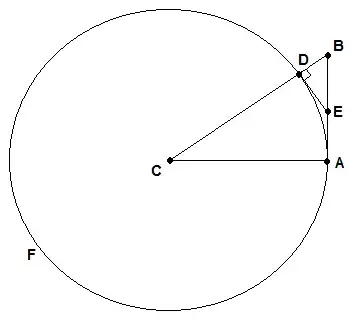
enter image description here

In unit circle $F$, draw $\Delta ABC$ with $C$ at the center of $F$ and $\overline{AB}$ tangent to $F$ at $A$. Let $D$ be a point on $\overline{BC}$ and $E$ be a point on $\overline{AB}$ such that $\overline{DE}$ is tangent to $F$ at $D$. Furthermore, let $\theta=\measuredangle ACB$.

It is clear that $\tan\theta = \lvert\overline{AB}\rvert$ because $\measuredangle CAB = \pi/2$ due to tangency. As well, $\tan\theta=\lvert\overline{AE}\rvert+\lvert\overline{EB}\rvert$, but $\lvert\overline{ED}\rvert\lt\lvert\overline{EB}\rvert$ because $\lvert\overline{EB}\rvert$ is the hypotenuse of $\Delta BDE$. Thus we have $$\tan\theta\gt\lvert\overline{ED}\rvert+\lvert\overline{EA}\rvert$$ From the diagram we see that sector ACD $\subset$ quadrilateral ACDE, and because both are convex sets, the perimeter of sector ACD $\lt$ perimeter ACDE or $$\lvert\overline{AC}\rvert+\lvert\overline{CD}\rvert+\lvert arc\:DA \rvert \lt \lvert\overline{AC}\rvert+\lvert\overline{CD}\rvert + \lvert\overline{DE}\rvert+\lvert\overline{EA}\rvert$$ $$\lvert arc\:DA \rvert \lt \lvert\overline{DE}\rvert+\lvert\overline{EA}\rvert$$ Finally we have $$\theta=\lvert arc\:DA \rvert \lt \lvert\overline{DE}\rvert+\lvert\overline{EA}\rvert\lt\lvert\overline{EA}\rvert+\lvert\overline{EB}\rvert=\tan\theta$$

John Joy
  • 8,060
4

Here is a sketch of what you might be looking for:

Showing $\tan x > x$ is equivalent to showing $\sin x - x \cos x > 0$, since $\cos x > 0$ on $(0,\pi/2$).

The series for $\sin x - x \cos x$ is $\displaystyle\sum_{j=1}^{\infty} \dfrac{(2j)x^{2j+1}}{(2j+1)!} = x^3/3 - x^5/30 + x^7/840 - x^9/45360 \ldots$

Group the terms in pairs: $(x^3/3 - x^5/30) + (x^7/840 - x^9/45360) + \ldots$. If $0 < x < \sqrt{10}$, the first difference is positive. The ratio of the terms in each difference is decreasing, so if the first difference is positive, all the rest are too, and the sum is positive. So $\sin x - x \cos x > 0$ on $0 < x < \sqrt{10}$, which gives you quite a bit of leeway since $\sqrt{10} > \pi/2$. (The first positive solution to $\sin x - x \cos x = 0$ happens at $x \approx 4.493$ according to WolframAlpha.)

KEW
  • 96
  • Wow, that's a bit messier than I would have liked, but it gets the job done. +1 – Mario Carneiro Jul 29 '14 at 16:30
  • If all you're given is the power-series definition of the sine and cosine functions, don't you first need to prove that $\cos x\gt0$ on $(0,\pi/2)$ to make this proof complete? (And won't this be tricky, since $\cos(\pi/2)=0$? Keep in mind, all you know about $\pi$ is that it's the smallest positive number that makes the power series for the sine function equal to $0$.) – Barry Cipra Jul 29 '14 at 17:41
  • @BarryCipra I neglected to mention it, but this is but one in a long series of proofs that verify the usual trigonometric identities, and in particular I know that the addition formulas for sine and cosine hold and $\cos x>0$ on $(0,\pi/2)$, $\cos(\pi/2)=0$ are already proven. It's actually much easier to prove that $\cos x>0$ for $x<\pi/2$ than $\cos x>0$ for $x<3/2$, since the latter contains the bound $3\le\pi$ implicitly. – Mario Carneiro Jul 29 '14 at 17:53
  • @MarioCarneiro, thanks for the clarification! – Barry Cipra Jul 29 '14 at 18:24
4

I'm adding a second answer because the method is very different.

This proof uses the double angle formulas for sine and cosine. From

$$\sin 2x=2\sin x\cos x\qquad\cos2x=2\cos^2x-1$$

we get

$$\tan2x=\frac{\sin2x}{\cos2x}=\frac{2\sin x\cos x}{2\cos^2x-1}>\frac{2x(1-x^2/3)(1-2x^2/3)}{2(1-x^2/3)^2-1},$$

using the bounds $\sin x>x(1-x^2/3)$, $1-2x^2/3<\cos x<1-x^2/3$ derived in the original post. Letting $y=x^2/3$, we have:

\begin{align}\frac{2x(1-y)(1-2y)}{2(1-y)^2-1}>2x&\iff(1-y)(1-2y)>2(1-y)^2-1\\ &\iff1-3y+2y^2>1-4y+2y^2\\ &\iff y>0. \end{align}

Now $y=x^2/3>0$ for $x\ne0$, and the first step is justified when $2(1-y)^2-1>0$, but $0<\cos 2x<2(1-x^2/3)^2-1$ ensures that this is the case, so we can conclude $\tan2x>2x$ for all $x\in(0,1]$ such that $\cos 2x>0$, which is to say, when $2x\in(0,\pi/2)$ (since $\pi/4<1$).

PS: This answer has been successfully turned into a formal proof.

2

(I should have added this as comment but don't have privilege yet)

Just in case OP haven't checked out yet, the infinite series expansion of $tan(x)$ is already available on Wikipedia. Quoting here:

$$tan(x) = x + \frac{1}{3}x^3 + \frac{2}{15}x^5 + \frac{17}{315}x^7 + {...}$$

for $\lvert x \rvert < \frac{\pi}{2}$.

  • This would actually be a proof, if the aforementioned series was actually derived. Unfortunately Wikipedia only cites "Abramowitz; Weisstein" which I assume refer to the handbook by Abramowitz and Stegun, and Eric Weisstein's MathWorld encyclopedia, neither of which generally prove the statements being made. – Mario Carneiro Jul 29 '14 at 19:29
  • @mario-carneiro To spoil the fun, there's a proof on ProofWiki for taylor series expansion, which arrives at the same answer. – Abel Cheung Jul 29 '14 at 19:49
  • Wow, that's complicated. I guess that's to be expected when the Bernoulli numbers get involved. +1 – Mario Carneiro Jul 29 '14 at 20:24
1

Equivalent to showing that $\arctan t<t$.

But $$ \arctan t=t-\frac{t^3}{3}+\frac{t^5}{5}+\cdots =\int_0^t\frac{ds}{1+s^2}<t, $$ for $t>0$.

0

The following is an attempt to transform "the calculus proof" into a non-calculus proof by writing out all the definitions directly.

Fix $a\in(0,\pi/2)$ and let $f(x)=\sin x-x\cos x$ and $g(x)=f(x)-xf(a)/a$. We wish to prove that $f(a)>0$. Let $z$ be an interior extremal point of $g(x)$ in $(0,a)$, which must exist because $g(0)=g(a)=0$ and $[0,a]$ is compact (this is the extreme value theorem). Then

$$\frac{g(z+h)-g(z)}h=\frac{f(z+h)-f(z)}h-\frac{f(a)}a\le0$$

for $h>0$ if $z$ is a maximum, or for $h<0$ if $z$ is a minimum. Now the difference quotient is

$$\frac{f(z+h)-f(z)}h=\\ \cos z\Big(\!\frac{\sin h}h-\cos h\Big)+(\sin z-z\cos z)\frac{1-\cos h}h+\sin z\sin h+z\sin z\frac{\sin h}h.$$

The bounds in the original question are sufficient to prove that the limits $\sin h\to0$, $\cos h\to1$, $\frac{\sin h}h\to1$, and $\frac{1-\cos h}h\to0$ exist as $h\to0$, so the above difference quotient tends to the last term, $z\sin z>0$, and in particular there is an $h$ near $0$ such that the above quotient is greater than zero. (This can also be written explicitly by combining the bounds to find a specific value for $h$.) For this $h$,

$$0<a\frac{f(z+h)-f(z)}h\le f(a).$$

Yes, it's thinly veiled calculus, but the proof itself makes no direct mention of derivatives.