10

Assume the following:
$f_n$ is a sequence of $C^1$ functions on $[0,1]$
$f_n(x) \rightarrow 0$ pointwise.
$f'_n(x) \rightarrow g(x)$ pointwise.

Is it true that $g(x) = 0$ almost everywhere? I think the answer is no, but I'm having trouble with finding a counter-example.

Mark
  • 6,038
  • 1
    Just to state the obvious: it's easy to build examples where $f_n(x)\to 0$, $f'_n(x)\to 1$ (say) almost everywhere (but $f'_n$ will diverge on a null set). The question as stated seems harder. –  Jul 12 '14 at 20:07
  • 2
    If $f_n'$ converges in the sense of distributions, then $g$ must be $0$ almost everywhere. So a counterexample would have to be pretty wild. – Daniel Fischer Jul 12 '14 at 20:37
  • @DanielFischer: I don't understand this comment. The pointwise limit and the limit in $\mathcal D'$ (assuming both exist) can of course be different. In the examples I had in mind, we can easily make $f'_n\to 1$ pointwise a.e. and $f'_n\to 0$ in $\mathcal D'$. –  Jul 12 '14 at 21:35
  • @ChristianRemling I meant "If $f_n' \to g$ in the sense of distributions". (That means that $g$ in particular would be locally integrable. But I guess that a function that is not locally integrable can be justly called "pretty wild".) – Daniel Fischer Jul 12 '14 at 21:42
  • Assuming $F_n\rightarrow 0$ is the sense of distributions and $F_n\rightarrow g$ pointwise, can we conclude anything about $g$? – Jonas Dahlbæk Jul 14 '14 at 10:09
  • The idea is to build a cantor-set-like set $X$ by removings families intervals $F_n$ from $[0,1]$. $F_n$ is a family of intervals, removed at step $n$. Define $g_n=1$ on what remains at step n, $0$ on the union of the intervals of $F_i$ for $i=1,...,n-1$ and $-k_n$ on the intervals of $F_n$ so that $\int_0^x g_n(t)$ is uniformly bounded by a constant $c_n\to 0$. Define $f_n=\int g_n$. By construction $f'_n=g_n$ converges to $g$, the characteristic function of $X$, and $f_n\to 0$. This construction does not work as $g_n$ is not continuous, so one need to fix this, by slightly modifying $g_n$. – user126154 Jul 17 '14 at 16:28

1 Answers1

6

One can show that $\{g=0\}$ is dense:

Suppose $X=\{x\in[0,1]\ :\ g(x)\neq0\}$ has non empty interior.

For $\varepsilon >0$, let $X_n^\varepsilon=\{x\in[0,1]\ :\ f'_m(x)\geq \varepsilon\ \forall m>n\}$, and for $\varepsilon <0$ let $X_n^\varepsilon=\{x\in[0,1]\ :\ f'_m(x)\leq \varepsilon\ \forall m>n\}$

$X_n^\varepsilon$ is closed. Moreover $X\subset \bigcup_{m\in\mathbb Z, m\neq0}\bigcup_nX_n^{1/m}$.

So $\bigcup_m\bigcup_nX_n^{1/m}$ has nonempty interior. As any countable union of closed sets with empty interior has empty interior, there is $\varepsilon$ and $n$ such that $X_n^{\varepsilon}$ has nonempty interior. W.l.g. we can suppose $\varepsilon >0$.

Let $(x,y)$ be an interval contained in $X_n^{\varepsilon}$

We have $$\varepsilon(x-y)=\int_x^y\varepsilon\geq\int_x^yf'_n(x)=f_n(x)-f_n(y)\to 0$$ contradiction.

REMARK: if $f_n'$ where bounded or dominated by an integrable function, then the Lebesgue theorem of dominated convergence applies and we can put the limit inside the integral, so for any $x,y\in[0,1]$ we would have $0=\lim_n(\int_x^yf'_n(t))=\int_x^y\lim_n f'_n(t)=\int_x^yg(t)$ which implies $g=0$ almost everywhere.


COUNTEREXAMPLE:

Here I describe a general conter example via the cantor set construction. The procedure is complicated to describe. I'll describe only the first three steps, hoping that it is clear how to continue. (If one could use the standard cantor set, the construction would be nicer, but the cantor set has zero measure!)

Let's consctruct a cantor-set-like set $X$. We remove from $[0,1]$ a central interval $(a_1,b_1)$, of size $\delta_1$. Then we remove two intervals $(a^0_2,b^0_2)$, central in $[0,a_1]$ and $(a^1_2,b^1_2)$ central in $[b_1,1]$, both of the same size $\delta_2$. We go on like in the construction of the cantor set. We choose the sizes $\delta_i$ so that the total measure of the remove parts in the proces is $1/2$, so that the remaining set $X$ will have measure $1/2$.

We describe now the functions $g_n=f'_n$ and define $f_n(x)=\int_0^xg_n(t)$.

The functions $g_n$ will be piecewise linear.

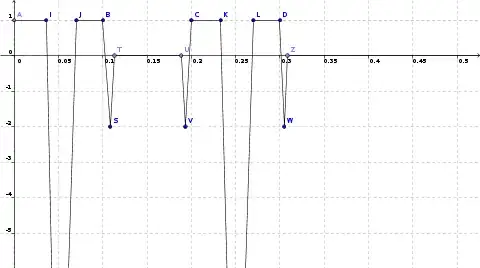
CONSTRUCTION of $g_1$. (see also the picture below)

$g_1(x)=1$ for $x\in[0,a_1]$. Then in $[a_1,1/2]$ define $g_1$ so that it is linear and $\int_0^{1/2} g_1(t)=0$. Finally, on $[1/2,1]$ defines $g_1$ symmetrically by imposing $g_1(x)=g_1(1-x)$.

CONSTRUCTION of $g_2$. (see also the picture below)

We modify $g_1$ as follows:

On $[0,a_1]$ we define $g_2$ so that $g_2(x)=1$ for $x\in[0,a^0_2]$ and $[b^0_2,a_1]$. On $[a^0_2,b^0_2]$ extends $g_2$ so that $\int_0^{a_1}g_2(t)=0$.

On $[a_1,1/2]$ we set $g_2(a_1)=1$, $g_2(a_1+\epsilon_2)=0$ and we extentd by a piecewise linear function so that $\int_{a_1}^{a_1+\epsilon_2}g_2(t)=0$ and so that $|g_2(t)|<10\epsilon_2$ on $[a_1,a_1+\epsilon_2]$

Finally, on $[1/2,1]$ we define $g_2$ symmetrically by imposing $g_2(x)=g_2(1-x)$.

Note that

1) $f_1=\int g_1$ is bounded by $(1-\delta_1)/2$, $\int_0^1 f_1=0$.

2) $f_2=\int g_2$ is bounded by $(\frac{1-\delta_1}{2}-\delta_2)/2<1/4$ on $[0,a^0_2],[b^0_2,a_1],[b_1,a_2^1]$, and $[b_2^1,1]$; $\int_0^{a_1}g_2=\int_0^1f_2=0$ and $f_2=0$ on $[a_1+\epsilon_2,b_1-\epsilon_2]$, and on $[a_1,a_1+\epsilon_2]$ is bounded by a constant dependint on $\epsilon_2$.

CONSTRUCTION OF $g_3$

On $[a_1,b_1]$ we just change $\epsilon_2$ with a smaller $\epsilon_3$

On the other intervals we do the same changes we did for passing from $g_1$ to $g_2$.

This construction leads to $f_n$ which is uniformly bounded by $(1/2)^2$ and a constant depending on $\epsilon_n$, which goes to zero.

on $X$, which is the complement of the removed intervals $g_n=1$ for al $n$. On the intervals removed $g_n(x)\to 0$ because we choose $\epsilon_n\to 0$.

In particular $g_n$ has a point wise limit which is the characteristic fucntion of $X$. None theless $g_n$ is not uniformly bounded because each $g_n$ has pieces where it is extremely negative (such pieces are tamed at time $n+1$) due to the fact that we require $\int g_n=0$ on intervals $[0,a_n^i]$.

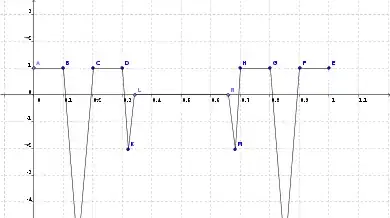
Here some very rude graphics of $g_1$, $g_2$, and $g_3$ (note that the third picture is the graphic of $g_3$ zoomed at the interval $[0,1/2]$, so it is "half" of $g_3$)

the first function $g_1$

the second function $g_2$

the third fucntion $g_3$

user126154
  • 7,649
  • 1
    You don't really know if ${g>0}$ has non-empty interior, but this is easy to fix by considering ${g\not= 0}$ instead and redefining $X_n^{\epsilon}$ by the condition $|f'_m|\ge\epsilon$. Also, in the next paragraph, you're applying Baire's theorem (of course, you can't make a claim about arbitrary unions). –  Jul 16 '14 at 20:56
  • yes sure, the case $g<0$ is symmetric, i'll edit – user126154 Jul 16 '14 at 21:28
  • The density of ${g=0}$ is immediate from Mean Value Theorem. Fix a subinterval $[a,b]$. For every $n$, there is a point $x_n\in [a,b]$ such that $f_n'(x_n) = (f_n(b)-f_n(a))/(b-a)\to 0$. Take a convergent subsequence of $x_n$; at its limit $g=0$. –  Jul 17 '14 at 00:14
  • @Thisismuchhealthier. I'm not totally convinced by this, as $\lim h_n(x_n)$ can easily be different from $\lim h_n(x)$ for a sequence $h_n$ that converges pointwise, but not uniformly. –  Jul 17 '14 at 00:56
  • @ChristianRemling Ah, that's right, the MVT approach does not work. –  Jul 17 '14 at 01:04
  • I'm having a hard time picturing this construction. Would you draw a picture of the first and second step? And for the first step you wanted $\int_0^{\frac{1}{2}} g_1(t)=0$ right? (the upper bound should be 1/2 instead of 1, in the construction, because the other half is determined by reflection.) – Mark Jul 17 '14 at 20:01
  • @mark I know, it is difficult without pictures, also I think the construction is correct, but I don't sell it as 100% correct... – user126154 Jul 17 '14 at 20:25
  • Let's suppose to do the same construction for the cantor set K. For K you remove at step n, each middle trird of any interval remained after step $n-1$. Now define $g_n$ in this case as $g_n(x)=1$ for what remains at the step n, $g_n(x)=-2$ in the intervals removed at the step n, $g_n(x)=0$ in the intervals removed till step n-2. $g_n$ has the property that $\int_0^xg_n(t)dt$ is bounded $(1/3)^n$ and also that $\int g_n=0$ one each interval of the step $n-1$. Finally $g_n(x)=0$ on the interval removed till step $n-2$. – user126154 Jul 17 '14 at 20:31
  • Now you have two issues: 1) $g_n$ is not continuous, and 2) the cantor set has zero measure. You fix 1) by hands at any step and 2) by changing the intevals removed to construct $K$. – user126154 Jul 17 '14 at 20:32
  • Still a little confused. How did you define the $\epsilon$? – Mark Jul 18 '14 at 06:24
  • $\epsilon_n$ is just a sequence going to zero, once you can chose the sequence of sizes $\delta_n$ (that goes monotonically to zero) it is enough to choose $\epsilon_n<\delta_{n-1}/2$ – user126154 Jul 18 '14 at 08:15
  • The pictures really helped. I think I see the gist of your construction now. – Mark Jul 18 '14 at 19:31
  • At every step, almost all the "wells" get filled in so that the wells converge to $0$. At each step, two wells appear to suppress the integral so that it remains 0. – Mark Jul 18 '14 at 19:40
  • Oh sorry my bounty expired before I was able to completely verify. I should have selected your answer and it seems they automatically gave you half. Sorry about that! – Mark Jul 18 '14 at 19:58
  • @Mark no prob with that, I'm happy that my answer resulted useful! – user126154 Jul 19 '14 at 13:43
  • @Mark, and I also learne how to produce and include in answers some pictures :) – user126154 Jul 19 '14 at 13:44