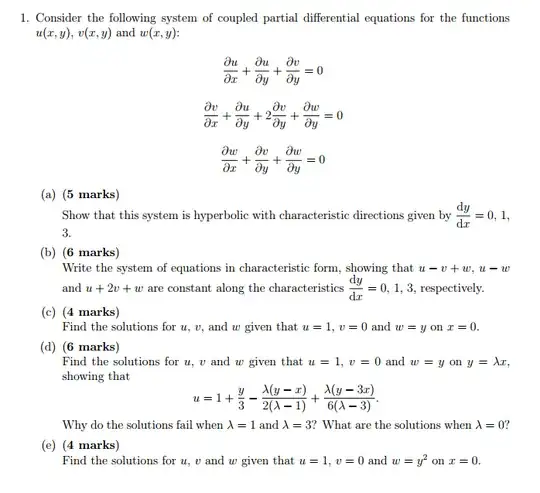
The solution is done in two steps.
First, diagonalise the linear system. We denote by $\mathbf{U}=[u;v;w].$ The original system becomes
$$\partial_x\mathbf{U}+M\partial_y\mathbf{U}=0,$$ where
$$
M=\begin{pmatrix}
1 & 1 & 0\\
1 & 2 & 1\\
0 & 1 & 1
\end{pmatrix}.
$$
We first diagonalise $M.$ We have (using Wolfram Alpha)
$$
M=S\,J\,S^{-1},
$$
where
$$
S = \begin{pmatrix}
1 & -1 & 1\\
-1 & 0 & 2\\
1 & 1 & 1
\end{pmatrix},
$$
$$
S^{-1} = \begin{pmatrix}
\frac{1}{3} & -\frac{1}{3} & \frac{1}{3}\\
-\frac{1}{2} & 0 & \frac{1}{2}\\
\frac{1}{6} & \frac{1}{3} & \frac{1}{6},
\end{pmatrix}
$$
$$
J = \mathrm{diag}(0,1,3).
$$
We denote by $\widetilde{\mathbf{U}}=S^{-1}\mathbf{U}.$ Then, the linear system becomes
$$
\partial_x\widetilde{\mathbf{U}} + J\partial_y\widetilde{\mathbf{U}} = 0,
$$
which consists of three independent scalar equations
$$
\begin{aligned}
\partial_x\widetilde{u} &= 0,\\
\partial_x\widetilde{v} + \partial_y\widetilde{v} &= 0,\\
\partial_x\widetilde{w} + 3\partial_y\widetilde{w} &= 0.
\end{aligned}
$$
The initial condition $\mathbf{U}(0)$ gives $\widetilde{\mathbf{U}}(0)=S^{-1}\mathbf{U}(0).$ In the case of (c),
$$
\begin{aligned}
&\left\{
\begin{aligned}
&\partial_x\tilde{u}=0,\\
&\tilde{u}(0,y)=\frac{1}{3}(1+y),
\end{aligned}
\right.
&\left\{
\begin{aligned}
&\partial_x\tilde{v}+\partial_y\tilde{v}=0,\\
&\tilde{v}(0,y)=\frac{1}{2}(-1+y),
\end{aligned}
\right.
&\left\{
\begin{aligned}
&\partial_x\tilde{w}+3\partial_y\tilde{w}=0,\\
&\tilde{w}(0,y)=\frac{1}{6}(1+y).
\end{aligned}
\right.
\end{aligned}
$$
Second step, we solve them independently,
$$
\begin{aligned}
&\tilde{u}(x,y)\equiv\tilde{u}(0,y)=\frac{1}{3}(1+y),\\
&\tilde{v}(x,y)=\tilde{v}(x,x+c)\equiv\tilde{v}(0,c)=\frac{1}{2}(-1+c)=\frac{1}{2}(-1+y-x),\\
&\tilde{w}(x,y)=\tilde{w}(x,3x+c)\equiv\tilde{w}(0,c)=\frac{1}{6}(1+c)=\frac{1}{6}(1+y-3x).
\end{aligned}
$$
Finally, we use $\mathbf{U}=S\,\tilde{\mathbf{U}}$ to obtain
$$
\begin{pmatrix}
u\\v\\w
\end{pmatrix}
=
\begin{pmatrix}
1 & -1 & 1\\
-1 & 0 & 2\\
1 & 1 & 1
\end{pmatrix}
\begin{pmatrix}
\tilde{u}\\\tilde{v}\\\tilde{w}
\end{pmatrix}
=\begin{pmatrix}
1 \\ -x\\ y
\end{pmatrix}.
$$