3

I'm reading an ACL 2014 paper: Lei, Tao, et al. "Low-Rank Tensors for Scoring Dependency Structures.", ACL 2014.

It defines the Kruskal form of a tensor as a sum of Kronecker products:

enter image description here

However, http://www.ima.umn.edu/industrial/2006-2007/kolda/kolda.pdf defines the Kruskal form of a tensor as a sum of outer products:
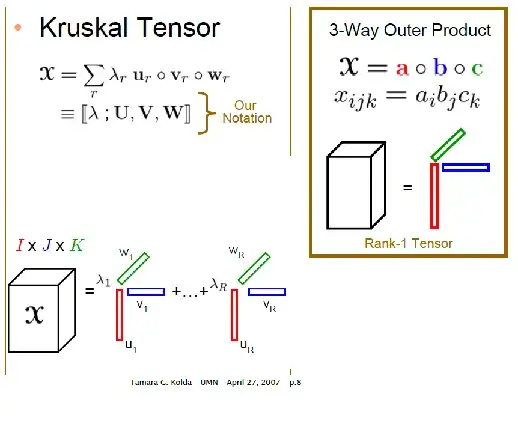
enter image description here

So should the Kruskal form of a tensor be defined as a sum of outer or Kronecker products?

remind
  • 383
  • They're the same thing. – Qiaochu Yuan May 16 '14 at 16:25
  • http://math.stackexchange.com/q/796709/150385 says a Kronecker product of 2 vectors outputs a vector, while an outer product of 2 vectors outputs returns a matrix. Also, in the slides I pointed to the question (http://www.ima.umn.edu/industrial/2006-2007/kolda/kolda.pdf) they use a different notation for outer and for Kronecker. – remind May 16 '14 at 16:26
  • Okay, fine, they're slightly different. As long as you're doing operations on vectors and matrices the difference is not very serious. – Qiaochu Yuan May 16 '14 at 16:31
  • Thanks, so should the ACL paper have used outer product instead of Kronecker? No intent to be picky, it's just to have everything clear in my head :) – remind May 16 '14 at 16:36
  • The outer product is a special case of a Kronecker product, which should make things clear in this context. See http://en.wikipedia.org/wiki/Kronecker_product. – jhclark Jul 16 '14 at 04:38

1 Answers1

1

The former is using $\otimes$ as an outer product, not a kronecker product. However there is a nice relationship between outer products and kronecker products. That is, if we define tensor vectorization in reverse lexicographic ordering (so that we have no inconsistencies with regular matrix vectorization) and we denote the vector outer product using $\circ$, then

$ vec \big( \circ_{i=1}^p \mathbf{a}_{i} \big) =\bigotimes_{i=p}^1 \mathbf{a}_i $, where $\mathbf{a}_1,..., \mathbf{a}_p $ are vectors of any size.

So you could define the kruskal tensor using the kronecker product, but only via its vectorization.

Car Loz
  • 250