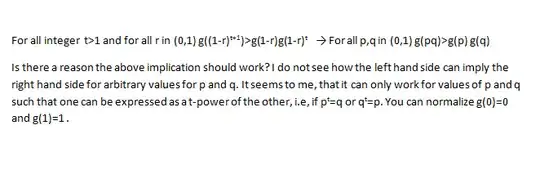
I have been stuck with the following puzzle for some time. I could not prove it, nor could I find a counter example. I would be grateful to get some help on this.
Asked
Active
Viewed 199 times
1

Juanito
- 11
-
2What is this function g? – Sandeep Silwal May 01 '14 at 01:51
2 Answers
1
The implication is wrong.
I'll assume $g$ is supposed to be a continuous function from $(0,1)$ to $(0,\infty)$.
Try
$$ g(s) = \exp\left({\ln^2(s) (4 + \cos(-\pi \ln s))}\right)$$
Note that since $-1 \le \cos(-\pi \ln s) \le 1$,
$$\exp({3 \ln^2(s)}) \le g(s) \le \exp({5 \ln^2(s)})$$ Now (taking $s = 1 - r$)
$$g(s^{t+1}) \ge \exp({3 \ln^2(s^{t+1})}) = \exp({3 (t+1)^2 \ln^2(s)})$$
while
$$ g(s)^{t+1} \le \left(\exp({5 \ln^2(s)})\right)^{t+1} = \exp({5 (t+1) \ln^2(s)})$$
and since $5 (t+1) < 3 (t+1)^2$ for all $t \ge 1$ we have
$$g(s^{t+1}) > g(s)^{t+1}$$
On the other hand, taking $p = \exp(-4)$ and $q = \exp(-1)$ we have
$$g(pq) = g(\exp(-5)) = \exp(75) < \exp(83) = g(p) g(q)$$

Robert Israel
- 470,583
-
I think you're supposed to prove the statement after the arrow given the left. I may be wrong. – Flowers May 01 '14 at 03:01
-
-
-
0
first of all, thank you all for your answers, specially @Robert. I think I was not clear in my question, and perhaps using a couple more of parenthesis would have made it more clear. I tried to rewrite the question on this page, but the admin asked me to remove and repost the question, hence, I reposted the question here: A unsolved puzzle from Number Theory/ Functional inequalities. I would love to get your comments on the question.

