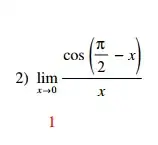
Are you familiar with indeterminate forms? Sure, if your limit looks like $\frac{k}{0}$ and $k \ne 0$ then you're going to have an infinite limit, but if the functions on the top and bottom both tend to zero then you need to do more work (e.g. applying L'Hôpital's rule before you can determine the limit. And sure enough, $\lim_{x \to 0} \cos (\frac{\pi}{2} - x) = 0$.
– Clive NewsteadApr 30 '14 at 05:22
I'm not sure because the name of the worksheet I was doing was Limits at Removable Discontinuities using trig, from AB calc
– chrissy kwonApr 30 '14 at 05:30
1 Answers1
1
well, $$ \cos( \frac{\pi}{2} - x ) = \sin( \frac{\pi}{2} - \frac{\pi}{2} + x ) = \sin x $$.