11

First of all, I am aware of the question in How to embed Klein Bottle into $R^4$ , which was inconclusive. Anyway, I've made some progress, but I still have a question.

I am using Do Carmo's Riemannian Geometry, and struggling to solve a problem.

The problem is:

Show that the mapping $G:\mathbb{R}^2\to\mathbb{R}^4$ given by

$$G(x,y)=((r\cos (2\pi y)+a)\cos (4\pi x),(r\cos (2\pi y)+a)\sin (4\pi x),r\sin (2\pi y)\cos (2\pi x),r\sin (2\pi y)\sin (2\pi x)))$$

induces an embedding of the Klein bottle into $\mathbb{R}^4$ (It is a slightly different function from the one in the book, but works in the same way).

First of all, it's not hard to see that $$G(x+n,y+m)=G(x,y)\text{ whenever }m,n\in\mathbb{Z}.$$ Therefore, this mapping is well-defined over the torus $\mathbb{T}^2$. What I need now is to show that $G(-x,-y)=G(A(x,y))=G(x,y)$, where $A$ is the antipode mapping. If this were true, then the mapping G would be well-defined over the Klein Bottle, but it's obvious that this is false.

Am I working wrong here somewhere?

Marra
  • 5,039
  • There's fundamentally a problem with $A$: it doesn't reverse orientation, so the quotient space associated to it is still orientable (whereas the Klein bottle isn't). You can try and see if $G$ is invariant under the map $(x,y)\mapsto (x,-y)$ or $(x,y)\mapsto (-x,y+\frac12)$. – Olivier Bégassat Apr 18 '14 at 15:06
  • But what would that mean? Does the quotient of the torus over the action of this map is equal to the Klein Bottle? – Marra Apr 18 '14 at 15:08
  • What map are you talking about? Also, you should add @myname in front of your question if you want me to be notified. (Although I was still notified for some reason, how did that happen???) – Olivier Bégassat Apr 18 '14 at 15:10
  • @OlivierBégassat Sorry about that. I was asking if the quotient of the torus over the action of the map $(x,y)\mapsto (x,-y)$ equals the Klein Bottle? – Marra Apr 18 '14 at 15:12
  • 1
    Sorry, the first map I wrote is wrong, I meant $(x,y)\mapsto(x+\frac12,-y)$. I think the one that is likely to work is $(x,y)\mapsto(x+\frac12,-y)$. – Olivier Bégassat Apr 18 '14 at 15:13
  • @OlivierBégassat Right, but the question remains, that is, this maps acts noncontinuously over the torus, and I don't know if the quotient space is equal to the Klein Bottle. If this is true, then G is well defined over the Klein Bottle and everything's fine. – Marra Apr 18 '14 at 15:16
  • It is. I'm interested, how does Do Carmo define the Klein bottle? – Olivier Bégassat Apr 18 '14 at 15:17
  • @OlivierBégassat See http://books.google.com.br/books?id=ct91XCWkWEUC&printsec=frontcover&hl=pt-BR&source=gbs_atb#v=onepage&q&f=false at page 25, example 4.9 (b). It refers to example 4.8 to build quotient manifolds (over discontinuous actions of groups), which is also in this preview.

    But he uses the Antipode mapping $A$ and the isomorphism group ${ Id, A}$ to obtain the Klein Bottle from the Torus, and it wasn't working

    – Marra Apr 18 '14 at 15:34
  • It's not the antipode you are using. When he applies the antipode of $\Bbb R^3$ to a point of the torus of revolution, one of the circle coordinates, the "horizontal" one, if you see the tours as a vertical circle being rotated along the horizontal circle $C=\lbrace(x,y,z)\mid z=0\text{ and }x^2+y^2=1\rbrace$) is shifted by 180° (which corresponds to the $x\mapsto x+\frac12$) while the second circle coordinate is being "complex conjugated" (which corresponds to the $y\mapsto-y$). – Olivier Bégassat Apr 18 '14 at 16:01
  • Great, I'll check this right now @OlivierBégassat. You might want to elaborate that as an answer so I can give you credit for the answer. Thanks for the help! – Marra Apr 18 '14 at 17:02

2 Answers2

13

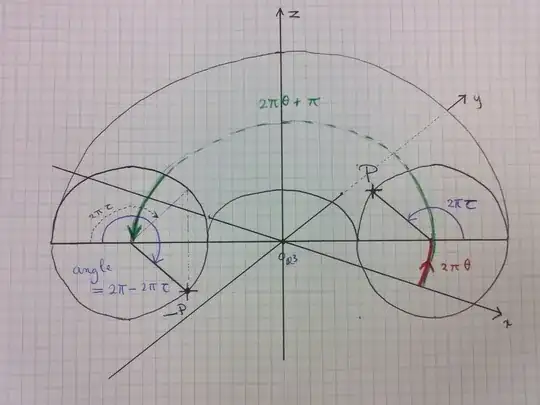
screenshot Consider the embedding $\psi:\Bbb R\times\Bbb R\big/{\Bbb Z\times\Bbb Z}\hookrightarrow\Bbb R^3$ $$\psi([\theta, \tau])= \begin{pmatrix} \cos(2\pi\theta) &-\sin(2\pi\theta) & 0\\ \sin(2\pi\theta) &\cos(2\pi\theta) & 0\\ 0&0&1 \end{pmatrix} \begin{pmatrix} 2+\cos(2\pi\tau)\\ 0\\ \sin(2\pi\tau) \end{pmatrix}$$ Then one verifies (on the picture and then by doing the math) that $-\psi([\theta, \tau])=\psi([\theta+\frac12, -\tau])$

Thus the Klein bottle is the quotient of $\Bbb R\times \Bbb R$ by the (non-commutative) group $H=\langle v,t\rangle$ of homeomorphisms generated by the vertical displacement by one $$v(\theta, \tau)=(\theta, \tau + 1)$$ and a twist $$t(\theta, \tau)=(\theta+\frac12, -\tau).$$ Notice that $t^2=h$ the horizontal displacement by one $h(\theta, \tau)=(\theta + 1, \tau)$.

You'll verify that $G(v(\theta, \tau))=G(\theta, \tau)=G(t(\theta, \tau))$, so $G$ descends to a map $\tilde{G}:K\to \Bbb R^4$. $\tilde{G}$ is an injective (easy verification) immersion ($G$ already was). By compactness of $K$, it is an embedding.

0

This is not a separate answer, but a long comment to Olivier Bégasset's answer.

Just for sake of completeness, let us give here the elementary proof that the map $\tilde{G}$ defined in the answer given by Olivier Bégasset is actually injective. Assume that $(x,y), (\bar{x},\bar{y}) \in \mathbb{R}^2$ are such that \begin{cases} (r\cos (2\pi y)+a)\cos (4\pi x)=(r\cos (2\pi \bar{y})+a)\cos (4\pi \bar{x}) \\ (r\cos (2\pi y)+a)\sin (4\pi x)=(r\cos (2\pi \bar{y})+a)\sin (4\pi \bar{x}) \\ r\sin (2\pi y)\cos (2\pi x)=r\sin (2\pi \bar{y})\cos (2\pi \bar{x})\\ r\sin (2\pi y)\sin (2\pi x)=r\sin (2\pi \bar{y})\sin (2\pi \bar{x}). \end{cases} By squaring the two members of the first two equations and summing up, you get \begin{equation} (r\cos (2\pi y)+a)^2=(r\cos (2\pi \bar{y})+a)^2, \end{equation} while by squaring the two members of the last two equations and summing up, you get \begin{equation} \sin^2(2\pi y)=\sin^2(2\pi \bar{y}). \end{equation} From the last two equations you easily get $$ (I) \qquad \cos(2 \pi y)= \cos (2\pi \bar{y}). $$ If we use (I) in the first two equations of the system, we get $$ x=\bar{x}+\frac{m}{2}, \qquad (m \in \mathbb{Z}). $$ Now, if $m$ is even, from the last two equations of the system we get $$ (II) \qquad \sin(2 \pi y)= \sin (2\pi \bar{y}), $$ so that from (I) and (II) we deduce that $y=\bar{y}+n$, with $n \in \mathbb{Z}$, hence $(x,y)$ and $(\bar{x},\bar{y})$ belong to the same H-orbit. If insted $m$ is odd, from the last two equations of the system we get $$ (III) \qquad \sin(2 \pi y)= -\sin (2\pi \bar{y}), $$ so that from (I) and (III) we deduce that $y=n-\bar{y}$, with $n \in \mathbb{Z}$, and again $(x,y)$ and $(\bar{x},\bar{y})$ belong to the same H-orbit.