4

I think I have this one, but I want to make sure:

Using Van Kampen's theorem,

Find the fundamental group of two disjoint spheres with each north pole identified, and each south pole identified.

The open sets I chose are sphere 1 minus the north pole, sphere 2 minus the south pole. The intersection is nonempty with trivial fundamental group since poles are identified, so we get trivial*trivial=trivial. Correct?

Stefan Hamcke
  • 28,621
Johnny Apple
  • 4,571
  • Those sets are not open. – Mariano Suárez-Álvarez Apr 07 '14 at 16:11
  • Moreover, to apply the Seifert-van Kampen theorem, the intersection of the two open sets must be path-connected. – Mariano Suárez-Álvarez Apr 07 '14 at 16:13
  • Do you have any suggestions on the open sets? – Johnny Apple Apr 07 '14 at 16:15
  • I suggest you play around with this for a while, trying all sorts of open sets :-) – Mariano Suárez-Álvarez Apr 07 '14 at 16:17
  • Well, why is the sphere minus a point not open? – Johnny Apple Apr 07 '14 at 16:18
  • Because you can easily construct a sequence in the other sphere converging to the other pole. – Mariano Suárez-Álvarez Apr 07 '14 at 16:19
  • @MarianoSuárez-Alvarez I think he means to delete the north and south poles after he has identified them together. This would result in open sets. – J126 Apr 07 '14 at 16:26
  • That is what I mean. However, the intersection is not path connected still. – Johnny Apple Apr 07 '14 at 16:27
  • Well, I've got no idea. That seems like the canonical guess for the two open sets, and it doesn't work. Need a hint. – Johnny Apple Apr 07 '14 at 16:33
  • @JoeJohnson126, he wrote «The open sets I chose are sphere 1 minus the north pole, sphere 2 minus the south pole». – Mariano Suárez-Álvarez Apr 07 '14 at 18:41
  • @MarianoSuárez-Alvarez I know what he wrote. But, there is still a very good notion of sphere $1$ and sphere $2$ after they have been identified. And there is still a north pole and south pole after the identification. So, he may have meant take the image of sphere $1$ in the identification minus the (shared) north pole. His reply to my comment seems to indicate that is what he meant. In short, I think he didn't write exactly what he meant. – J126 Apr 07 '14 at 18:48
  • @JohnnyApple, can you please edit the question to make it clear what sets you intend to take? – Mariano Suárez-Álvarez Apr 07 '14 at 19:02
  • 1
    @JoeJohnson126, indeed, there is a well good notion of sphere 1 and sphere 2 after the poles have been identified, and according to the obvious one, «the sphere 1 minus the north pole» is not an open set in the total thing! I am not being dense on purpose, I am trying to get the question to be clear and, to boot, to show the OP where the problem was. Learning to write what one means is an important step in everything. – Mariano Suárez-Álvarez Apr 07 '14 at 19:04
  • See this answer for the universal cover of your space. From the group action described in that answer, it follows that the fundamental group is $\Bbb Z$. – Ayman Hourieh Apr 07 '14 at 19:05

4 Answers4

5

Let $X$ be your space. Another possibility, not using van Kampen theorem (explicitely), is to glue a 3-cell inside each sphere. Because the fundamental group depends only on the 2-skeleton, $\pi_1(X)$ is isomorphic to the fundamental group of our new space $\tilde{X}$. Now, $\tilde{X}$ clearly retracts by deformation on a circle, hence $$\pi_1(X) \simeq \pi_1(\tilde{X}) \simeq \pi_1(\mathbb{S}^1) \simeq \mathbb{Z}.$$

Seirios
  • 34,083
  • That follows from $\pi_2(e^3\cup_\phi X,X,x_0)$ and $\pi_1(e^3\cup_\phi X,X,x_0)$ being $0$ in the exact sequence for relative homotopy groups, right? – Stefan Hamcke Apr 08 '14 at 14:17
  • I don't understand your question: what is the fact you want to justify? (by the way, I don't know the relative homotopy groups, so the answer to your question is probably more elementary) – Seirios Apr 08 '14 at 14:40
  • I'm just delving into higher homotopy groups, and came across the fact that $\pi_r(e^n\cup_\phi X, X, x_0)=0$ for $r<n$, where $e^n\cup_\phi X$ means "glue an $n$-ball to $X$ along its boundary". If we set these terms to $0$ for $n=3, r=1,2$ in the exact sequence of relative homotopy groups, we obtain an isomorphism $\pi_1(X,x_0)\to\pi_1(e^3\cup X,x_0)$. Maybe there is a more elementary proof that the fundamental groups doesn't change upon attaching a 3-cell. – Stefan Hamcke Apr 08 '14 at 14:51
  • It is a general fact, described in Massey's book for instance. I do not remember the argument, but I think it is elementary. – Seirios Apr 08 '14 at 21:29
1

Denote the two spheres by $S_1,S_2$. Let $$A_i=S_i\cap\{(x,y,z)\mid y>-0.1\},\qquad B_i=S_i\cap\{(x,y,z)\mid y<0.1\}\\ A=(A_1\sqcup A_2)/\sim,\qquad B=(B_1\sqcup B_2)/\sim$$ $A, B$ are subspaces of $X$, and their intersection is homotopy equivalent to a $$\Huge\Bbb O$$ Let us denote the four edges pointing downwards by $a,b,c,d$ left to right. Then $\pi_1(\Bbb O,N)$ is generated by $b^{-1}a,\ c^{-1}b,\ d^{-1}c$.
Let $γ_A,γ_B$ denote the class of $c^{-1}b$ in $\pi_1(A,N),π_1(B,N)$ respectively.

$A$ and $B$ can be thought of each as two disks with their north poles glued together and their south poles glued together. The fundamental group $π_1(A,N)$ is generated by $γ_A$, and $π_1(B,N)$ is generated by $γ_B$

Applying van Kampen we see that $π_1(X,N)$ is the free product $\pi_1(A,N)*\pi_1(B,N)$ modulo the smallest normal subgroup containing $γ_A^{-1}γ_B$. $$π_1(X,N) = \langle γ_A,γ_B \mid γ_A^{-1}γ_B \rangle \cong \Bbb Z$$

In order to see that $⟨a,b ∣ a^{−1}b⟩\cong \Bbb Z$, we consider the homomorphism $$\phi: ⟨a,b⟩ \to \Bbb Z,\quad a,b\mapsto 1$$ So $ϕ$ sends a word to the sum of the exponents appearing in it. Since $ϕ(a^{-1}b)=0$, the normal subgroup $N$ is in ker$(ϕ)$ and we have an induced morphism $\barϕ:⟨a,b ∣ a^{−1}b⟩\to \Bbb Z$. This $\barϕ$ is an isomorphisms if the kernel of $ϕ$ is precisely $N$. In practice this means we have to show that if some word represents $0$ in $\Bbb Z$, then it can be turned into the empty word by applying the relation $a=b$.

Stefan Hamcke
  • 28,621
  • Unique answer. Love it. – Johnny Apple Apr 08 '14 at 16:24
  • Could you explain the last step a bit? So, the fundamental group of both A and B are trivial. So we take a trivial fundamental group mod these relations and get Z? I'm a bit confused. Also, what does your notation mean in the brackets? Gamma 1 times gamma 2 inverse equals identity? – Johnny Apple Apr 08 '14 at 18:29
  • @JohnnyApple: It should read $γ_A,γ_B$, I edited it. The term $⟨ab∣a^{−1}b⟩$ means "the group freely generated by $a,b$ modulo the smallest normal subgroup containing $a^{-1}b$". The elements to the left are called generator, the elements to the right (which must be words in the free group on those generators) are called relators. Intuitively $⟨ab∣a^{−1}b⟩$ is the group which is "as free as possible" while at the same time satisfying the relation $a^{-1}b=1$ or, equivalently, $a=b$. – Stefan Hamcke Apr 08 '14 at 23:33
  • What is the easiest way to see that this is $\Bbb Z$? Also, doesn't Van Kampen's theorem tell us that ALL relations on the intersection must hold, such as $c$=$d$, and $b$=$c$? – Johnny Apple Apr 09 '14 at 02:34
  • @JohnnyApple: Note that $b^{-1}a$ and $d^{-1}c$ are loops that can be contracted in $A$ and $B$, so they can be ignored. See my edit for the isomorphism with $Z$. – Stefan Hamcke Apr 09 '14 at 14:29
0

You may also try by collapsing a segment from the north pole to the south pole in one of the sphere, thus obtaining the wedge sum of a sphere (call it $S$) with a sphere with the two poles indentified (call it $T$), and this space you have obtained is homotopy equivalent to the former (essentially this is due to the fact that a segment is contractible). Now, since the basepoint (the point in which the glueing happens) has contractible neighbourhoods in both space, the fundamental group of your space is the coproduct of the fundamental group of $S$ and $T$, which is easily computable as being $\mathbb{Z}$.

-1

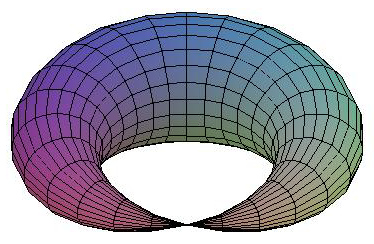
First of all, we may picture the two spheres as a torus pinched in two points, namely North and South points of the two spheres. Doing this, it's clear that our space $X$ is path connected and can be covered by two open sets: $A = \left[\left(S^2 \amalg S^2 \right)/ \sim \right] \setminus \left[\,\{N\}\,\right]$ where $\sim$ is the relation with North and South poles identified and $\left[\,\{N\}\,\right]$ is the class of equivalence of North poles of the two spheres; and $B$, the first half of the 2-pinched torus, namely $\left[ S^2 \amalg \{S\} \right]$.

$A$ and $B$ are obviously open sets and path connected; $A$ is homeomorphic to $S^2 \vee S^2$, $B$ is homeomorphic to $S^2$. Their intersection $A\cap B$ is homeomorphic to an infinite cylinder and thus its fundamental group is $\mathbb{Z}$.

Now, Van Kampen says that $\pi(X) = \pi(A) \times \pi(B)$ if $A \cap B$ is simply connected. In a more general version, it says that $\pi(X) = \left[ \pi(A) \times \pi(B) \right] \star \pi(A\cap B)$, where $\star$ is the free product. Now we know that $\pi(A)$ is trivial (again for Van Kampen, if you desire) and $\pi(B)$ is trivial. So, $\pi(X) = \pi(A\cap B) = \mathbb{Z}$.