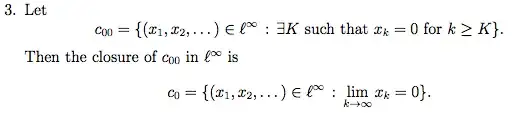
Consider a point in $c_0$ that is $x = (x_1, x_2, \dots )$ s.t. $x_n \rightarrow 0$. It is the limit of
$Y_1 = (x_1, 0, 0, \dots)$
$Y_2 = (x_1, x_2, 0, 0, \dots)$
$\dots$
Check : $Y_N \rightarrow x$ in $l^\infty$ norm.
So $c_0 \subset \overline{c_{00}}$ under $l^{\infty}$ norm.
Is one side of the proof.
For the other part consider an element $X = (x_1, x_2, \dots)$ in $\overline{c_{00}}$.
Now for given any $\epsilon > 0$ there exists a $X_\epsilon = (x_1^{\epsilon}, x_2^{\epsilon}, \dots )$ s.t. $$ \|X - X_\epsilon\|_\infty < \epsilon$$ because $X_\epsilon$ is in $c_{00}$, n > $n_\epsilon$ all the $x_n^\epsilon = 0$, which amounts to saying :
for all $n > n_\epsilon$ we have $$|x_n| < \epsilon$$
We can choose smaller $\epsilon$ and a larger $n_\epsilon$ in the same fashion every time. Thus seeing that indeed the $x_n \rightarrow 0$.
Closedness of $c_0$ becomes unnecessary in this case. You have $\overline{c_{00}} \subset c_0$ here thus combining both the parts.
$$c_0 = \overline{c_{00}}$$ in $l^\infty$.