3

I just wanted to have your opinions on my solution to this question. Any criticism would be welcome, especially with LaTeX formatting. I'm new to this website and still can't seem to get my LaTeX code to work on here. I assume it's not as simple as copy and pasting the code. There is a blank box or \qed symbol at the bottom, it just wasn't shown in the screen shot.

Here is an updated proof.
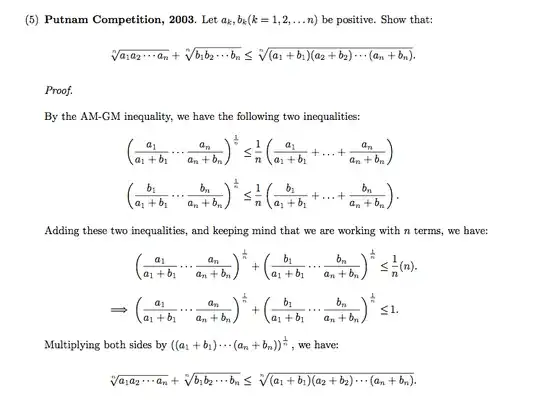
enter image description here

H5159
  • 999
  • Could you post the actual question and your solution? –  Mar 08 '14 at 22:53
  • Yes, I'm sorry, it made me change the tags so it posted it before I could answer. – H5159 Mar 08 '14 at 22:53
  • 2
  • 1
    There is nothing wrong with this proof as far as I can see. –  Mar 08 '14 at 22:56
  • @SanathDevalapurkar Thank you. Are the \implies arrows too frequent? I'm finding that I'm using them a lot in \align* environments. I'm new to LaTex, learning it this semester. – H5159 Mar 08 '14 at 22:57
  • @Frumpy Well, in a few cases, the $\implies$ arrows are a bit redundant (such as the first three, and the last one). –  Mar 08 '14 at 22:59
  • You say "WLOG, we will assume ..." But the $a_i$ and $b_i$ are given positive, so you're not assuming anything. – Eric Towers Mar 08 '14 at 23:01
  • @SanathDevalapurkar That is what I thought, do I not need any sort of arrow or implication in the beginning of each line? – H5159 Mar 08 '14 at 23:01
  • @EricTowers I thought that was a problem as well early on. I will change that. Thank you. – H5159 Mar 08 '14 at 23:02
  • 1
    Read it as a sentence. Would you say "... we are working with $n$ terms, we have: which implies the n-th root of the quantity ..."? – Eric Towers Mar 08 '14 at 23:03
  • @EricTowers Nope that would not make sense, thank you very much. – H5159 Mar 08 '14 at 23:12
  • Whoever deleted the comment saying it is not true, can you explain to me what you found that changed your mind? Interested to see what you thought. – H5159 Mar 08 '14 at 23:29
  • 1
    I deleted my previous comment, and I took too mch to explain myself because I am on a cellphone. Your proof is actually right, but the $^{1/n}$ exponent in the RHS of the first two inequalities in the proof shouldn't be there. – chubakueno Mar 08 '14 at 23:36
  • @chubakueno Yes you are right, they should not be there. – H5159 Mar 08 '14 at 23:40
  • @Frumpy, I'm sorry, but it's still unclear to me. Could you explicitly state your actual question in your question, not just a proof? – recursive recursion Mar 08 '14 at 23:46
  • Totally OK now!(and sorry for the typos in my previous comment, I can no longer edit them ._.) – chubakueno Mar 08 '14 at 23:48
  • @recursiverecursion I'm very sorry for that. When I made the post, I had the question in the picture, but I realized I put it as an answer instead of in the original post. I've updated the proof, to show the question. – H5159 Mar 08 '14 at 23:50
  • I am curious, where did you find this question? Normally Putnam questions are much harder, so I think this comes from a selection of High School Olympiad level source of excercises. Am I correct? Can you share it? – chubakueno Mar 08 '14 at 23:56
  • @chubakueno I'm not sure. It's just a problem given to us by our professor on a project. This project was mainly focused on the AM-GM inequality and other inequalities as well as convex functions. The course is a broad course where we go over a lot of classical stuff. This problem may be easy to you, but this course is very, very difficult for the most part, conceptually. – H5159 Mar 08 '14 at 23:59
  • No, I don't claim it was easy, I would say it is pretty fair .I just say that Putnam questions are, in general, not fair :) .Well, you can always answer yourself to close the topic, thank you anyways, and enjoy MSE! – chubakueno Mar 09 '14 at 00:02
  • @chubakueno Thank you for your help and comments ;D Have a great night/day. – H5159 Mar 09 '14 at 00:05
  • 1
    Related: http://math.stackexchange.com/questions/29357/an-inequality-is-it-true-if-it-is-then-how-to-prove-it –  Mar 09 '14 at 01:08

0 Answers0