4

In defining a positive measure $\mu$ over an abstract measure space $(X,\mathcal A)$ isn't saying

for any countable pairwise disjoint collection $\{A_n\}\subset\mathcal A,~\mu(\cup A_n)=\sum\mu(A_n)$ an overstatement? I think it's enough to say for $A,B\in\mathcal A,~\mu(A\cup B)=\mu(A)+\mu(B)?$

Well I can see that if each $\mu(A_n)$ is finite then both the sequence being monotone either convergent to the same limit or diverges to $+\infty.$ However if at least one $\mu(A_k)$ is $+\infty$ then both of the sides equal $\infty$. Whats's wrong with the logic?

I would like to quote from the following lecture note which motivates me to ask the question:
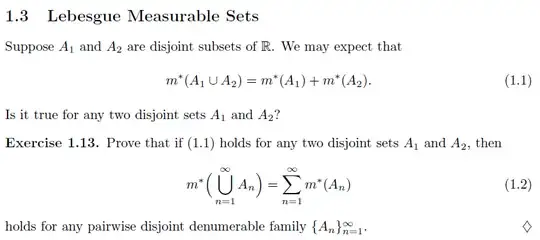
enter image description here

  • Your condition quickly yields finite additivity. That is not enough for many applications. – André Nicolas Mar 06 '14 at 02:34
  • I think $\mu(\cup A_n)=\sum\mu(A_n)$ follows from finite additivity. – user133432 Mar 06 '14 at 02:36
  • 2
    @user133432 Unfortunately, you're wrong. –  Mar 06 '14 at 02:36
  • There are easy examples of set functions which are finitely additive but not countably additive. Google it. – MPW Mar 06 '14 at 02:37
  • Mike is right. User133432 is wrong. – MPW Mar 06 '14 at 02:38
  • 1
    If we have a countable set of "atoms" and they all have positive mass, then yes. – André Nicolas Mar 06 '14 at 02:38
  • Well I can see that if each $\mu(A_n)$ is finite then both the sequence being monotone either convergent to the same limit or diverges to $+\infty.$ However if at least one $\mu(A_k)$ is $+\infty$ then both of the sides equal $\infty$. Whats's wrong with the logic? – user133432 Mar 06 '14 at 02:39
  • U may B inter8sted in the fallowing questioin: http://math.stackexchange.com/questions/564718/why-do-we-want-probabilities-to-be-countably-additive – Christian Chapman Mar 06 '14 at 02:51
  • The lecture notes being quoted are discussing Lebesgue outer measure $m^$. The very next exercise beyond the quotation says, "Prove that (1.2) need not hold for every denumerable disjoint family" and the exercise after that asks for two disjoint sets $A_1$ and $A_2$ of $\mathbb{R}$ such that $m^(A_1 \cup A_2) \neq m^(A_1) + m^(A_2)$. These exercises, including the one quoted above, are aimed at understanding the limitations of Lebesgue outer measure, which is defined for all subsets of $\mathbb{R}$ but cannot fulfill the finite additivity condition if applied so broadly. – hardmath Mar 06 '14 at 13:03
  • Having addressed the context you raised, let's also note that finite additivity not implying sigma (countable) additivity (which isn't really that context) has been considered here, here, and more recently here. – hardmath Mar 06 '14 at 13:18

2 Answers2

4

There is no reason to think that $$\lim_{n\to\infty}\mu\left(\bigcup_{k=1}^n A_k\right) = \mu\left(\bigcup_{k=1}^\infty A_k\right)$$

It's clear that, with finite additivity, you get $$\lim_{n\to\infty}\mu\left(\bigcup_{k=1}^n A_k\right) \leq \mu\left(\bigcup_{k=1}^\infty A_k\right)$$

but you want equality.

A simple example where that would fail is the natural number "density" measure. For $X\subseteq \mathbb N$, define $$\mu(X)=\lim_{n\to\infty} \frac{\left|X\cap [1,n]\right|}{n}$$

This satisfies finite additivity, but not countable additivity.

For example, $A_k=\{k\}$ each have measure zero, but $\mu\left(\cup A_k\right)=1$.

Thomas Andrews
  • 186,215
  • If $\lim_{n\to\infty}\mu\left(\bigcup_{1}^n A_k\right)$ not necessarily equals $\mu\left(\bigcup_{k=1}^\infty A_k\right)$ then what is the interpretation for $\mu\left(\bigcup_{1}^\infty A_k\right)?$ – user133432 Mar 06 '14 at 02:45
  • That's a confusing question. Can you be clearer? $\mu$ is a function defined on (some) subsets of your original set, so $\mu\left(\bigcup\dots\right)$ is defined if it is defined. Look at the example which is finite but not countably additive. There is some use of such things, but they don't let us define integration, for example. – Thomas Andrews Mar 06 '14 at 02:47
  • But how would I interpret $\cup A_n?$ I don't have any idea for convergence of unions. – user133432 Mar 06 '14 at 02:50
  • 2
    $\cup_{1}^\infty A_k$ just means the set of all points that are in at least one of the $A_k$. Doesn't require any notion of convergence - we can define the union of any collection of sets, no matter the size of the collection. – Thomas Andrews Mar 06 '14 at 02:54
  • With a finitely additive measure, the value of $\mu\left(\bigcup_{k=1}^{\infty}A_{k}\right)$ cannot be deduced from the values of $\mu(A_{k})$. That is the point! However, if you have lower semicontinuity ($\mu\left(\bigcup_{k=1}^{\infty} A_{k}\right)=\lim_{j\to\infty} \mu\left(\bigcup_{k=1}^{j}A_{k}\right)$), together with finite additivity, then countable additivity follows. – Unwisdom Mar 06 '14 at 02:56
  • You probably want to clarify that the natural density $\mu(X)$ is not defined for all $X\subseteq\mathbb N$. – Andrés E. Caicedo Mar 06 '14 at 02:56
  • All I'm saying is motivated from the lecture I've just uploaded. Is it wrong then? – user133432 Mar 06 '14 at 02:57
  • That snippet is missing context. Presumably, that's a specific $m$ and you are trying to prove it is a measure? – Thomas Andrews Mar 06 '14 at 02:58
  • Ya, that's lebesgue outer measure. But if the logic (that I've given) hold their why not here? – user133432 Mar 06 '14 at 03:01
  • Is $m^*$ the Lebesque outer measure? – Thomas Andrews Mar 06 '14 at 03:01
  • Because it doesn't? You have to find some particular reason it holds for $m^*$, but not for my density "measure." – Thomas Andrews Mar 06 '14 at 03:04
  • Well! For the above exercise I've proved by using $m^(\cup_{n=1}^\infty A_n)=\lim m^(\cup_{n=1}^k A_n).$ Would it be vaild? if, it be so, then why not for abstract measure? – user133432 Mar 06 '14 at 03:07
  • If you can prove that for $m^*$, you are done, yes. – Thomas Andrews Mar 06 '14 at 03:08
  • I mean why does $(\cup_{n=1}^\infty A_n)=\lim m^(\cup_{n=1}^k A_n)$ valid where $m^$ is the outer measure. – user133432 Mar 06 '14 at 03:13
  • Ah, that's really a separate question... – Thomas Andrews Mar 06 '14 at 03:18
1

What you are talking about is called a finitely additive measure. There are finitely additive measures that are not proper measures (i.e., not countably additive). See here for a counterexample.

triple_sec
  • 23,935