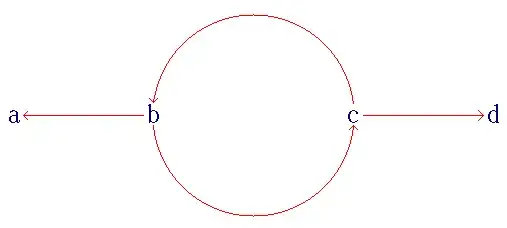
An Abstract rewriting system is a set A, whose elements are usually called objects, together with a binary relation on A, traditionally denoted by $\rightarrow$.
An object $x \in A$ is called reducible if there exist some other $y \in A$ and $x\rightarrow y$; otherwise it is called irreducible or a normal form. An object $y$ is called a normal form of $x$ if $x{\stackrel {*}{\rightarrow }}y$, and $y$ is irreducible. If $x$ has a unique normal form, then this is usually denoted with $x\downarrow$.
${\stackrel {*}{\rightarrow }}$ is the transitive closure of $\rightarrow \cup =$, where $=$ is the identity relation, i.e. ${\stackrel {*}{\rightarrow }}$ is the smallest preorder (reflexive and transitive relation) containing $\rightarrow $. It is also called the reflexive transitive closure of $\rightarrow$ .
$\leftrightarrow$ is $\rightarrow \cup \rightarrow ^{{-1}}$, that is the union of the relation → with its inverse relation, also known as the symmetric closure of $\rightarrow$.
${\stackrel {*}{\leftrightarrow }}$ is the transitive closure of $\leftrightarrow \cup =$, that is ${\stackrel {*}{\leftrightarrow }}$ is the smallest equivalence relation containing $\rightarrow$ . It is also known as the reflexive transitive symmetric closure of
$\rightarrow$ .An Abstract rewriting system is said to possess the Church-Rosser property if and only if $x{\stackrel {*}{\leftrightarrow }}y$ implies $x{\mathbin \downarrow }y$ for all objects x, y.
An Abstract rewriting system $(A,\rightarrow )$ is said to be locally confluent if and only if for all $w, x$, and $y$ in $A$, $x\leftarrow > w\rightarrow y$ implies $x{\mathbin \downarrow }y$. This property is sometimes called weak confluence or having weak Chuch Rosser property.
I know the difference in the definitions, but what I can't see are the consequences of these differences.
Can you give me examples of relations that have weak diamond property but don't have the strong one?
Are there references where there are practical consequences of the differences between?