14

If you don't have strong personal feelings about it already, most of you have at least witnessed the opposing factions on how we should define a ring and, by extension, how we should define a ring homomorphism. The strong majority define a ring to have a unity and require that ring homomorphisms preserve it. Others do not require these things of a ring.

The general pattern I've seen which determines into which camp any given mathematician falls is how 'good' they want their category of rings to be. Those who want zero morphisms and want to be able to define the kernel of a morphism categorically often opt to go without unity. There is a printed semi-famous comment about this problem in the Radical Theory of Rings by Gardner and Wiegandt:
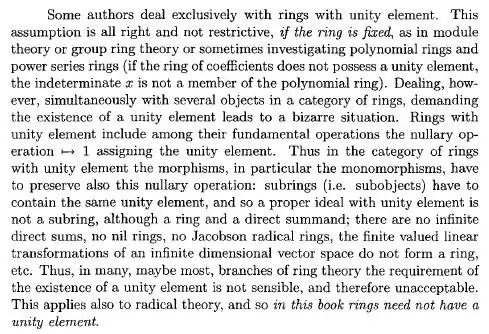
enter image description here

This is where my question begins. I have searched for why the category of Rings (with unity) does not have infinite coproducts. And basically everywhere that comments on it does not prove that there is no object in Ring which satisfies the universal property of a coproduct for an infinite family.

What they do explain is that the thing we would expect to be the coproduct (namely the set-theoretic direct sum with pointwise addition and multiplication) is not a coproduct in Ring.

I have attempted to prove the non-existence of such an object for myself but have not gotten far. One would have to show that either every infinite family of rings cannot all be embedded in another ring; or in the case that there is such an object, there is always a 'smaller' (non-isomorphic) object in Ring which has the same property.

Thus my question is can someone prove to me that Ring (the category of rings with unity and unity preserving homomorphisms) does not have infinite coproducts? Or can you direct me to a reference that may have my answer?

  • It doesn't need to prove that because it never claims that :) And thanks for posting this! – rschwieb Feb 11 '14 at 04:05
  • I read Gardner and Wiengadt's passage as there is no coproduct for infinite families (I know they say 'direct sum', but the terms are used interchangeably sometimes). –  Feb 11 '14 at 04:08
  • Yes, especially so since the are interchangeable in the category of modules! – rschwieb Feb 11 '14 at 04:14
  • 1
    The comment by Gardner and Wiegandt is not convincing (for me). Of course rings as well as pseudo-rings appear naturally, but it is not correct that "dealing ... with several .. rings, demanding the existence of a unity element leads to a bizarre situation." and all those examples of pseudo-rings don't justify to name them rings. – Martin Brandenburg Feb 11 '14 at 12:54
  • @Bryan: This misconception between coproducts and direct sums is very common. See also http://math.stackexchange.com/questions/345501 – Martin Brandenburg Feb 11 '14 at 12:59

1 Answers1

6

It does not say there is nothing satisfying the coproduct axioms: As you say, it is just saying that the direct sum construction (the elements of the Cartesian product which are finitely nonzero) is a ring without multiplicative identity. This is straightforward to show.

In fact ring categories can and do have objects satisfying the coproduct axioms. It's just that they aren't the things given by the direct sum construction. The right thing is built with a sort of free product of rings.

In fact you will probably be satisfied by Qiaochu's answer here which goes into a little detail about it for someone asking for an explicit construction. Martin Brandenburg has also supplied a detailed construction in a comment below.

rschwieb
  • 160,592
  • Yes. Thank you for the reference. I must say that the fact that an infinite family of rings can have the zero ring as a colimit convinces me that the 'correct' definition of a ring does not require unity. –  Feb 11 '14 at 04:16
  • @anon you're right, I fixed my slip :s thanks as always. – rschwieb Feb 11 '14 at 04:35
  • @Bryan Nonsense. The coproduct of a finite family of rings can be zero, e.g. $\mathbb{F}_p \otimes \mathbb{Q}$. – Zhen Lin Feb 11 '14 at 09:17
  • @rschwieb: Please, don't call this a free product. It is not a product (perhaps some day this unfortunate terminology will be replaced by the correct one). – Martin Brandenburg Feb 11 '14 at 12:57
  • Dear @MartinBrandenburg I did not call it a free product. I used "a sort of free product" as a rough descriptor since I'm not supplying a full description. If you can suggest something better, I wouldn't mind replacing it. Regards. – rschwieb Feb 11 '14 at 13:28
  • Coproduct, free coproduct, sum, direct sum, ... (there shouldn't be any confusion with the direct sum of abelian groups if one doesn't apply the forgetful functor secretly) – Martin Brandenburg Feb 11 '14 at 14:11
  • Dear @MartinBrandenburg : If you take a look at the function of the sentence, it is to give a rough idea of what the coproducts look like. Those are all words for what I'm describing, but none of them attempt to describe it. I clearly cannot say "there are coproducts in the category of rings: they look like coproducts/directsums." – rschwieb Feb 11 '14 at 14:17
  • Dear @MartinBrandenburg : Rather than quibbling about terminology, what would rapidly clear up any ambiguity is a solution containing a detailed description/construction. I don't feel up to the task, but I know you can probably pull it off. I would very much like to read that solution. Qiaochu's post was the closest thing I could find to a detailed construction. Regards. – rschwieb Feb 11 '14 at 14:20
  • 5
    Coproducts (more generally colimits) exist in any category of algebraic structures. You can construct them as free objects on the disjoint union of the underlying sets modulo the obvious relations which make the inclusions to homomorphisms. The coproduct of a family of presented algebraic structures $\langle X_i | R_i \rangle$ is therefore $\langle \coprod_i X_i | \cup_i \overline{R_i} \rangle$ where $\overline{R_j}$ denotes the image of $R_j \subseteq \langle X_j \rangle$ in $\langle \coprod_i X_i \rangle$. There is nothing really special to rings or pseudo-rings. – Martin Brandenburg Feb 11 '14 at 14:40