5

enter image description here

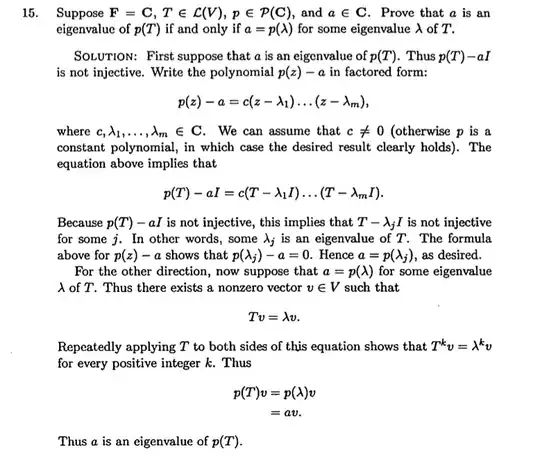
The solution is below, I just do not understand why if:

$p(T)-aI$ is not injective, then $T-\lambda_jI$ is not injective for some j either.

Also, what does repeatedly applying T to both sides accomplish?

Thanks!

user123276
  • 3,565
  • 1
    When posting a scanned image from a book, you might want to identify the source. – Marc van Leeuwen Feb 05 '14 at 08:25
  • I cannot tell if there are any assumptions on the $\mathbf C$-vector space $V$. Without any, the result does not hold. If $V$ is infinite dimensional (the given proof does not seem to contradict that this might be allowed) then $T$ might not have any eigenvalues at all (but only taking $p$ a constant polynomial will be possible for a counterexample). See this answer. – Marc van Leeuwen Feb 05 '14 at 08:37
  • @MarcvanLeeuwen This is exercise 15 in chapter 5 of Axler Sheldon, Linear Algebra Done Right. As I understand in linear algebra every vector space is finite dimensional. The subject dealing with infinite dimensional vector spaces is functional analysis. – user89987 Feb 05 '14 at 08:43
  • @user89987: It is definitely not true that in linear algebra every vector space is finite dimensional, though when talking about eigenvalue problems this is most often assumed (exactly because in infinite dimension eigenvalues may not exist at all). However the result stated here is almost true in infinite dimension too; one just needs to exclude constant polynomials. If you read the proof, you can see the phrase "the desired result clearly holds" is where existence of some eigenvalue is implicitly assumed. N.B. this result holds when $\dim V=0$, even though that implicit assumption does not. – Marc van Leeuwen Feb 05 '14 at 08:55
  • @MarcvanLeeuwen Sheldon's book on page 1 starts as follows: ''Linear algebra is the study of linear maps on finite-dimensional vector spaces.'' So this highly regarded book starts with a false statement? – user89987 Feb 05 '14 at 09:17
  • On Wikipedia it is stated that linear algebra is the study of linear maps on vector spaces and ''Functional analysis studies the infinite-dimensional version of the theory of vector spaces.'' This seems to implicitly state that linear algebra is only about finite dimensional spaces. – user89987 Feb 05 '14 at 09:27
  • If on Wikipedia it is stated that linear algebra is the study of linear maps on vector spaces, then this explicitly means that linear algebra is not restricted to the study of finite dimensional spaces. The phrase about Functional analysis (which I would not condone) seems to imply that functional analysis is a subdomain of linear algebra (I don't think it is, because I believe functional analysis uses notions outside the pure linear algebra toolbox. – Marc van Leeuwen Feb 05 '14 at 11:24
  • @MarcvanLeeuwen Thank you for your comment. So basically the book is wrong... – user89987 Feb 05 '14 at 14:45

1 Answers1

2

To answer just your questions:

  • Any (finite) composition of injective maps is injective. Hence if a composition of maps is not injective, at least one of the maps being composed was not injective.

  • Deriving from $Tv=\lambda v$ that $T^kv=\lambda^kv$ for any $k\in\mathbf N$ is straightforward by induction on $k$. The induction step applies $T$ to both sides of the equation $T^kv=\lambda^kv$, giving $T^{k+1}v=T(\lambda^kv)$, and the latter evaluates, using the linearity of$~T$, to $T(\lambda^kv)=\lambda^kTv=\lambda^{k+1}v$.