Actually, to educate the OP a little - you can use complex variables techniques here. You just have to avoid the branch points. Consider the following integral:
$$\oint_C \frac{dz}{\sqrt{1+z^4}} $$
where $C$ is the following contour:
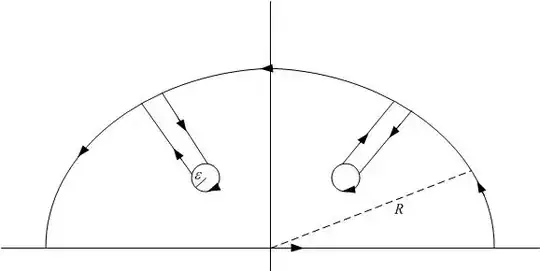
We can then write out the contour integral explicitly in terms of a parametrization; the various terms are
$$\int_{-R}^R \frac{dx}{\sqrt{1+x^4}} + i R \int_0^{\pi} d\theta \, \frac{e^{i \theta}}{\sqrt{1+R^4 e^{i 4 \theta}}} \\ + e^{i \pi/4} \int_1^{R}dt \frac{e^{i \pi/2}}{\sqrt{t^4-1}}- e^{i \pi/4} \int_1^{R}dt \frac{e^{-i \pi/2}}{\sqrt{t^4-1}}\\ + i \epsilon \int_{2 \pi}^0 d\phi \, \frac{e^{i \phi}}{\sqrt{1+(e^{i \pi/4}+\epsilon e^{i \phi})^4}} \\ + e^{i 3\pi/4} \int_1^{R}dt \frac{e^{i \pi/2}}{\sqrt{t^4-1}}- e^{i 3\pi/4} \int_1^{R}dt \frac{e^{-i \pi/2}}{\sqrt{t^4-1}}\\ + i \epsilon \int_{2 \pi}^0 d\phi \, \frac{e^{i \phi}}{\sqrt{1+(e^{i 3\pi/4}+\epsilon e^{i \phi})^4}} $$
Note that the factors of $e^{i \pi/2}$ and $e^{-i \pi/2}$ are a result of the $2 \pi$ jumps about the branch points.
In the limit as $R \to \infty$ and $\epsilon \to 0$, the second, fifth, and eighth integrals vanish. Simplifying, we are left with
$$\int_{-\infty}^{\infty} \frac{dx}{\sqrt{1+x^4}} + i 2 \left ( e^{i \pi/4} + e^{i 3 \pi/4}\right ) \int_1^{\infty} \frac{dt}{\sqrt{t^4-1}}$$
Noting that the contour integral is zero by Cauchy's theorem, we may finally deduce that
$$\int_0^{\infty} \frac{dx}{\sqrt{1+x^4}} = \sqrt{2} \int_1^{\infty} \frac{dt}{\sqrt{t^4-1}}$$
The integral on the RHS may be simplified by subbing $t=1/y$ to get
$$\sqrt{2} \int_0^1 \frac{dy}{\sqrt{1-y^4}}$$
Then sub $y = u^{1/4}$ to get
$$\frac{\sqrt{2}}{4} \int_0^1 du \, u^{-3/4} (1-u)^{-1/2}$$
which is a Beta function. Thus the integral is
$$\frac{\sqrt{2}}{4} \frac{\Gamma \left ( \frac14\right ) \Gamma \left ( \frac12\right )}{\Gamma \left ( \frac{3}{4}\right )} = \frac{4}{\sqrt{\pi}} \Gamma \left ( \frac{5}{4}\right )^2$$
The RHS may be derived using the reflection formula.


