Can the following integral be computed?

Can the following integral be computed?


Hint: consider $$A_n=\int_{1/(n+1)}^{1/n}\{1/x\}^{4}dx$$. This can be computed. Does the series $\sum_{i=1}^\infty A_i$ converges?

With some preliminary transformations (in attachement) the integral is reduced to the integral of a polygamma function which is known (I let WolframAlpha do the known part of the job).
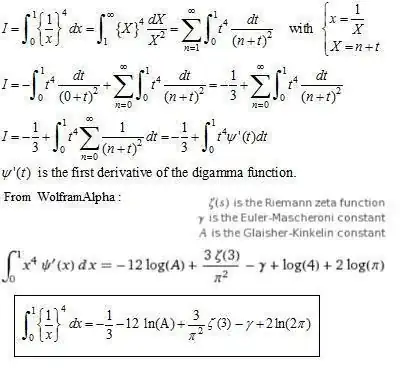

First, let's prove that it converges:
$$\int_0^1\bigg\{\frac1x\bigg\}^4dx=\int_1^\infty\frac{\{t\}^4}{t^2}dt\color{red}<\int_1^\infty\frac{1^4}{t^2}dt=\bigg[-\frac1t\bigg]_1^\infty=1,\qquad\text{since }0\le\{t\}<1.$$
$$\int_0^1\bigg\{\frac1x\bigg\}^4dx=\int_1^\infty\frac{\{t\}^4}{t^2}dt=\sum_1^\infty\int_k^{k+1}\frac{(t-k)^4}{t^2}dt=\sum_1^\infty\int_0^1\frac{u^4}{(u+k)^2}du=$$
$$=\sum_1^\infty\bigg(\frac43-2k+4k^2-\frac1{k+1}+4k^3\ln\frac k{k+1}\bigg)=\ldots<1$$
