3

Consider the system

$\dot{x}=3x^2-1-e^{2y}, \dot{y}=-2xe^{2y}$

1)Show that $\frac {\partial{f}}{\partial{y}}=\frac {\partial{g}}{\partial{x}}$

2)Find the potential $V(x,y)$

3)Show trajectories always cross the equipotentials at right angles.

$\dot{x}=f(x,y)$ and $\dot{y}=g(x,y)$

I showed the first partial derivative part but i couldn't second and third part

Harry Peter
  • 8,193
hello
  • 85
  • 6
  • 1
    Do you know what a potential is? Not the potential. For an explanation and a worked out example on how to find a potential, see my answer here. In this I suggest integrating the second function with respect to $y$. – Git Gud Jan 06 '14 at 00:47

2 Answers2

5

Given:

$$x'= f(x,y) = 3x^2-1-e^{2y}, y'= g(x,y) = -2xe^{2y}$$

1) Show that $\dfrac {\partial{f}}{\partial{y}}=\dfrac {\partial{g}}{\partial{x}}$

  • $\dfrac{\partial f}{\partial y} = -2 e^{2y}$
  • $\dfrac{\partial g}{\partial x} = -2 e^{2y}$

2) Find the potential function $V(x,y)$

  • $x' = 3x^2 - 1 - e^{2y} = -V_x$, so $$ V = - \int (3x^2 - 1 - e^{2y})~ dx + F(y) = -x^3 + x + xe^{2y} + F(y)$$
  • $y' = -2xe^{2y} = -V_y$, so $$V = - \int (-2xe^{2y})~dy + G(x) = xe^{2y} + G(x)$$
  • From the needed conditions for a gradient system, we can take $F(y) = 0$ and $G(x) = -x^3 + x$, hence

$$V(x,y) = -x^3 + x + xe^{2y}$$

3) Show trajectories always cross the equipotentials at right angles.

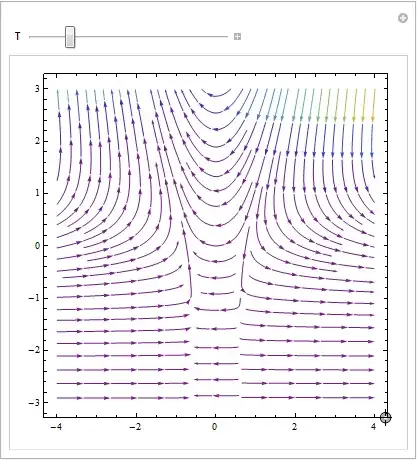
Please add what you have done here. If they only want you to show it, the following phase portrait may suffice. However, if they want a proof, that is harder.

enter image description here

Amzoti
  • 56,629
3

Nota Bene: In preparing this answer, I in my haste used $\phi$ for the potential instead of the OP's $V(x, y)$; I have let it so stand to avoid the editing a change would entail. Ah well, as Treebeard the Ent might say, "hrooooom, hrooooom, let us not be hasty!" Sorry for any confusion, and remember, here

$\phi = V. \tag{0}$

This being said:

According to our OP hello, we can take as given the evident fact that

$\dfrac{\partial f}{\partial y} = \dfrac{\partial g}{\partial x}. \tag{1}$

Denoting the vector field $(f, g)^T$ by $X$:

$X = \begin{pmatrix} f(x, y) \\ g(x, y) \end{pmatrix}, \tag{2}$

we see that (1) implies that

$\nabla \times X = 0, \tag{3}$

which in turn implies the existence of a function $\phi(x, y)$ such that

$X = \nabla \phi. \tag{4}$

(3) also implies, via Stoke's theorem, that around any (sufficiently smooth) closed path $\Gamma$, we have

$\int_\Gamma X \cdot ds = \int_\Omega (\nabla \times X) \cdot dA = 0, \tag{5}$

where $\Omega$ is the region bounded by $\Gamma$ and $dA$ is the corresponding area element. (5) in turn shows that the function $\phi(x, y)$ may be defined, up to an arbitrary constant, by

$\phi(x, y) = \int_\gamma X \cdot ds \tag{6}$

for any path $\gamma(s)$ joining some fixed point $(x_0, y_0)$ and $(x, y)$, since (5) in fact implies such integrals are independent of the particular path chosen. We are thus free to evaluate $\phi$ by using a path of exceptional convenience. Since $X$ is defined on the entire $x$-$y$ plane $\Bbb R^2$, we may choose $(x_0, y_0) = (0, 0)$ and take $\gamma$ to run from $(0, 0)$ to $(x, 0)$ along the $x$-axis, then from $(x, 0)$ to $(x, y)$ along the segment parallel to the $y$-axis. We thus have

$\phi(x, y) = \int_{(0, 0)}^{(x,0)} (3s^2 - 2) ds + \int_{(x,0)}^{(x, y)} (-2xe^{2s}) ds; \tag{7}$

in the first of these integrals the $y$-component of $X$, $g(x, y)$, does not appear since the path is solely in the $x$-direction; $X \cdot \gamma'(s) = f(x, y)$ along this path component. And $f(x, y)$ does not appear in the second integral for the same reason, with the roles of $x$ and $y$ reversed. Evaluating these integrals, we find that

$\phi(x, y) = (x^3 - 2x) - x(e^{2y} - 1) = x^3 - x - xe^{2y}; \tag{8}$

it is now easy to see that

$\nabla \phi = (f, g)^T = X, \tag{9}$

that is, $\phi$ is a potential function for $X$. To see that the trajectories of $X$ are normal to the equipotentials of $\phi$, it is perhaps simplest at this point to observe that since the equipotentials are the curves

$\phi(x, y) = c \tag{10}$

for constant $c$, implicit differentiation of (10) with respect to $x$ yields

$f + gy'(x) = 0, \tag{11}$

which may in fact be written as

$X \cdot (1, y'(x)) = 0, \tag{12}$

and then use the fact that $(1, y'(x))$ is the tangent to the curve $(x, y(x))$, a parametric representation of the equipotential with parameter $x$ itself. This is valid everywhere except where $g(x, y) = 0$, that is, where $x \ne 0$; but it is easy to see that when $g = 0$ we are on the $y$-axis, and there $X$ points in the $x$-direction, so orthogonality of $X$ to the equipotentials holds there as well.

Hope this helps. Happy New Year,

and as always,

Fiat Lux!!!

Robert Lewis
  • 72,871
  • My tag (11) will soon return from lunch! – Robert Lewis Jan 06 '14 at 03:10
  • Perhaps you will enjoy lunch with my friends $/tag{11}$, "evaluting", and "eqiptoentials" . . . but wait! They're back! Thanks for pointing out my mistakes. As for the $-\nabla V$, I have long found that $-$ sign both annoying and extraneous, though I realize it has it's place in custom and tradition. So I have consciously moved away from the norm at that point. Anyway, you might recall that we have had a similar conversation before, when I believe I mentioned the vicissitudes of trying to type math into a tiny 'droid touchscreen, as I was using when I first wrote this. More . . . – Robert Lewis Jan 06 '14 at 04:02
  • Here's more: you sympathized with my plight and as I recall mentioned your own "fat fingers". Do you remember? Anyway, best wishes for the New Year. May you solve the Riemann Hypothesis! Regards, RKL. PS, +1 yerself! – Robert Lewis Jan 06 '14 at 04:04
  • Wow! I do not know how you type this sort of post on droid! Yes, I recall our conversation and if I were able to solve the RH, I am not sure I'd be trolling MSE! :-) Have a great evening and my comments will all soon be out to lunch! Best wishes to you too in the new year sir, I really enjoy reading your enlightened posts! – Amzoti Jan 06 '14 at 04:08
  • Please don't delete your comments . . . I think a little humor is good thing around here! And I must say I am really quite gratified by your kind words about my posts. Very kind words indeed, sir. Now get to work on that RH! – Robert Lewis Jan 06 '14 at 04:11