2

in a previous question a composition of circular functions was defined for each binary string of finite length. this question will use the same terminology.

if the existence of a fixed point is guaranteed for each binary string $b$ then we may refer to this point as $b_*$. [note since we have not yet restricted the $b$'s to primitives$^1)$, this appellation for a point is not unique.]

let $\sigma$ be the operator on the elements of $B_n$ defined by a circular left shift of one position. so: $$\sigma(01011) = 10110 \\ \sigma^2(01011) =01101$$ and so forth.

we may term the set of $n$ fixed points of such a set of shifts conjugates. if the $\psi_b$ function is factored into its $n$ components $\psi_{b,0} \circ \psi_{b,1} \circ \dots \psi_{b,n-1}$ then the iteration of this factored operator will not give a single fixed points, bt rather convergence towards an orbit or limit cycle.

using an index notation to indicate the action of the shift operator, then for a string $b$ of length $n$ we may define the mean of its set of conjugate fixed points. formally: $$ \mu(b) = \frac1n \sum_{j=0}^{n-1} b_*^{\sigma^j}$$

CONJECTURE for any string $b$ we have: $$ \mu(b) \le \alpha = 1_*$$ where $\alpha$ is the cosine fixed point corresponding to the string $1$ of length $1$

NOTE my friend Mr Richard Monkhouse has kindly run a few tests on a calculating machine for small values of $n$ and so far has not discovered any exceptions to the suggested rule.

(1) as the reader will guess, by primitive is meant a binary string which cannot be written as the concatenation of $m \gt 1$ copies of a shorter pattern. so $110101110$ is a primitive $9$-string, whereas $010010010 = 010^3$. obviously for any pattern $b$ then $(b^m)_*=b_*$

David Holden
  • 18,328

6 Answers6

2

Quick answer to David's post.

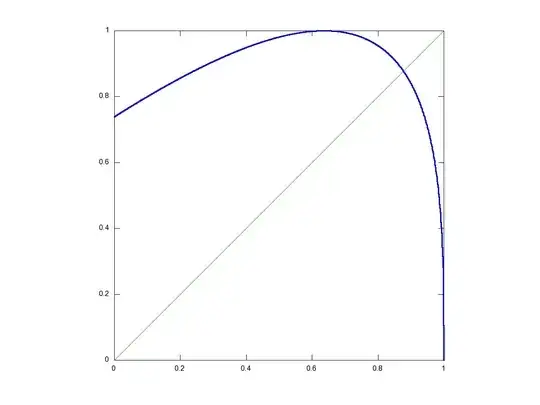
$\psi_*$ is maps [0,1] to [0,1] but is concave with a maximum value of $1$ at $\theta = 2/\pi$, i.e. $$ \psi_*\left(\frac{2}{\pi}\right) = 1 $$ What is true is that $\psi_*$ is differential function of $\theta$ and hence continuous also. So $\psi_* \in F$ I have not been able to establish that $\psi_*$ is a contraction, though the graph of $\psi_*$ indicates that it is.

Here is the graph of $\psi_*$ with the $45^o$ line to show the unique fixed point.

Graph of $\psi_*$

user44197
  • 9,818
  • Should we take this discussion off here? Not sure anyone can follow what we are saying. Not sure how to take the discussion private. – user44197 Jan 01 '14 at 08:38
  • I think it is fairly private here - private enough anyway! - I like the possibility of error-correction and other input from friendly parties (I also have a dedicated little team of downvoters) and it keeps the work in one place. but I would be happy to use some other channel if you wish to suggest one. I am also happy to post further related questions, but don't want to flood the market, as it were. you have made remarkable progress. the graph of $\psi_*$ is beautiful. – David Holden Jan 01 '14 at 09:39
  • btw your discovery that $\psi_*\left(\frac{2}{\pi}\right) = 1$ is rather lovely. the convergence seems rapid here. can you actually prove the result? (I have no doubt of its truth!) – David Holden Jan 01 '14 at 13:09
  • This follows from $\cos\left(1-\frac{\pi}{2}\cdot \frac{2}{\pi}\right) = 1$. – user44197 Jan 01 '14 at 14:20
1

I am puzzling over your problem and my guess is that this is a deep problem and you may not get a solution any time soon. Here are some thoughts/partial answers.

Clearly composition of circular function maps $[-1,1]$ to $[-1,1]$. So by Brower's fixed point theorem there is a fixed point. Also any fixed point must be in the interval $[-1,1]$. One can restrict the interval to $[0,1]$. However, I want to establish that there is a unique fixed point.

The derivative of composition of circular function is a product of circular function. Hence the derivative has to have magnitude less than or equal to $1$. Except in the trivial case of $\sin $, the derivative is strictly less than 1 in magnitude. Hence the function is a contraction map. This establishes the following:

Suppose that $\psi(\cdot)$ is a composition of circular functions ($\sin$, $\cos$). Then there exists a unique real number $r$ such that $\psi(r)=r$ and $0 \le r < 1$ (not too hard to show the upper limit is less than $1$).


A secondary question: What is the least upper bound for $r$?

user44197
  • 9,818
  • I think the upper bound for $r$ is $1$, because if you consider the representative of $1$ in strings of length $n$, you get $n-1$ $\sin$es followed by a $\cos$ine – David Holden Dec 30 '13 at 23:57
  • by the way, I think your observation re the derivatives is absolutely fundamental here, even though once stated it seems intuitively obvious. could you sketch a proof? we don't want to have to assume it as an axiom, however "self-evident" it may be. some of the most powerful tools are so near the cutting edge that they do have a direct appeal to intuition, yet what other so interesting classes of functions are obvious. could you define a Narajatan class of endomorphisms of the unit interval, such that all compositions satisfy $|f'| \le 1$? or has this already been defined? – David Holden Dec 31 '13 at 00:02
  • I should perhaps have said monoid rather than class, apologies – David Holden Dec 31 '13 at 00:08
  • of course, at the back of this is the question whether all the fixed points except zero are transcendental, since $1_*$ is easily shown to be – David Holden Dec 31 '13 at 00:12
  • I do not have a formal education in Mathematics so I wouldn't even know where to begin vis-a-vis the monoid but thanks for the kind sentiments. – user44197 Dec 31 '13 at 02:47
  • well neither have I, but you are way ahead of me. I've added a few thoughts below. this question offers a quiet retreat, where I can explore some ideas without too large an audience when making a fool of myself. happy new year! – David Holden Jan 01 '14 at 06:19
1

This got too complicated for me to type in the comment section, so here goes.

Let $\psi$ be a composition of circular functions. Have to show that $|\psi'| \le 1$. Proof is by induction on the number of terms in $\psi$ and goes something like this:

Assume it to be true for composition of $n$ circular functions. Suppose $\psi$ is a composition of $n+1$ circular function, i.e. of the form $$ \psi(x) = \text{circular} \circ \phi(x)$$ Then by chain rule: $$ \psi'(x) = \text{circular}'(\phi(x)) \cdot \phi'(x)$$ Since the derivative of circular functions are also circular function, etc...

Regarding $\mu(b)$, I can establish that $$\mu(b) < 0.921$$ Still a long way away from $\alpha$.

user44197
  • 9,818
  • If the length of the string $b$ is 3 or more, I can get a better bound: $\mu(b) < 0.8624$. My method is too ad-hoc so give me some time to work out the kinks – user44197 Dec 31 '13 at 06:38
  • I find it intriguing you have got anywhere near this. however I will wait for the revelation! all the best for 2014! – David Holden Jan 01 '14 at 09:32
  • btw the motivating idea behind the hypercube comment below is that instead of the mean of the orbit values (which may seem obscure) we can actually use the $\ell_1$ norm on the Banach space $\mathbb{R}^n$ - which is a solidly established concept – David Holden Jan 01 '14 at 13:12
0

(notes)

let $F$ be the family of $C^{\infty}$ endomorphisms of the closed unit interval which additionally satisfy: $$ |f'| \le 1$$ then $F$ is a non-abelian monoid (with multiplication defined by function composition), since:

(a) the identity function belongs to $F$.

(b) if $f,g \in F$ then $f \circ g$ and $g \circ f$ are in $F$

(justification: $|D(f \circ g)| = |Dg| \; |(Df) \circ g| \le 1)$

define the map $$ \Psi:[0,1] \rightarrow F $$ $$\Psi_{\theta}(x) = \cos(x-\frac{\pi \theta}2) $$ so that $$\Psi_0(x)= \cos x \\ \Psi_1(x)= \sin x $$ for each $\theta \in [0,1]$ the function $\Psi_{\theta}(x)$ has a fixed point $\theta_*$ whose existence and uniqueness are guaranteed by Natarajan's (user44197) application of the Brouwer fixed point theorem. in particular, with this notation $0_* = \alpha$, the cosine fixed point.

QUESTION it seems reasonable to hypothesize that the function $$\psi_*: \theta \mapsto \theta_*$$ is a continuous strictly decreasing function of $\theta$ whose maximum is precisely the cosine fixed point $\alpha$. how should one confirm or refute this supposition?

AUXILIARY QUESTION if confirmed, then what is the fixed point of $\psi_*$?

MORE DIFFICULT QUESTION: is it further the case that $\psi_* \in F$? i.e. is $\psi_* \in C^{\infty}([0,1])$ and do we have $|D\psi_*| \le 1$?

David Holden
  • 18,328
  • 1
    I will add my comment here so it is with your post. $\psi_^{-1}$ has a nice explicit formula: $\psi_^{-1}:~\theta_* \mapsto \frac{2}{\pi}\left(\theta_* \pm \arccos\left(\theta_\right)\right)$, with the understanding that if one of $\pm$ results in the right hand side outside $[0,1]$, then it is rejected. This also shows that $\psi_$ is differentiable. – user44197 Jan 01 '14 at 14:30
0

we may also note that $\Psi$ can be lifted to an endomorphism of the unit hypercube $H^n$ in $\mathbb{R}^n$. of course there is an obvious way of doing this, but it is more interesting to use this idea to obtain a natural representation of the limit cycle of an operator which is factored as a composition of $n$ other operators.

let $\bar \theta = (\theta_1,\dots,\theta_n) \in H^n$, and let $\sigma$ be the permutation $(12\dots n)$ (i.e. the circular right shift on $\{1,2\dots n\})$. then if we set: $$ \Phi_{\sigma^j}(\bar \theta) = \Psi_{\theta_{\sigma^j(1)}} \circ \dots \circ \Psi_{\theta_{\sigma^j(n)}} $$ we have a mapping $\xi:H^n \to H^n$ defined by $$ \xi(\bar \theta) = (\Phi_{\sigma^0_*},\Phi_{\sigma^1_*},\dots,\Phi_{\sigma^{n-1}_*}) $$ since $\sigma^0$ is the identity, the first coordinate is the fixed point of: $$ \Psi_{\theta_1} \circ \Psi_{\theta_2} \circ \dots \circ \Psi_{\theta_n} $$ the second is the fixed point of: $$ \Psi_{\theta_2} \circ \Psi_{\theta_3} \dots \circ \Psi_{\theta_n} \circ \Psi_{\theta_1} $$ and generally: $$ \xi(\bar \theta)_k = \Phi_{\sigma^{k-1}_*}=\Psi_{\theta_k}(\Phi_{\sigma^k_*}) $$so that a single point in $H^n$ represents the limit cycle which we approach as we iterate the composition of the $n$ operators.

the $2^n$ vertices of the hypercube correspond to the composition of circular functions as originally defined, with the origin corresponding to the iterated cosine.

this mapping is an endomorphism of $H^n$ and allows the conjecture that $\alpha$ is the supremum of orbital means for the pure circular function iterations to be expressed as: $$ ||\xi(V)||_1 \le n \alpha $$ where $V$ is a vertex of $H^n$

by definition the leading diagonal of the hypercube is mapped to itself, and this map is the same as in the one-dimensional case.

thus the origin $(0,0,...,0)$ maps to the point each of whose coordinates is $\alpha$, i.e. $$ \xi(\bar 0) = (\bar \alpha)$$ likewise $$ \xi(\bar 1) = (\bar 0) \\ \xi(\bar {\frac2{\pi}}) = (\bar 1) \\ \xi(\bar \nu) = (\bar \nu) $$ where $\nu$ is the fixed point indicated by Natarajan in the diagram.

David Holden
  • 18,328
0

I am pretty sure your conjecture is true. Here I give a proof based on the "whack it with a hammer until it breaks" philosophy... hopefully there is a more illuminating short-cut which I have not seen.


Consider the function $M(x) = \frac12(x + \cos(x))$. Its derivative is positive on $[0,1]$. This in particular means that $M(x) < x$ whenever $x < 1_*$.

Observe also that if $x < 1_*$, $\cos(x) > 1_*$ and vice versa.

Now consider a cycle for the nontrivial string $b$. There are several types of points:

  1. $x > 1_*$ which is obtained from $x = \cos(y)$ where $y < 1_*$.
  2. $x \geq 1_*$ which is obtained from $x = \sin(y)$ where $y > 1_*$.
  3. $x < 1_*$ which leads to $y = \cos(x) > 1_*$.
  4. $x \leq 1_*$ which leads to $y = \sin(x) < 1_*$.

Note that 1 and 3 are paired. Each pair has average less than $1_*$ and so can be ignored.

We are down to points of type 2 and 4. For $x$ of type 2, the corresponding $y$ must be at least $\arcsin(1_*)\approx 0.8316$

First consider a type 2 number $x$, its predecessors can be written as the string

$$ x' \to \text{some chain of alternating type 1 and 3 numbers} \to x $$

we have several possibilities:

  1. the intermediate chain is length 0, and $x'$ is type 2.
  2. the intermediate chain has length a positive even number, with $x'$ being type 2.
  3. the intermediate chain has length a positive even number, with $x'$ being type 4.

In the first case it is obvious that $x' > x$. I claim that this is also true for the second case. Consider $y$ as above, we have that $\arccos(y) \approx 0.59 < 0.67 \approx \sin(1_*)$. This means that $\arccos(y)$ can only be obtained as $\sin$ of a type 4 number or $\cos$ of a type 1 or 2 number, and not $\sin$ of a type 1 or 2 number. Using that $1_*$ is a global attractor this means that by induction all the connecting operators for the entire type 1-type 3 chain is cosine, and that each of the type 1 numbers appearing in the chain is bigger than the subsequent one. The same argument shows that $x' > x$.

Now, since $\arcsin(\arcsin(1_*)) \approx 0.982$ and $\arcsin(\arcsin(\arcsin(1_*))) > 1$, this means that if we start with the cycle for the string $b$, and remove all type 1 and type 3 points from it, the resulting reduced cycle can only have at most 2 consecutive type 2 points.

Let us now look at the third case. That $1_*$ is a global attractor for $\cos$ means that during the intermediate chain the distance to $1_*$ is monotonically decreasing. The distance from the type 4 point $x'$ to the first element of the intermediate chain is smaller than the distance from $x$ to the last element of the chain: this is due to $x-\sin x$ being an increasing function on $[0,1]$. Hence in the third case $x' + x < 2\times 1_*$.


Let me summarise what we have done so far: the cycle contains a bunch of pairs of the form

  • Type 1 $\to \cos \to$ type 3, which averages to less than $1_*$.
  • Type 4 $\to \sin\to$ (type 1 - type 3 chain) $\to \sin \to$ type 2, where the average of the type 4 and 2 numbers is less than $1_*$.

We have some type 2 numbers which are preceded by type 2 numbers left over, and we need to control them.


Suppose that $x' \to x$ are consecutive numbers in the cycle for $b$. There are only two ways for $|x' - 1_*| < |x - 1_*|$:

  1. $x'$ is type 4
  2. $1_* \leq x' < A$ where $A + \sin A = 2 \times 1_*$.

We have shown above that in a string

$$ z \to \text{some alternating string of type 1 and 3 numbers} \to x $$

where $x$ is type 2, no number in the intermediate string can belong to the second class above. The same argument in fact also shows that in a string

$$ z \to \text{alternating type 1/3} \to \text{type 2} \to \text{alternating type 1/3} \to x $$

where $x$ is type 2, none of the intermediate string between $z$ (which is necessarily type 4) and $x$ can be of the second case above. This implies that $z \leq \arcsin(\arccos(\arcsin(1_*))) \approx 0.63 < \sin(1_*)$. This tells us that going backwards from $z$ can only increase the distance to $1_*$ unless one hits another type 4 number.

But recall that from the above, we have that the average of $z$ and the intermediate type 2 number is less than $1_*$, which means that $z$ is further away from $1_*$ than the intermediate type 2 number. The monotonicity thus implies that $z$ cannot be preceded by another type 2 number without meeting a type 4 number in between. The monotonicity again implies that this type 4 number is further away from $1_*$ than $x$ (remember $x$?).

Thus we see that every number of type $1$ and $2$ can be paired, respectively, with a number of type $3$ and $4$ in the cycle for $b$, in a way that the average between the pairs is less than $1_*$. Hence the total average of all the conjugates is $< 1_*$.

Willie Wong
  • 75,276