137

I've always felt that the concise, suggestive nature of the written language of mathematics is one of the reasons it can be so powerful. Off the top of my head I can think of a few notational conventions that simplify problem statements and ideas, (these are all almost ubiquitous today):

  • $\binom{n}{k}$
  • $\left \lfloor x \right \rfloor$ and $\left \lceil x \right \rceil$
  • $\sum f(n)$
  • $\int f(x) dx$
  • $[P] = \begin{cases} 1 & \text{if } P \text{ is true;} \\ 0 & \text{otherwise} \end{cases}$

The last one being the Iverson Bracket. A motivating example for the use of this notation can be found here.

What are some other examples of notation that really improved mathematics over the years? Maybe also it is appropriate to ask what notational issues exist in mathematics today?

EDIT (11/7/13 4:35 PM): Just thought of this now, but the introduction of the Cartesian Coordinate System for plotting functions was a HUGE improvement! I don't think this is outside the bounds of my original question and note that I am considering the actual graphical object here and not the use of $(x,y)$ to denote a point in the plane.

Shaun
  • 47,747
Patrick
  • 2,126
  • 69
    Positional notation to write numbers. – OR. Nov 07 '13 at 18:21
  • 25
    As this doesn't seem like it would have a right answer, I am flagging to make the question community wiki – Stahl Nov 07 '13 at 18:28
  • 10
    $x^2+ax+b$ or, in general, using letters to denote numbers. – egreg Nov 07 '13 at 18:47
  • ... You should only ask practical, answerable questions based on actual problems that you face. Chatty, open-ended questions diminish the usefulness of our site and push other questions off the front page. – voromax Nov 07 '13 at 23:59
  • 4
    @voromax Hmm, you're not from here, you come from [so] like me ;) I've noticed that here at Math.SE, these types of questions are encouraged. It's not the same as SO here – Doorknob Nov 08 '13 at 01:21
  • @voromax In what way is my question not answerable? – Patrick Nov 08 '13 at 01:39
  • On the other hand, other similar questions on this site have been closed for being too subjective. The community doesn't always act consistently. – Cheerful Parsnip Nov 08 '13 at 01:47
  • 2
    I have to agree with ABC . . . positional notation is without a doubt the most significant advance in notation. Try simple addition with Roman numerals. Try ANYTHING with Roman Numerals, tally marks, or any other system of numeration. – Marc Nov 08 '13 at 02:17
  • 1
    @Doorknob: Not encouraged, but not discouraged either. – Asaf Karagila Nov 08 '13 at 06:46
  • @Marc: unary is not so bad, but takes some space (I'm kidding) and behind positional notation of course there is one of the most basic ones: using a dedicated digit for zero ! The Romans didn't had that one either. – kriss Nov 08 '13 at 07:55
  • 1
    On the other hand, dedicated compact notations comes with a cost: you need to learn them or you can't understand them. But as we are usually learning notation and notion together it's usually OK. – kriss Nov 08 '13 at 08:02
  • And it also reminds of the famous comment of Gauss, when Waring (acknoledging it's failure) said proving Wilson's Theorem would be very difficult due to the lack of a proper notation. To what Gauss replied that the trouble didn't resides with Notations but with Notions ("Non Notationes sed Notiones"). I'm not sure where it places Gauss regarding this question. – kriss Nov 08 '13 at 08:06
  • It's not really mathematical notation, but using numbers to describe collections is pretty useful: words like 'one', 'two' and so on had to be invented as well! Imagine if there were a different collective noun for a group of two cows vs. a group of two sheep... – yatima2975 Nov 08 '13 at 13:18
  • yatima2975: Until you abstract the "threeness" from a set of three cats, three rocks, three days, three trees, etc., you quite literally can't count, but is that really a form of "notation"? I suppose you could say that notches on a stick forming a one-to-one correspondence between the notches and the number of bison killed by Mighty Hunter would be the original, the "Mother of all Mathematics and Mathematical Notation". – Marc Nov 08 '13 at 15:18
  • @Doorknob To say the truth this is a great idea to raw data now into the open source. But imagine wiki tags with this notation information. It could be searchable and usable. Sometimes SO is over disciplined;-) – voromax Nov 10 '13 at 15:12

28 Answers28

90

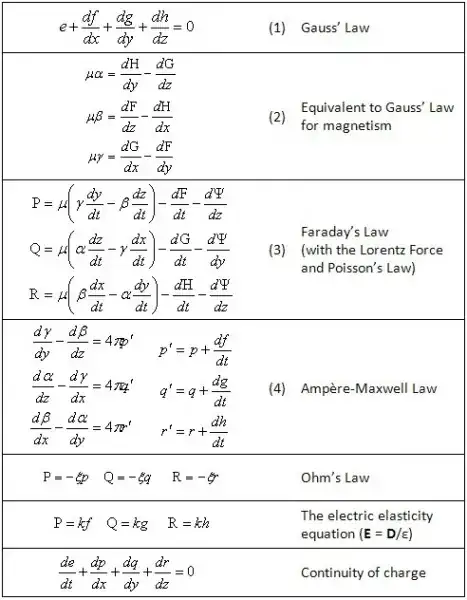
Vector notation! The fact that you can write: $$\vec{a}\cdot\vec{b}$$ Instead of: $$a_1 b_1 + a_2 b_2 + \ldots$$ Or that you can use vector operators such as $\vec\nabla$, really helped develop linear algebra and its use in applied fields. To point out one famous example, Maxwell's original equations take up an entire page!

$\quad\quad\quad\quad\quad$Maxwell's equations

And here's the same using vector notation for comparison:

$$\boxed{\begin{align}\\\,\\\qquad&\qquad\nabla\cdot\mathbf D=\rho&&\text{(1)} \qquad\qquad\text{Gauss' law}&\\\,\\ \qquad&\qquad\nabla\cdot\mathbf B=0&&\text{(2)}\quad\text{Gauss' law for magnetism}&\\\,\\ \qquad&\,\,\,\nabla\times\mathbf E=-\dfrac{\partial\mathbf B}{\partial t}&&\text{(3)}\qquad\quad\,\text{Faraday's law}&\\\,\\ \qquad&\,\nabla\times\mathbf H=\dfrac{\partial\mathbf D}{\partial t}+\mathbf J&&\text{(4)}\qquad\text{Ampère-Maxwell law}\qquad\\\,\\ \end{align}}\\\,\\\textit{Maxwell's equations in vector form}$$

(Image from IEEE's history page)

  • 1
    I would argue that "vector notation" isn't really special notation, just a useful definition of operators like the scalar product. In a programming language, we'd say it's just a custom-defined operator but all in the language's default syntax. – leftaroundabout Nov 08 '13 at 15:05
  • 5
    vector notation also obviates the need to refer to spatial coordinates/parametrization. – Jonathan Nov 09 '13 at 02:55
  • 2
    Maxwell actually wrote twenty equations, of which (4) is actually two equations. There are actually eight equations in vector form, (4) breaks into [math]\nabla\times H = C \quad C = J + \dot D[\math]. Maxwell actually invented something like Nabla, by writing these as the scalar and vector parts of a quarterion. – wendy.krieger May 03 '15 at 10:23
  • 2
    @wendy.krieger We use a $stuff$ tag here, not a [math]stuff[\math] tag. That's $\nabla\times H = C \quad C = J + \dot D$. – Akiva Weinberger May 03 '15 at 12:49
  • 2
    Late comment but lets not forget that when tensor notation was introduced Maxwell’s equations were simplified into just two! See here: https://en.m.wikipedia.org/wiki/Covariant_formulation_of_classical_electromagnetism – aidangallagher4 Apr 02 '18 at 17:18
78

Algebraic notation with letters instead of verbal descriptions for quantities that are not explicitly known. The transition from rhetorical mathematics to syncopated and then symbolic had a tremendous impact on mathematics, making it possible to state rules and algorithms in greater generality.

egreg
  • 244,946
  • 21
    I think that consistency in the choice of some letters for some mathematical objects has proven particularly helpful. I'm thinking about $n,,m$ for integers, $i,,j$ for indices, $z,,x,,y$ when talking about complex numbers, $p,,q$ for prime numbers, $k$ for the base field, $\phi_i : U_i \rightarrow V_i$ for charts, and so on. – Luca Bressan Nov 07 '13 at 20:37
  • 9
    For me this is by far the most important notational advance in mathematical history, whose impact on mathematics is so fundamental that it hard to express properly. Without it mathematics just couldn't have advanced much beyond its medieval state. I'll take the freedom to replace "numbers" in the first sentence though, as this is improper; apart from some rare cases like$~\pi$, letters are almost never used in place of (explicit) numbers. – Marc van Leeuwen Nov 08 '13 at 08:42
  • Agreed; this seems to me the single most important answer by far. It’s hard to conceive that modern mathematics could have developed if we were still writing out “that number, which when squared and added to five times itself yields 3” and the like. – Peter LeFanu Lumsdaine Nov 08 '13 at 15:58
  • Just think how Indian mathematicians stated all of their theorems! Paragraphs! Implicit reference unrolled through winding sentences! – bright-star Nov 11 '13 at 09:38
76

I would suggest Gauss's invention of the notation for congruences in modular arithmetic:

"The invention of [congruence notation] by Gauss affords a striking example of the advantage which may be derived from an appropriate notation, and marks an epoch in the development of the science of arithmetic."

G. B. Matthews (1861-1922)

Edit:

For anyone who is not sure what the notation actually is:

$$a \equiv b \pmod{k}$$ means that $a$ and $b$ give the same remainder on division by $k$, or equivalently, that $a-b$ is divisible by $k$.

leo
  • 10,769
Old John
  • 19,875
  • 2
    Absolutely. ${}{}{}{}$ – Pedro Nov 07 '13 at 18:58
  • 6
    It is hard to believe how they managed without it before then, I reckon. – Old John Nov 07 '13 at 18:59
  • 7
    And yet I read somewhere that Gauss said something like, “We need new notions, not new notations.” – Lubin Nov 08 '13 at 01:39
  • 7
    @Lubin: "But in our opinion truths of this kind should be drawn from notions rather than from notations." - Gauss, Disquisitiones Arithmeticae, Article 76. (Of course, the original quote was in Latin.) This was a remark towards Edward Waring's Meditationes Algebraicae, another Latin work, wherein Waring states that a proof of Wilson's theorem (and other theorems of 'that sort') would be difficult because of a lack of notation to represent prime numbers. – Reid Nov 08 '13 at 07:03
  • Ah, @Reid, thank you very much. – Lubin Nov 08 '13 at 19:25
  • 35
    I agree fully that having a notation for congruences is invaluable, but I must admit that I've always found the $\equiv \pmod k$ notation itself to be cumbersome. I wish it were written $a=_k b$ or $a\equiv_k b$ or something like that. – Alexander Gruber Nov 10 '13 at 01:43
  • In case someone else comes across this page searching for the text of Gauss's quote mentioned by @Reid, here it is: "At nostro quidem iudicio huiusmodi veritates ex notionibus potius quam es notationibus hauriri debebant." – Omar Antolín-Camarena Jul 21 '16 at 19:46
  • @AlexanderGruber I learned that notation in my undergrad. I always assumed it was known, despite not being the most popular notation. – Git Gud Dec 01 '18 at 12:46
60

Landau notation for describing the asymptotic behavior of a function:

$$O(n)\quad o(\log n)\quad \Omega(n!)\quad \Theta(2^n) \quad \dots$$

Nate Eldredge
  • 101,664
  • 13
    I actually think the notation for this is not very good. For example, we say $2x^2 = O(x^2)$, but also that $2x^2 = O(x^3)$, even though $O(x^3) \neq O(x^2)$ (and whether we can say $O(x^2) = O(x^3)$ depends on what book you read). It would have been better to use =, <, and > to convey a partial-ordering, so that we could say $O(2x^2) = O(x^2) < O(x^3)$ – BlueRaja - Danny Pflughoeft Nov 07 '13 at 21:47
  • 56
    @BlueRaja-DannyPflughoeft Maybe we should say, for instance, $2x^2 \in O(x^2)$ instead, interpreting $O(x^2)$ as a set of functions. – lily Nov 07 '13 at 21:50
  • 1
    @Istvan: That's a (common) quick-fix for the notation as taught, but it would still have been better the way I suggested - the current form requires three new forms of notation ($O(n), \Theta(n), \Omega(n)$) rather than one, with another three for the stronger-bounding "little-o" notation. Also, it still doesn't do a good job of conveying the partial ordering of the functions. – BlueRaja - Danny Pflughoeft Nov 07 '13 at 21:56
  • 10
    @BlueRaja-DannyPflughoeft: I think the most powerful way to use Landau notation is as shorthand for a generic function in the set, and combining it with other functions. E.g. $f(n) = n! + o(n^2)$. If you insist on treating $o(n^2)$ formally as a set, you'll have to replace this with something much more clunky. – Nate Eldredge Nov 07 '13 at 21:58
  • 13
    @BlueRaja-DannyPflughoeft I don't get what you mean. $2x^2 = O(x^2)$ is a notation abuse. The correct notation is $2x^2 \in O(x^2)$ since $O$ is a set. Hence there is absolutely nothing strange in having $2x^2 \in O(x^2) \wedge 2x^2 \in O(x^3) \wedge O(x^2) \neq O(x^3)$. Also you must use three different notations to describe the relationship between functions because we want to be able to express $f$ is at most as big as $g$, but also $f$ is at least as big as $g$ and even $f$ is "close" to $g$. Making these three cases distinct is clearer (explicit is better than implicit) – Bakuriu Nov 07 '13 at 22:03
  • 2
    @Bakuriu: (Re: notation abuse) Yes, we seem to be agreeing - see also equals sign (abuse of notation). But that is just more reason that this is not a good answer for this question. – BlueRaja - Danny Pflughoeft Nov 07 '13 at 22:09
  • 3
    @NateEldredge: $f(n) \in n! + o(n^2)$ isn't that clunky – Max Nov 10 '13 at 15:59
  • @Max What would be a non-clunky alternative for $f(n) \le n - o(1)$? – Erick Wong Jan 06 '14 at 20:31
  • 1
    I think it's unfortunate that the Bachman--Landau notation prevailed over the now obsolete symbols $f \preccurlyeq g \equiv f = O(g)$, $f \prec g \equiv f = o(g)$, $f \asymp g \equiv f = \Theta(g)$, etc. This notation is explained in Hardy's "Orders of Infinity: The 'Infinitärcalcül' of Paul du Bois-Reymond". – Yakov Shklarov Jul 15 '18 at 06:20
  • 1
    The notation $\prec$ was introduced in 1870 by Paul du Bois-Reymond ("Sur la grandeur relative des infinis des fonctions") and popularized (along with a few other similar symbols) by Hardy in his book "Orders of Infinity", 1910. Big O notation was introduced by Paul Bachmann in 1894 (source: Graham, Knuth, Patashnik - Concrete Mathematics, §9.2). It seems to me that big O-style notation is nice for specifying the order of growth of a single function, but curly-style notation is nicer for comparing two functions. – Yakov Shklarov Jul 15 '18 at 22:54
48

Commutative diagrams! Their use revolutionized whole areas of mathematics and probably paved the way to the discovery-invention of category theory.

See this discussion on MO.

Bruno Joyal
  • 55,975
47

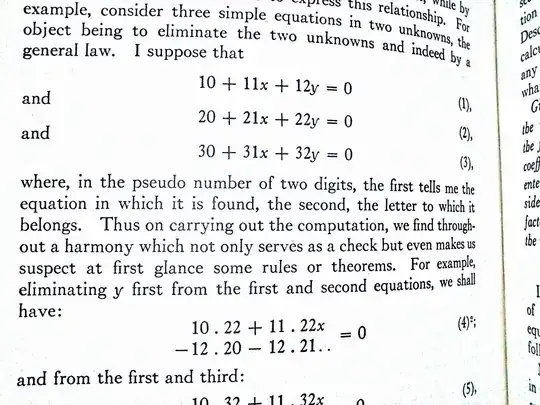
Writing matrices with double subindices $$\begin{pmatrix}a_{11}&a_{12}&a_{13}&\dots\\a_{21}&a_{22}&a_{23}&\cdots\\\vdots&\vdots&\vdots&\ddots\end{pmatrix}$$

Here's a little information and images of how things were done before. It is thought Leibniz was the pioneer. In fact, you can find this in A Source Book in Mathematics:

enter image description here

Pedro
  • 125,149
  • 19
  • 236
  • 403
  • +1 for your invaluable link. I was just discussing the extraordinary creativity of Leibni(t)z with a friend this afternoon and that was before you taught me that the double index notation is also due to him. Voltaire was very, very wrong to mock Leibniz in Candide :-) [but the book is so well-written that one can't help forgiving him ...] – Georges Elencwajg Nov 07 '13 at 20:25
  • 4
    Not to mention he originated the $\int$ notation for integrals ... – Kyle Hale Nov 07 '13 at 20:58
  • 1
    @GeorgesElencwajg Thanks for the comment. Agreed! =) – Pedro Nov 07 '13 at 21:11
41

Einstein summation notation really helped simplify things in areas of linear algebra applied to physics and differential geometry.

For example:

$$ y = \sum_{i=1}^3 c_i x^i = c_1 x^1 +c_2 x^2 + c_3 x^3 $$

could be written as

$$ y = c_i x^i $$

where the lower and upper indices imply "sum over $i$".

RDizzl3
  • 3,277
  • And of course this notation is even more useful when used with higher dimensional tensors.. – Nathaniel Bubis Nov 07 '13 at 19:28
  • Einstein's notation is indeed the power of math at its finest! I would add Kronecker and Levi-Civita symbols to this answer. – swish Nov 07 '13 at 19:51
  • 35
    "Really hate" would be a bit strong, but I seriously dislike it. Unlikely that I will ever win an Abel Prize though, and my chance for a Fields medal is gone, so take it just as my personal preference. – Daniel Fischer Nov 07 '13 at 20:05
  • 38
    A caveat: many mathematicians really hate this notation and it is actually not common at all in pure mathematics. Bourbaki, Serre, Henri Cartan certainly haven't used it and I would guess that very few Fields medalists and no Abel Prize winner ever used it. I don't know however about Henri Cartan's Daddy Elie ... (Just for clarification: I don't use that convention but it doesn't disturb me in the least to read documents which do use it) – Georges Elencwajg Nov 07 '13 at 20:11
  • [@Daniel is answering my comment which I removed and rewrote because I couldn't modify it any more after 5 minutes. Sorry about this mess.] – Georges Elencwajg Nov 07 '13 at 20:13
  • -1 (if I had enough rep to do so). I would hardly call shaving off the summation symbol a "notation that really improved mathematics" (but perhaps my imagination is limited). In fact, I think that notation is horrible. If one were to be lazy, I think the following is much better $$ y = \sum_{i} c_i x^i $$ – Thomas Eding Nov 09 '13 at 17:41
  • 11
    Pg 122 of "Michael Atiyah Collected Works Volume 5: Gauge Theories" The foot note reads "The Einstein summation convention is employed...". Sir Michael Atiyah (British) also collaborated with and inspired Edward Witten (American) who also wrote on Gauge theories and used the convention in countless papers. Michael Atiyah won the Abel prize in 2004, Edward Witten won the Fields medal in 1990. – Graham Hesketh Nov 09 '13 at 17:59
  • 3
    This is a great example of an advance in notation. Reducing clutter like the summation symbol is not trivial. A less cluttered notation allows one to think more clearly about mathematical ideas. It also saves chalk. Mathematicians avoid going to components but for some calculations it is preferable or even necessary. That is when Einstein's notation shows its power. (+1) – user26872 Nov 10 '13 at 23:21
  • 1
    @oen: You might find this answer interesting. – Nikolaj-K Jan 02 '14 at 17:47
  • @NickKidman: Thanks for the link. Ron explains well some of the downsides of index-free notation. – user26872 Jan 02 '14 at 20:59
40

$$ Y^X $$

This is some of the most suggestive notation I can think of (and the best notation for some object should be suggestive of the structure of that object). If $X$ and $Y$ are numbers, then we have the familiar rule $(Y^X)^Z = Y^{X\times Z}$, and this holds in more generality as well: if $X$, $Y$, and $Z$ are topological spaces, then $Y^X = \{f : X\to Y\mid f\textrm{ continuous}\}$, and $(Y^X)^Z \cong Y^{X\times Z}$. Moreover, if we are only thinking of $X$, $Y$, and $Z$ as sets, and of $Y^X$ as set-theoretic functions, we have $\left|Y^X\right| = \left|Y\right|^{\left|X\right|}$ (assuming the expressions make sense). It even works in some cases where one of the expressions doesn't make sense; we obtain the correct combinatorial interpretation of $0^0$ via this rule: $1 = \left|\emptyset^{\emptyset}\right| ``=" 0^0$ (one could take this as the reason that $0^0 = 1$ for discrete types of things, although there are others as well).

$$ \frac{d}{dx} $$ Another piece of notation that is useful/suggestive is the Leibniz $\frac{d}{dx}$ notation. There's the chain rule $\frac{d f}{dx} = \frac{df}{dg}\cdot\frac{dg}{dx}$ (while we're not actually cancelling $dg$'s, it at least makes it easier to remember) and the rule $\frac{dy}{dx} = \frac{1}{dx/dy}$, for example. The $\frac{d}{dx}$ (and $\int$) notation can also be seen as an operator, and this also lends itself to some interesting formal calculations that turn out to give the right answer!

Of course, the suggestiveness of these notations is not their only benefit - they also are convenient/useful/space saving!

Another to add to this: functions as arrows from one space to another $$ X\xrightarrow{f} Y $$ or $$ f : X\to Y $$

Stahl
  • 23,855
  • 1
    Another piece of notation that is useful/suggestive is the Leibniz $\frac{d}{dx}$ notation Leibniz! Him again! – Georges Elencwajg Nov 07 '13 at 20:29
  • Haha the formal calculations document is pretty cool. Do you know if such techniques work in the general case? – fiftyeight Nov 08 '13 at 01:22
  • @fiftyeight: The arguments presented in the link actually can be made rigorous by interpreting the derivative and integral as operators and observing that they have operator norm less than $1$, so that it does make sense to use the infinite geometric series identity. However, I don't know all the details required to make the arguments precise. – Stahl Nov 08 '13 at 04:13
  • nice post and very cool article – Jonathan Nov 09 '13 at 02:44
35

Perhaps $\forall , \exists , \vee , \wedge , \neg , \Rightarrow , \Leftarrow , \Leftrightarrow , =$ belong in this list, together with $\in$.

Shaun
  • 47,747
32

The use of decimal notations for tenths, hundredths ...

When dealing with noninteger number early European mathematicians used sexagesimal fractions

for example Fibonacci gave the solution to the equation $x^3 + 2x^2 + 10x = 20$ as
$1^{\circ}22'07''42'''33^{IV}04^{V}40^{VI}$

From chapter 4.1 of The art of computer programming .

And in fact, this sexagesimal system is still used for minuts and seconds.

Try calculating eg a compound index using such a system!

johanvdw
  • 243
  • 27
    Fibonacci's notation nearly just gave me a seizure. – Bruno Joyal Nov 07 '13 at 23:22
  • 4
    Sexagesimal has the advantage of 60 being highly-composite, with 10 non-trivial divisors, compared to only 7 for 100 and only 2 for 10 itself.

    Fibonacci's notation is horrible, though. Something like 01;22:07:42:33:04:40 would give the same information with less clutter.

    – Dan Nov 08 '13 at 00:58
  • @Dan: good points about divisors. However for your last point: Fibonnacci's notation straight-away tells it's a sexagesimal number [even many years later], whereas your alternative doesn't – Olivier Dulac Nov 08 '13 at 11:18
  • 1
    @OlivierDulac But if his had been used, we would know right away. I'd prefer (1.22 07 42 33 04 40)_{60}, though. (Don't know how you get spaces in mathjax, that last bit is meant to be a subscript) – Random832 Nov 08 '13 at 17:42
  • Fibonacci also used 'added fractions', or 'continued numerators'. For example, the amount of half a guinea (as shown on the mad hatter's hat) is \frac{10}{20}\frac{6}{12}, the pound being 20 shillings, the hat costs 10 of the same, and the shilling gives twelve pence, the hat needs six of these. So the first fraction is (10 6/12)/20. This, with a string of 10's as the denominator. – wendy.krieger May 03 '15 at 10:28
  • 1
    Stevins wrote decimal numbers using exactly the same form, but with a different second-series number: eg 1(0)6(1)1(2)8(3)3(5)4(6) for what we write 1.618034. Note he did not show 0(4). The units are primes, seconds, thirds, &c. A tenth metre is the unit 1(10) metre in this scale, we write it 1e-10 metre. – wendy.krieger May 03 '15 at 10:32
  • @Random832 $(1.22\ 07\ 42\ 33\ 04\ 40)_{60}$ – Akiva Weinberger May 03 '15 at 13:13
30

The equal sign.

The earliest known printed occurrence is Recorde's Whetstone of witte, England, 1557. It was a significant step in the direction of symbolic logic.

Recorde described it as two parallel lines of equal length; according to him nothing could be more equal than that.

DanielV
  • 24,386
27

One huge innovation that flies so far under the radar that multiple other answers to this question (as well as the question itself!) have used it in one way or another without note: the notation $f(n)$ for (take your pick) expressing the value of the function $f$ at the parameter-value $n$, or applying the function/operator $f$ to the argument $n$. It's probably the single most-used notation in mathematics beyond the basic operations themselves, and I've always found it absolutely amazing that the calculus itself was invented before the standard notation for functions existed.

23

How about the basics: the notation of basic arithmetic expressions: $+$, $-$, $\times$, $\div$, and their precedence rules and parentheses. And of course "Arabic" numerals (including zero), as @ABC already noted in a comment.

Doorknob
  • 275
alexis
  • 2,117
  • 12
  • 12
15

Of course positional notation of numbers with zero.

kriss
  • 849
10

The use of $\lambda$ for abstraction, as in Church's $\lambda$-calculus. It may not have improved mathematics generally speaking, but it beautifully complements the notation for application, and it simplified reasoning about currying. It certainly proved useful for computer science, at least.

Luca Bressan
  • 6,961
  • 2
    Lambda notation does make it clearer that functions are objects independent of their arguments. Syntactically $f=\lambda x. y$ is just solving for $f$ in $f(x)=y$. – Jon Purdy Nov 08 '13 at 03:14
  • 7
    Related to this would the notation $\mapsto$. – Baby Dragon Nov 08 '13 at 06:43
  • 7
    Actually the choice of using the symbol $\lambda$ for this is a pretty lousy one, since it is already used as a variable name (and often one of preference: eigenvalues, partitions,...) in many areas. I would argue that this choice, while harmless in the subfield where the notation emerged, has greatly hampered the spread of anonymous function notation throughout mathematics. For what it's worth, I use a notation like $v\mapsto(\alpha\mapsto \alpha(v))$ for the map $V\to V^{**}$ in linear algebra, without feeling much need to explain the notation. – Marc van Leeuwen Nov 08 '13 at 08:33
  • 9
    Originally it was not supposed to be $\lambda x. x$, but $\hat{x}.x$, as in Russell and Whitehead's Principia Mathematica. Typewriters printed this as $\hat{} x. x$, and $\hat{}$ was mistaken as a $\Lambda$, which then became $\lambda$. – Luca Bressan Nov 08 '13 at 09:20
10

The only one that comes to mind is the representation of zero.

Going from having to write ML or 1    5      and hoping the omission would allow the number to be understood, to 1050 as an unambiguous representation

SeanC
  • 101
9

How about Bra-Ket notation?

$\langle \phi | \psi \rangle$

$\langle \phi | A | \psi \rangle$

$| \phi \rangle \langle\psi |$

swish
  • 840
  • 1
  • 7
  • 18
  • 34
    Physicists may like this, but I'm not sure that most mathematicians find it an improvement over our usual notation for vectors and operators in Hilbert space. – Nate Eldredge Nov 07 '13 at 19:59
  • 1
    @NateEldredge I think it is an improvement. Compare vector expressed as a series in usual notation $\sum \langle x,\phi \rangle \phi$ and in bra-ket notation $\sum \langle \phi | x \rangle |\phi\rangle$. The bra-ket notation also can be read not just as sum of vectors with coefficients but also as matrix-vector multiplication just by swapping things around. Also we can treat $\sum |\phi\rangle\langle\phi |$ as an identity and it gives rise to a bunch of useful algebraic manipulations. – swish Nov 07 '13 at 20:25
  • 60
    It's a matter of taste, of course. But for me, when I see $\sum \langle \phi | x \rangle |\phi\rangle$, my first thought is not "matrix multiplication" but rather "parse error, unbalanced delimiters". – Nate Eldredge Nov 07 '13 at 20:28
  • 10
    @NateEldredge Which version are you running? – Bruno Joyal Nov 08 '13 at 01:58
  • 5
    I love bra-ket notation. It really adds nothing conceptually to write it as $\langle \phi \mid \psi \rangle$ instead of $\langle \psi , \phi \rangle$, but dang, do I feel cool when I'm doing it. – Alexander Gruber Nov 10 '13 at 01:48
  • 2
    @swish, you forgot to mention the main reason to use bra-ket notation: all the great identities you get! For instance, $\langle \phi \mid (\mid \psi \rangle) = \langle \phi, \psi \rangle$, and $(\mid \phi \rangle \langle \psi \mid)^* = \mid \psi \rangle \langle \phi \mid$, and the fact that $\mid \phi \rangle \mapsto \langle \phi\mid$ is an isomorphism from $H$ to $H'$, etc. – Julien Clancy Aug 07 '14 at 03:12
  • 1
    You might find this interesting. – Ruslan Nov 11 '14 at 13:37
  • 1
    Of course the real win with this notation is that at dinner parties Dirac could say “I invented the bra!” (As discovered in https://en.m.wikipedia.org/wiki/The_Strangest_Man) – aidangallagher4 Apr 02 '18 at 17:32
8

How about complex and imaginary number notation: $$ a + bi $$

Includes the phase plane representation of vectors $$ z = a + bi = |z|\space(\cos( \theta) + i\space \sin (\theta)) = |z| \space e^{i \space \theta} $$

based on one of the more elegant statements in all mathematics, Euler's formula:

$$ e^{ix} = \cos(x) + i \space \sin(x) $$

or in a more limited application, a beautiful equation relating the fundamental constants: $\pi,i,e,1,$ and $0$.

$$ e^{i\pi} + 1 = 0 $$

Random832
  • 503
7

Leibniz notation has been immensely useful in the improvement of applied mathematics. The notion of $dx$ denoting infinitesimal increments of a quantity $x$ (while not strictly consistent Newton's limit interpretation) has helped many a scientist arrive at a better intuitive understanding of the relationship between various physical quantities and facilitated modelling of physical processes and objects.

I find Euler and Bernoulli's work in applied math (which prefers Leibniz's notation) speaks for how intuitive Leibniz calculus is compared to the alternative.

pxq
  • 63
5

So - what about fraction notation? Using this:

$$\frac{a+b}{c+d}$$

Instead of this:

$$(a+b)\div(c+d)$$

And to some extent anything else that trades vertical space for horizontal compactness, e.g.:

$$\sum^{10}_{x=1}x^2$$

instead of (for example) $\mathrm{sum}(x,1,10,x\uparrow 2)$

Random832
  • 503
2

The switch from Roman to Arabic numerals has to be a fundamental improvement.

Try to calculate IL divided by VII !!

TravisJ
  • 7,556
  • 7
  • 28
  • 42
Tom Collinge
  • 8,221
  • 27
  • 63
2

The arrow notation invented by Knuth for representing large numbers (i.e. so large that scientific notation isn't practical).

JDM
  • 101
2

The mutli-index notation is used to write tuples and express sums, powers and products of these tuples. The $n$ dimensional multi-index is a $n$-tuple $$\alpha = (\alpha_1, \alpha_2, \alpha_3, \ldots, \alpha_n)$$ with each $\alpha_i > 0$

For multi-indices $\alpha, \beta$ we have

  • Component wise summation $$\alpha \pm \beta = (\alpha_1 \pm \beta_1, \alpha_2 \pm \beta_2, \ldots, \alpha_n \pm \beta_n)$$
  • For $x = (x_1, x_2, \ldots, x_n) \in \mathbb{R}$, we have $$x^\alpha = x_1^{\alpha_1}x_2^{\alpha_2}\ldots x_n^{\alpha_n}$$
  • Partial derivatives $$\partial^\alpha = \partial_1^{\alpha_1}\partial_2^{\alpha_2}\ldots \partial_n^{\alpha_n}$$ where each $\partial_i^{\alpha_i} = \partial^{\alpha_i}/\partial x_i ^{\alpha_i}$.

This notation helps in topics such as functional analysis and pseudo differential operators. Look at the Wikipedia article for more examples

leo
  • 10,769
Tyler Hilton
  • 2,815
1

I like the French invention ∃! to designate unicity. It is nicely useful in mathematics but is not universally used. There are a lot of illustrations of this ("∃x such that f(x) is something and this x is unique" changes by "∃!x such that f(x) is something" or "Prove that ∃!x such that something". A professor of University of Toledo (Ohio) adopted this notation after I mentioned it).

Roly
  • 150
Ataulfo
  • 32,657
1

I love the exclamation mark for factorial

x! = 1 * 2 * .. * x

because of the way that bang indicates intensity in natural language. Seems quite fitting to its fast growth.

0

Coxeter co-joined Stott's operator and Schläfli's description of regular polytopes into a combined notation that is used to this day.

Stott wrote the truncated icosahedron as e_1 I. Wythoff wrote it as t_0,1 I. Coxeter writes it as t_0,1 {3,5}. Krieger writes it as x3x5o. If one wants to write the figure where the inter-hexagon edge is phi, then only Krieger's notation works: f3x5o.

I greatly revamped the notation in terms of vectors and phase-space the effect is similar from going from roman notation to digital forms, and with the new notation, we describe figures well past the scope of Coxeter's Stott-Schläfli construction.

0

Conspicuous by its absence among the above answers is any celebration of the usual notation for multiplication.

John Bentin
  • 20,004
0

Matrix notation: Ax=mx, A*=(P^-1)BP etc.., block matrices. Without it it will be very hard to express these operations.