Coxeter and Greitzer, in their excellent Geometry Revisited, list a few "hardy perennials" in elementary geometry: tough problems solvable by elementary methods. Their problem number 4 (on page 26 in my edition) is as follows:
Let $ABC$ be an isosceles triangle with equal angles $80^\circ$ at $B$ and $C$. Segments $BD$ and $CE$, extended to the opposite sides of the triangle, divide $\angle B$ and $\angle C$ into $60^\circ$/$20^\circ$ and $30^\circ$/$50^\circ$, respectively. (See figure below.) What is the measure of $\angle EDB$?
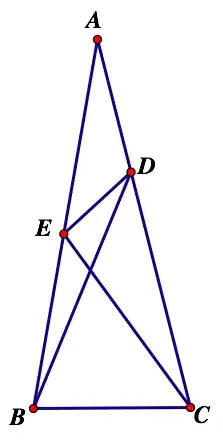
This site poses a similar problem, and calls it the "world's hardest easy geometry problem." In this problem, the $80^\circ$ angles are divided as $60^\circ$/$20^\circ$ and $70^\circ$/$10^\circ$.
Both of these problems are difficult and quite satisfying. (I will not give the answer here so as not to deprive casual searchers of the pleasure of solving them themselves; solutions to both can be easily found online.) I have also solved the related problem where the two $80^\circ$ angles are split as $70^\circ$/$10^\circ$ and $50^\circ$/$30^\circ$.
I have two questions:
My solutions to all three problems have a similar flavor, but they're quite different. Is there a unifying insight or more sophisticated perspective that provides the solution to all three?
All three problems are very pleasantly challenging, despite their apparent simplicity. What accounts for their difficulty? Is there a unifying insight that shows why precisely they are both difficult and solvable by elementary means?
