4

By definition: $$ e^x = \lim_{n \rightarrow \infty} ( 1 + \frac{x}{n} ) ^ n$$

I am interesting in calculating the error $$\left | e^x - \left( 1 + \frac{x}{n} \right) ^ n \right|$$ for some fixed $n \in \mathbb{N}$.

What I've done so far:

First note:
$$e^x = \sum_{k = 0}^\infty \frac{x^k}{k!} = 1 + x + \frac{x^2}{2!} + \dots \frac{x^n}{n!} + O\left(\frac{1}{(n+1)^{(n+1)}}\right)$$ and

$$\left( 1 + \frac{x}{n} \right) ^ n = \sum_{k = 0}^n {n \choose k} \frac{x^k}{n^k} = 1 + x + \frac{x^2}{2!}\left(1 - \frac{1}{n} \right) + \dots + \frac{x^n}{n!}\left(1 - \frac{1}{n} \right) \dots \left(1 - \frac{n-1}{n} \right)$$

Subtracting term by term yields $$\frac{x^2}{2!}\left(\frac{1}{n} \right) + \frac{x^3}{3!}\left(\frac{3}{n} - \frac{2}{n^2}\right) + \frac{x^4}{3!}\left(\frac{6}{n} - \frac{11}{n^2} + \frac{6}{n^3}\right) + \dots + O\left (\frac{1}{(n+1)^{(n+1)}}\right)$$

Where can I got from here? I want to be able to calculate the exact difference, and I don't think the expression above is good enough for that task.

Any help would be highly appreciated.

user90275
  • 151

1 Answers1

5

I take a simple-minded approach: whenever practical, write the Taylor formula with Lagrange form of remainder. Since $(1+x/n)^n=\exp(n \ln(1+x/n))$, I begin with the logarithm:
$$ \ln(1+x/n) = \frac{x}{n}+\frac{(x/n)^2}{2}\frac{-1}{(1+\xi)^2} \tag{1}$$ where $\xi$ is between $0$ and $x/n$. Formula (1) is Taylor's formula applied to $t\mapsto \ln(1+t)$.

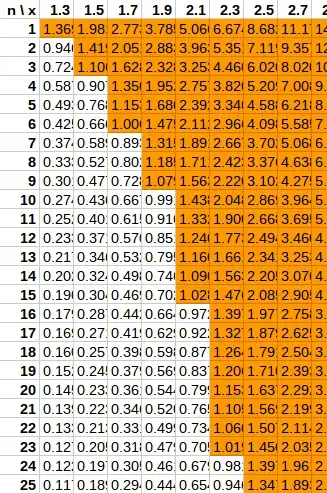
So, $$ (1+x/n)^n = e^x \exp\left(-\frac{x^2}{2n} \frac{1}{(1+\xi)^2}\right) \tag{2}$$ which is already a reasonable error estimate. When $x>0$, it can be brought into the form you seek without too much sweat. Since $\xi>0$ in (2), we have $$ 0<e^x-(1+x/n)^n < e^x(1-e^{-x^2/(2n)}) \tag{3}$$ Use the Mean Value theorem (i.e., the simplest form of the Lagrange remainder formula): $$ 1-e^{-x^2/(2n)} = \frac{x^2}{2n} e^{-\zeta},\quad 0<\zeta<\frac{x^2}{2n} \tag{4}$$ Hence, the conclusion: for $x>0$, $$ 0<e^x-(1+x/n)^n < \frac{x^2}{2n}e^x \tag{5}$$ Of course, (5) is not telling us anything new when $x^2>2n$. But it correctly shows that $x^2/n$ is what determines the quality of approximation. This quadratic relation is visible on the spreadsheet below, where I calculated the difference $e^x-(1+x/n)^n$ and colored the cells where the difference is at least $1$.

spreadsheet

  • For the case $x < 0$ one can do the same steps until (2). Then restrict to $-x \in (0, an)$ for $a \in (0,1)$ to estimate $(1+\zeta)^{-2} \leq (1-a)^{-2}$. One obtains (5) for $x \in (-an,0)$ with an additional factor $(1-a)^{-2}$ on the RHS. – Thomas Rippl Oct 01 '14 at 11:50