A function $f\colon A \to B$ is locally xyz if every point $x \in A$ has a neighbourhood $U$ such that $f\lvert_U$ is xyz. (For things like local homeomorphisms, one has to also consider a neighbourhood of $f(x)$, but for locally Lipschitz, only the restriction of the domain is relevant.)
$f\colon A \to \mathbb{R}^m$, where $A\subset \mathbb{R}^n$, is (globally) Lipschitz-continuous, if there is a constant $L \geqslant 0$ with
$$\bigl(\forall y,z \in A\bigr)\bigl(\lVert f(y)-f(z)\rVert \leqslant L\cdot \lVert y-z\rVert\bigr).$$
$L$ is called a Lipschitz constant for $f$. An equivalent definition is that
$$L_f := \sup \left(\left\lbrace \frac{\lVert f(y)-f(z)\rVert}{\lVert y-z\rVert} : y,z \in A, y \neq z\right\rbrace \cup \{0\}\right) < \infty.$$
$L_f = 0$ if and only if $f$ is constant.
Thus $f \colon A \to \mathbb{R}^m$ is locally Lipschitz-continuous, if every point $x_0 \in A$ has a neighbourhood $U$ such that $f\lvert_U$ is Lipschitz-continuous. Since the open balls with centre $x_0$ form a neighbourhood basis at $x_0$, that is equivalent to
$$\bigl(\forall x_0\in A\bigr) \bigl(\exists \delta_0 > 0\bigr)\left(L_{f;x_0,\delta_0} < \infty\right),$$
where
$$L_{f;x_0,\delta_0} := \sup \left(\left\lbrace \frac{\lVert f(y)-f(z)\rVert}{\lVert y-z\rVert} : y,z \in A, \lVert y-x_0\rVert < \delta_0, \lVert z-x_0\rVert < \delta_0, y\neq z\right\rbrace \cup \{0\}\right);$$
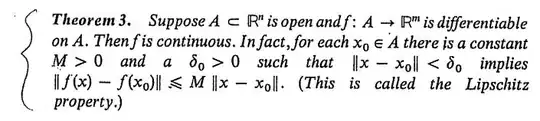
or that for all $x_0 \in A$ there exist constants $\delta_0 > 0$ and $M_0 \geqslant 0$ ($\delta_0$ depending on $x_0$, and $M_0$ depending on $x_0$ and $\delta_0$) such that
$$\bigl(y,z\in A, \lVert y-x_0\rVert < \delta_0, \lVert z-x_0\rVert < \delta_0 \Rightarrow \lVert f(y)-f(z)\rVert \leqslant M_0\cdot \lVert y-z\rVert\bigr).$$
We can allow or disallow the choice $M_0 = 0$ in the definition, that doesn't change the definition. For most functions and points, $M_0 = 0$ would not be a possible choice, since the inequality with $M_0 = 0$ says that $f$ is constant in a neighbourhood of $x_0$, but there is no reason to disallow it a priori. With the notation above, any $M \geqslant L_{f;x_0,\delta_0}$ satisfies the condition and would be a possible choice for $x_0$ and $\delta_0$.


\|instead of||. – joriki Mar 14 '23 at 17:03