26

In proof of the following theorem;

If $f$ has a second derivative that is non-negative (positive) over an interval then $f$ is convex (strictly convex). $f$ is in real number space.,

the book I refer, uses Taylor series expansion but disregards terms of order 3 and above. So I'm not convinced of the correctness of the proof, which I paste below. Is there a way to bound the terms of order 3 and above in the follow proof?
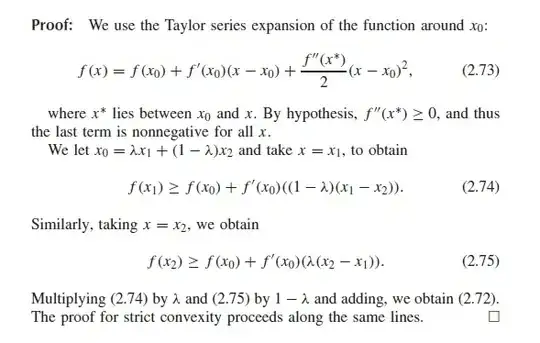
enter image description here

I think bounding the error of higher order terms is important in many cases. So would really appreciate a clear answer. Thanks a lot.

triomphe
  • 3,948

2 Answers2

16

You can prove this more or less my drawing pictures and looking at graphs. The way to make this intuition rigorous is usually by using the mean value theorem, I'll do it for you.

If $f$ is not convex it means that there is some interval $[a,b]$ where the line segment joining $f(a)$ and $f(b)$ is not always above the graph. Lets translate and rescale the argument of the function to make $a=0$, $b=1$. We are allowed to do this and it makes the algebra cleaner. Now there exists $c \in [0,1]$ such that $f(c)$ is above the line. By the mean value theorem there exists a point in $[0,c]$ where the derivative of $f$ is equal to the average rate of change between $f(0)$ and $f(c)$. But the average rate of change between $f(0)$ and $f(c)$ is greater than the slope of the line from $f(0)$ to f(1). Since $f'$ is increasing we have that after $c$, the function will be increasing too steeply to intersect the line from above at $f(1)$. This contradiction implies the function is convex.

Daron
  • 11,639
  • 7
    Note that this does not require reasoning by contradiction: in a nutshell, $cf(1) + (1-c)f(0) - f(c) ={}$ $c[f(1)-f(c)] - (1-c)[f(c)-f(0)] ={}$ $c(1-c)[f'(\beta)-f'(\alpha)]\geq 0$ with $\alpha\in [0,c]$, $\beta\in [c,1]$. – Alex Shpilkin Jan 31 '19 at 02:22
8

To expand on Jonathan Y's comment, note that the argument of $f''$ in $(2.73)$ is $x^*$ and not $x_0$. The proof simply states that $x^*$ lies between $x$ and $x_0$. It turns, that you can pick such an $x^*$ such that $(2.73)$ is exact (that is, there a no higher order terms to begin with). Check out the Jonathan Y's link, look for the "Lagrange form" of the remainder, $R_k$, and plug in $k=1$.

jkn
  • 5,277
  • 26
  • 54